I was planning to see Mom for just an hour and a half today, but when I arrived she had four emergencies to tell me about. It turned into three and a half hours.
Her early morning caregiver, Jona, leaves at 2 pm, and her afternoon caregiver doesn't arrive until 5 pm on Monday, Wednesday, and Friday.
My plan was to arrive at 2:30, take her to pick up her opal ring, and leave her in the common room at 4 pm waiting for dinner.
But she was awake and agitated when I walked into the room.
"Oh Anne, I didn't sleep all night. The phone kept ringing and someone was talking. I won't sleep in that bed another night. I'll have to go to a motel or sleep at your house."
I mumbled a few inquiries and wondered if the ringing was the Posey alarm. I had taken the whole bed apart yesterday to reposition the alarm and keep it from going off when she just shifts her weight in the bed.
"And that new plate is terribly painful. I can't wear it. I told the girl I will not have it."
Wow--all those trips to the dentist, and now four days after getting the new plate, it hurts her jaw?
"But you didn't have any trouble eating the Kentucky Fried Chicken with it yesterday," I argued. "Here, show me your mouth. Let's put the new plate in and see where it hurts."
She screamed when I tried to do this. "No, I'm not going to have that in my mouth!"
"I see you got your hair done," I countered.
"I nearly fell out of the chair at the beauty shop, and she had to yell at that girl and tell her to get out of her chair and help me."
"Well, that's good that she helped you. What are you watching on television?"
"Love potions are really true. The man who owns this whole place had a love potion. He wants to screw me all the time, and there's nothing I can do but accept it."
By this time my can-do attitude had dissolved nearly into tears. The Posey alarm was not working right, the lower partial plate was not fitting, some scene had taken place in the residence beauty shop, and she was having Valentine's Day hallucinations.
I had come to make a brief visit, but now I had to start problem solving. The first problem was to figure out whether any of these stories had any basis in reality.
I went to ask the staff if any notes had been written up last night on her not sleeping or a problem with her Posey alarm. No problems had been recorded or reported to the day staff. Maybe it was all in her head--but I resolved to come back at 11 pm and check in with the night staff. I hadn't made a night visit lately.
There were two options with the partial lower plate: put it in a drawer and forget it, or make another dentist appointment. I really really didn't want to go see him again. She has swallowed a tooth, lost a lower plate, and sat in the dental chair with bm in her Depend. Just walking in the door is embarrassing.
But the alternative was letting $1750 go down the drain. I called his office.
"Oh, come right over," Xuje invited. "He can take a look at it this afternoon."
I accepted and took Mom to the bathroom eliminate any surprises in that department.
Dr. Feder was cheerful and kind. I thought Mom might refuse to let him put the plate in, as she had done with me, but she cooperated.
"Mmmm--Ah! Mm-da-eeeeeh-aaaaaahh," she said, making a running nonverbal commentary as he poked around. It was the kind of sounds you might hear from someone walking a tightrope--not quite what you might hear from someone riding a rollercoaster.
"Mom, shh! Don't talk! Just be quiet while he works on you," I pleaded.
"Oh, it's all right," he said. "I don't mind her singing."
He claimed to have found one edge to be a little sharper than the other and went to grind it down. When he came back and popped it in her mouth, she didn't complain.
"Oh, thank you!" I exclaimed, completely amazed.
"No problem--come back any time," he said with a smile.
"We'll try not to," I said grimly.
"No, really," he insisted. "It's always a pleasure to see you, Evelyn."
Somehow we got out of there. I swear I will never enter that door again for six months.
Next stop: picking up the opal ring, which we had left yesterday to be soldered onto a gold band to keep it from slipping around into her palm.
Maybe the only thing more embarrassing than daily crisis-related trips to the dentist's office is arriving at Whitehall Jewellers and having all four sales clerks extend a warm greeting like next-door neighbors.
We've bought two or three rings there, plus Christmas gifts; had a ring sized larger when her hand was swollen and sized down when the hand recovered; bought a gold band to hold the opal in place, and now had the opal and band welded together.
"Hi! Good to see you! What a nice outfit you have her in today," they began.
But it turned out the ring, promised for 3 pm, was not ready. I had not called to check on it before bringing Mom to the mall.
"He's had a high volume of work with Valentine's Day," they reported. "But he'll get to it right now. Could you come back in forty-five minutes or an hour?"
Gee, why not? So Mom got a little spin around the mall, finding an ice cream shop and getting a butter pecan cone, of course.
With half an hour still to kill, I decided to head up the street to the Borders bookstore. I deserved a treat too.
Somehow we dawdled until after 5 pm, got the ring, and arrived back at Ocean View. I handed her over to her 5 pm to 11 pm caregiver, explaining about the alleged noise at night.
Now all I have to do is go back at 11:30 or so and figure out why she had a wild story about last night.
Monday, February 13, 2006


Sunday, February 12, 2006
Dressing Up: The Only Game
There are not too many things you can do for recreation when you live locked into the memory-impaired floor of an assisted living residence.
Meals are the big events of the day.
Watching television is always an option--including CDs of old movies. Julie Andrews, Katherine Hepburn and Cary Grant, Ginger Rogers and Fred Astaire.
Then there is planned recreation--throwing a beach ball for exercise, singing, playing Bingo.
Mom refuses to play Bingo any more because last September she was studiously covering the numbers called out when she fainted, was taken to the ER, and ended up in the hospital for a week having a pacemaker installed.
But one thing she can still do is dress up. She still has a closet full of nice clothes (down from several closets a few years ago), and she enjoys wearing a different color-coordinated outfit every day, complete with earrings, necklace, and bracelet.
She can't select the clothes any more or put them on in the correct order. That's frontal temporal lobe organization, which she has lost.
Her caregiver or I plan the outfits. She wears them and enjoys the compliments. We usually add a colorful sun hat and one of several unique purses if she is going out.
Beaded or pressed flower or glittery purses are a lot of fun because they always get comments. After all, she no longer has a big house or a car or many other forms of conspicuous consumption.
Even sadder, she no longer has a career in nursing or remembers much about it. She never used to be too interested in clothes when she was planning curriculum or managing public health students in various locations around Baltimore.
"You dress me like a big doll," she said today because I was enjoying putting a new outfit on her.
It's true. I had replaced some worn white cotton pants with a swishy pair of lined white rayon pants, and I had bought a pale pink thin sweater with a white shirt collar and cuffs sewed into it. I did all this alone, without her trying them on, so I was delighted when they actually fit her.
It was a new outfit for Valentine's Day. The caregivers commented at breakfast; at the jewelers the sales clerks commented. (We went there to get two rings soldered together. The opal kept slipping inside to her palm, bothering her, causing her to become obsessed about it.)
Shopping is something she can still do too, if she has someone with her to make the choices and handle her debit card.
Gambling is another activity that people in dementia can enjoy, as we found out two years ago when we visited Reynold in Laughlin Nevada. Anyone can put coins in a slot machine and pull the handle.
I've never had much interest in dressing nicely or in shopping or gambling. Now that I know they're good activities for the mentally impaired, I'm even less interested.
Meals are the big events of the day.
Watching television is always an option--including CDs of old movies. Julie Andrews, Katherine Hepburn and Cary Grant, Ginger Rogers and Fred Astaire.
Then there is planned recreation--throwing a beach ball for exercise, singing, playing Bingo.
Mom refuses to play Bingo any more because last September she was studiously covering the numbers called out when she fainted, was taken to the ER, and ended up in the hospital for a week having a pacemaker installed.
But one thing she can still do is dress up. She still has a closet full of nice clothes (down from several closets a few years ago), and she enjoys wearing a different color-coordinated outfit every day, complete with earrings, necklace, and bracelet.
She can't select the clothes any more or put them on in the correct order. That's frontal temporal lobe organization, which she has lost.
Her caregiver or I plan the outfits. She wears them and enjoys the compliments. We usually add a colorful sun hat and one of several unique purses if she is going out.
Beaded or pressed flower or glittery purses are a lot of fun because they always get comments. After all, she no longer has a big house or a car or many other forms of conspicuous consumption.
Even sadder, she no longer has a career in nursing or remembers much about it. She never used to be too interested in clothes when she was planning curriculum or managing public health students in various locations around Baltimore.
"You dress me like a big doll," she said today because I was enjoying putting a new outfit on her.
It's true. I had replaced some worn white cotton pants with a swishy pair of lined white rayon pants, and I had bought a pale pink thin sweater with a white shirt collar and cuffs sewed into it. I did all this alone, without her trying them on, so I was delighted when they actually fit her.
It was a new outfit for Valentine's Day. The caregivers commented at breakfast; at the jewelers the sales clerks commented. (We went there to get two rings soldered together. The opal kept slipping inside to her palm, bothering her, causing her to become obsessed about it.)
Shopping is something she can still do too, if she has someone with her to make the choices and handle her debit card.
Gambling is another activity that people in dementia can enjoy, as we found out two years ago when we visited Reynold in Laughlin Nevada. Anyone can put coins in a slot machine and pull the handle.
I've never had much interest in dressing nicely or in shopping or gambling. Now that I know they're good activities for the mentally impaired, I'm even less interested.
Saturday, February 11, 2006
Keeping Track of Meds, Doctors, and All
In emergencies, or just on days of doctor and dentist appointments, it's so hard to arrive with all the necessary information for one's elderly parent, in updated form: medications, doctors' phone numbers, recent events in the care and medical history.
Here's how a friend of mine, Joyce Holman, handles it all:
I maintain a carefully crafted 2 pages of information about my mom that I update when there are changes to her medication or physician lists, & I give it to doctors & others as needed.
One page describes her medical conditions, preferences, limitations, cautions, & hospitalizations. It helps people to see her as more than an 85-year-old with Alzheimer's disease.
It has phone numbers for my family, the facility where she lives, her doctors, 2 hospitals & a rehab. center, & our minister.
The other page has each medication (its brand name & generic name) & over-the-counter drug or vitamin, dosage, reason, how long she's been taking it at that dose, & recent medicines that she's not taking anymore.
Another page I try to keep updated for the family is a list of all the health-related phone numbers.
I go to appointments with my parents to ask questions, take notes, be an advocate.
I've finally started a 3-ring binder as the repository for notes from health visits & phone calls, lab reports, medication details, disease specifics, symptoms to watch for, letters to doctors & to my mom's facility, the phone list, & the other 2 pages.
My parents' health care advance directives are already in the car, alongside an emergency kit & my overnight bag.
Congratulations, Joyce! May we all be so organized.
Here's how a friend of mine, Joyce Holman, handles it all:
I maintain a carefully crafted 2 pages of information about my mom that I update when there are changes to her medication or physician lists, & I give it to doctors & others as needed.
One page describes her medical conditions, preferences, limitations, cautions, & hospitalizations. It helps people to see her as more than an 85-year-old with Alzheimer's disease.
It has phone numbers for my family, the facility where she lives, her doctors, 2 hospitals & a rehab. center, & our minister.
The other page has each medication (its brand name & generic name) & over-the-counter drug or vitamin, dosage, reason, how long she's been taking it at that dose, & recent medicines that she's not taking anymore.
Another page I try to keep updated for the family is a list of all the health-related phone numbers.
I go to appointments with my parents to ask questions, take notes, be an advocate.
I've finally started a 3-ring binder as the repository for notes from health visits & phone calls, lab reports, medication details, disease specifics, symptoms to watch for, letters to doctors & to my mom's facility, the phone list, & the other 2 pages.
My parents' health care advance directives are already in the car, alongside an emergency kit & my overnight bag.
Congratulations, Joyce! May we all be so organized.
Friday, February 10, 2006
Riding in the Car
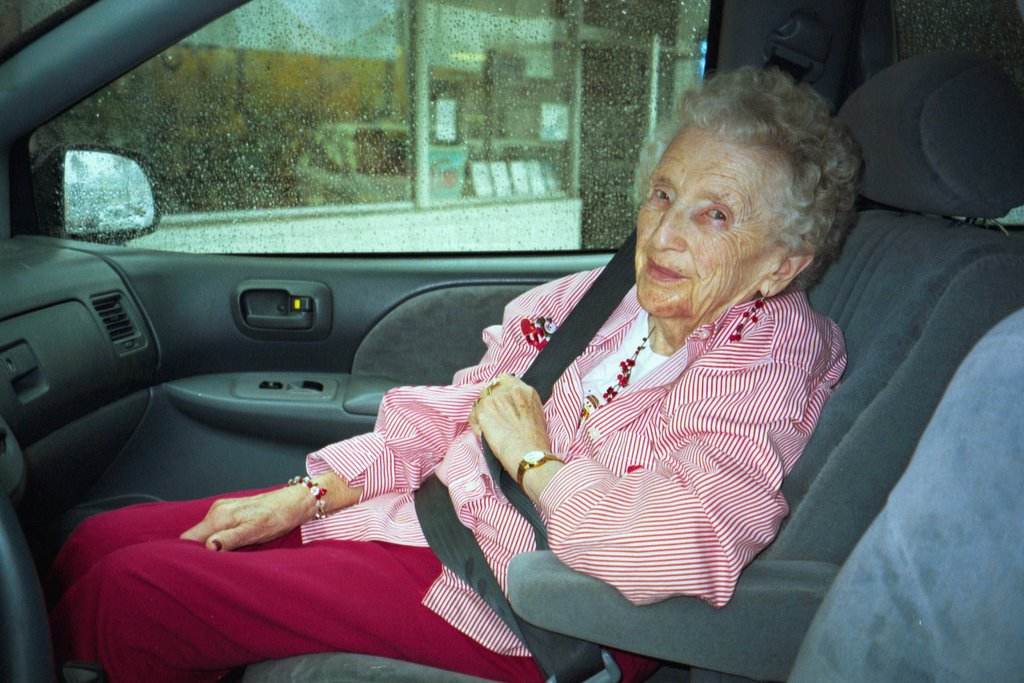
Mom's favorite thing to do, besides sitting in my kitchen and eating raisin toast, is riding in the car. At least once a week she gets out to go to church or to a doctor's appointment or just to do errands.
She sits happily in the Sav-On parking lot while I buy Kleenex, Efferdent, Depends, wipes, boxes of 50 thin green plastic gloves, etc.
She's good at telling me when the light has turned green (I'm often studying a map or talking on the cell phone and need to be told). The only problem comes when I can't respond--there are cars ahead of me--but she still thinks the green light means "Go!"
Today our errands include picking up from the tailor four pairs of velour and cotton elastic-waist pants that have been shortened by 6-8 inches. I am removing several dresses and skirts from her closet in favor of pants, which are easier for the caregiver to deal with during toileting. Then we stop at the dry cleaners and also at Out of the Closet, a local thrift shop that benefits AIDS LA.
But the first errand on her mind is going to 31 Flavors. She remembers that we didn't do this yesterday, after physical therapy, and I had promised tomorrow. So we do that first. She always wants a scoop of butter pecan on a plain cone. I bravely put a 24 x 18 plastic bib on the front of her (it's really a sheet for protecting chairs or the bed) and give her the cone. She has lost touch with how to catch the dripping ice cream by licking and rotating the cone, but she enjoys tackling it in big bites. Usually it's not too big a mess.
After the other errands we drive to the post office to mail valentines to her two oldest and dearest friends. Cookie S. went through nurses training with Mom in the 1930s at Children's Hospital in Denver and now lives in Georgia. Janelle K. worked with Mom as a public health nurse in Boulder in the 1950s and was later dean of the school of nursing at the University of Arizona.
Then it's back to Ocean View--a successful trip because she got to ride around, but I only had to get her in and out of the car once.
Where the Dead Still Live
The other errand Mom wanted to do today was visit her brother Reynold, who died over a year ago.
"We ought to stop and see Reynold for a minute, shouldn't we?" she asks as we emerge from the parking garage and head toward Baskin-Robbins.
I don't answer, trying to figure out what to say.
I have learned not to keep reminding her that her mother and others have died. Therapists say that discovering this anew can cause grief, and I've seen her upset like this.
Earlier today I didn't comment when she accidentally called me "Mother." I do contradict her when she thinks we are in Colorado. I pick my battles.
It's true that we visited Reynold in Laughlin, Nevada, two years ago this weekend. Furthermore, he didn't have a memorial service--there was no travel to a family gathering--so that makes it harder for her to hang onto the information that he died.
"He doesn't get much company," she continues, as I continue stalling.
Right, I think. He doesn't.
"Anyway, he's a Mason and that's important because the men are Masons and the women are--"
She pauses, trying to remember what the women are, then says "DARs."
The conversation moves to another topic, and I am grateful.
Half an hour later, as we are driving toward Sav-On, she suddenly says, "Maybe he's driving that truck."
I know who she's talking about, but I don't answer her.
An hour later I say, "The errands are done. Time to go back to Ocean View."
"We didn't go see Reynold yet!" she says urgently. She has thought of a reason to avoid going back to her residence.
"No, we didn't," I say, again stalling. "He's a long ways away."
"Where does he live?" she asks suddenly. "Telluride?"
"That's a long way away," I say, not explaining that he lived many years in Washington state. "We need to just go back to Ocean View."
"My big brother might be there," she says.
"You think he'll be there," I comment.
"Yes, it's not that far for him," she says. "He'll say I'm spoiled. I'm the only girl. I have three brothers."
I don't argue. Who knows? Maybe he's there. Maybe it's not that far.
She must have had a vivid dream about Reynold this afternoon before I arrived to do errands.
Either that or she had a visit.
"We ought to stop and see Reynold for a minute, shouldn't we?" she asks as we emerge from the parking garage and head toward Baskin-Robbins.
I don't answer, trying to figure out what to say.
I have learned not to keep reminding her that her mother and others have died. Therapists say that discovering this anew can cause grief, and I've seen her upset like this.
Earlier today I didn't comment when she accidentally called me "Mother." I do contradict her when she thinks we are in Colorado. I pick my battles.
It's true that we visited Reynold in Laughlin, Nevada, two years ago this weekend. Furthermore, he didn't have a memorial service--there was no travel to a family gathering--so that makes it harder for her to hang onto the information that he died.
"He doesn't get much company," she continues, as I continue stalling.
Right, I think. He doesn't.
"Anyway, he's a Mason and that's important because the men are Masons and the women are--"
She pauses, trying to remember what the women are, then says "DARs."
The conversation moves to another topic, and I am grateful.
Half an hour later, as we are driving toward Sav-On, she suddenly says, "Maybe he's driving that truck."
I know who she's talking about, but I don't answer her.
An hour later I say, "The errands are done. Time to go back to Ocean View."
"We didn't go see Reynold yet!" she says urgently. She has thought of a reason to avoid going back to her residence.
"No, we didn't," I say, again stalling. "He's a long ways away."
"Where does he live?" she asks suddenly. "Telluride?"
"That's a long way away," I say, not explaining that he lived many years in Washington state. "We need to just go back to Ocean View."
"My big brother might be there," she says.
"You think he'll be there," I comment.
"Yes, it's not that far for him," she says. "He'll say I'm spoiled. I'm the only girl. I have three brothers."
I don't argue. Who knows? Maybe he's there. Maybe it's not that far.
She must have had a vivid dream about Reynold this afternoon before I arrived to do errands.
Either that or she had a visit.
Thursday, February 09, 2006
New Teeth
Today after physical therapy we went straight to the dentist's office.
Fortunately, the dentist is next door and PT is half a block away. Location, location, location.
Dr. Feder slipped the new lower plate into her mouth, and it fit perfectly.
We thanked everyone and left, promising not to lose it this time.
Every night it will go into the small container for soaking with Efferdent.
It will not go under her pillow to be stolen away by the tooth fairy.
(See blogs from mid-December, 2005.)
Fortunately, the dentist is next door and PT is half a block away. Location, location, location.
Dr. Feder slipped the new lower plate into her mouth, and it fit perfectly.
We thanked everyone and left, promising not to lose it this time.
Every night it will go into the small container for soaking with Efferdent.
It will not go under her pillow to be stolen away by the tooth fairy.
(See blogs from mid-December, 2005.)
Graduation Day
On Tuesday when Mom arrived at the center for her physical therapy and started slowly shoving her walker forward, the therapist immediately noticed a decline.
"She's not doing well today," Michael whispered to me and Jona.
"No," I answered. "On Sunday she walked easily all the way to the dining room for breakfast, and back afterward. But yesterday she couldn't put her right foot down solidly. She was kind of limping along, and I had to have the wheelchair brought for her when she was about halfway there."
On Wednesday I don't know how she did--my sister visited her and I took a day off.
But today she's doing better than ever.
In the morning Jona walked with Mom all the way to the dining room, about one hundred feet, and she didn't keep a hand on her. Instead she followed directly behind her with the wheelchair, so that if she collapsed the chair would be there.
"You didn't get anyone from Ocean View to help you walk with her?" I asked anxiously.
"They were too busy,"Jona said.
I could imagine the scene: all the caregivers rounding up the 28 residents and bringing them to the dining room, with some residents leaving their seats at the table before lunch was served, before others had arrived.
"Okay," I said, "As long as you don't hurt your back."
But Jona assured me that Mom had even pulled herself to standing, after Jona raised the electric recliner to its maximum, reared-up position.
She admitted that she hadn't used the gait belt, but I couldn't complain because I don't use it either.
When we arrived at physical therapy today, Suzanne the PT saw Mom at her best.
She pulled herself to standing at her walker a few times--slowly, with complaints.
The effort she put into this caught my heart--it was a glimpse of her old self, fiercely determined to do something, not letting anything stop her.
She walked easily in a circle around the room using her walker, without anyone holding onto her. At the parallel bars, she stood up from her wheelchair by herself ten times, even more slowly with even more complaints. Then Suzanne required another six or ten times, occasionally giving her a boost by pulling up on the gait belt around her waist.
After another spin around the room, Suzanne pronounced Mom finished with her physical therapy. It had been just five sessions, but she had made good progress.
Medicare benefits have been cut back to 15 physical therapy or speech therapy sessions per year, so Suzanne didn't want to use them all up in the first two months. I assured her that Mom's Blue Cross / Blue Shield covers about 50 visits per year, but Suzanne still wanted to declare Mom rehabilitated.
"She's reached a plateau, and I don't think we are going to see improvement from this point. The goal is just to keep her walking and pulling herself to stand as she is now."
"Wow! Congratulations, Mom, you graduated," Connie and I told Mom.
She was proud of herself.
Our job now is to make sure she walks as much as possible, at least three trips to the dining room and back per day.
She also needs to push herself to stand from sitting, ten times in a row, once or twice per day.
In today's PT she had done a step-up exercise, stepping up onto a small platform five times with one foot leading, then five times with the other. I bought a step for her to continue practicing this one, but she will need two people ready to support her in case she falls.
We fussed over her for doing well today, but the reality is that there will be neither a smooth upward curve nor any guarantee of staying on a plateau.
One of the features of Lewy Body Dementia is that each day, her physical and mental condition is different.
We can hope that she stays generally at this level for a good while longer, but at some point there will be a steep decline, if the dementia she has is really Lewy Body.
"She's not doing well today," Michael whispered to me and Jona.
"No," I answered. "On Sunday she walked easily all the way to the dining room for breakfast, and back afterward. But yesterday she couldn't put her right foot down solidly. She was kind of limping along, and I had to have the wheelchair brought for her when she was about halfway there."
On Wednesday I don't know how she did--my sister visited her and I took a day off.
But today she's doing better than ever.
In the morning Jona walked with Mom all the way to the dining room, about one hundred feet, and she didn't keep a hand on her. Instead she followed directly behind her with the wheelchair, so that if she collapsed the chair would be there.
"You didn't get anyone from Ocean View to help you walk with her?" I asked anxiously.
"They were too busy,"Jona said.
I could imagine the scene: all the caregivers rounding up the 28 residents and bringing them to the dining room, with some residents leaving their seats at the table before lunch was served, before others had arrived.
"Okay," I said, "As long as you don't hurt your back."
But Jona assured me that Mom had even pulled herself to standing, after Jona raised the electric recliner to its maximum, reared-up position.
She admitted that she hadn't used the gait belt, but I couldn't complain because I don't use it either.
When we arrived at physical therapy today, Suzanne the PT saw Mom at her best.
She pulled herself to standing at her walker a few times--slowly, with complaints.
The effort she put into this caught my heart--it was a glimpse of her old self, fiercely determined to do something, not letting anything stop her.
She walked easily in a circle around the room using her walker, without anyone holding onto her. At the parallel bars, she stood up from her wheelchair by herself ten times, even more slowly with even more complaints. Then Suzanne required another six or ten times, occasionally giving her a boost by pulling up on the gait belt around her waist.
After another spin around the room, Suzanne pronounced Mom finished with her physical therapy. It had been just five sessions, but she had made good progress.
Medicare benefits have been cut back to 15 physical therapy or speech therapy sessions per year, so Suzanne didn't want to use them all up in the first two months. I assured her that Mom's Blue Cross / Blue Shield covers about 50 visits per year, but Suzanne still wanted to declare Mom rehabilitated.
"She's reached a plateau, and I don't think we are going to see improvement from this point. The goal is just to keep her walking and pulling herself to stand as she is now."
"Wow! Congratulations, Mom, you graduated," Connie and I told Mom.
She was proud of herself.
Our job now is to make sure she walks as much as possible, at least three trips to the dining room and back per day.
She also needs to push herself to stand from sitting, ten times in a row, once or twice per day.
In today's PT she had done a step-up exercise, stepping up onto a small platform five times with one foot leading, then five times with the other. I bought a step for her to continue practicing this one, but she will need two people ready to support her in case she falls.
We fussed over her for doing well today, but the reality is that there will be neither a smooth upward curve nor any guarantee of staying on a plateau.
One of the features of Lewy Body Dementia is that each day, her physical and mental condition is different.
We can hope that she stays generally at this level for a good while longer, but at some point there will be a steep decline, if the dementia she has is really Lewy Body.
Wednesday, February 08, 2006
Suddenly, We're Not Alone
It has been almost two years since Dr. Kawas first suggested Lewy Body Dementia as a possible diagnosis for Mom.
In that time, I've told many people about her illness. None had heard of LBD before.
But in the last two weeks suddenly three people have said to me, "Oh yes, my mother [husband] [sister] has it too."
First was my friend Ginny in Berkeley, who emailed to say that her younger sister in Denver has been diagnosed with LBD. She's very concerned about her sister's care and how her sister's husband will cope with the challenges of care giving.
Then a lawyer who is helping us handle some inherited property mentioned that his mother in Santa Barbara has LBD. He spends a lot of time driving up there and back to manage her care. Fortunately, his own practice is flexible enough that he can work evenings or weekends to make up for hours lost in caregiving.
On Friday at the P.E.O. meeting, my new friend Dorothy asked what kind of dementia my mother has, and I told her Mom's probable diagnosis.
"Oh, my husband has Lewy Body too," she said. "At least that's what his doctors are saying now. They don't know for sure."
Her husband's illness began three years ago with peripheral neuropathy and falling down. Now he is in a wheelchair and needs a Hoyer lift to be helped into and out of bed. He has dementia, too, much like my mother, but he doesn't get out of the house much because he is too heavy for just one person to handle.
It's really sad to think of these three people afflicted with this mentally and physically crippling disease.
But I'm grateful that I now have several friends with whom to share the suffering and questions. Dealing with the illness is hard enough, without having to start from zero in every conversation: "No, it's not Alzheimer's. It's the second most common dementia...."
Suddenly, my siblings and I are not alone.
In that time, I've told many people about her illness. None had heard of LBD before.
But in the last two weeks suddenly three people have said to me, "Oh yes, my mother [husband] [sister] has it too."
First was my friend Ginny in Berkeley, who emailed to say that her younger sister in Denver has been diagnosed with LBD. She's very concerned about her sister's care and how her sister's husband will cope with the challenges of care giving.
Then a lawyer who is helping us handle some inherited property mentioned that his mother in Santa Barbara has LBD. He spends a lot of time driving up there and back to manage her care. Fortunately, his own practice is flexible enough that he can work evenings or weekends to make up for hours lost in caregiving.
On Friday at the P.E.O. meeting, my new friend Dorothy asked what kind of dementia my mother has, and I told her Mom's probable diagnosis.
"Oh, my husband has Lewy Body too," she said. "At least that's what his doctors are saying now. They don't know for sure."
Her husband's illness began three years ago with peripheral neuropathy and falling down. Now he is in a wheelchair and needs a Hoyer lift to be helped into and out of bed. He has dementia, too, much like my mother, but he doesn't get out of the house much because he is too heavy for just one person to handle.
It's really sad to think of these three people afflicted with this mentally and physically crippling disease.
But I'm grateful that I now have several friends with whom to share the suffering and questions. Dealing with the illness is hard enough, without having to start from zero in every conversation: "No, it's not Alzheimer's. It's the second most common dementia...."
Suddenly, my siblings and I are not alone.
Tuesday, February 07, 2006
61,000 Members and Growing Fast--What Is It?
You guessed it: the centenarians club in the US today.
There are a lot of families dealing with how to care for 100-year old relatives, not to mention those caring for people in their nineties or eighties, or those caring for LBD patients of still younger ages.
For a discussion of financial issues, go to my blog entry for January 31, based on the Wall Street Journal article on January 23.
We caregivers are starting to think about our own financial planning for later years. Buying long-term care health insurance is starting to look like a smart step. A benefit of $100 per day would not cover assisted living, but it would supplement Social Security and Medicare to make devouring one's life savings in the last few years of life less likely.
My husband has long-term health care insurance.
The serious cost and my own optimism have prevented me from signing up for it so far, but if I want to protect my children from the financial impact of my care after some event such as a stroke, I should start paying now.
Well, maybe not now--how about after we finishing paying college tuitions?
There are a lot of families dealing with how to care for 100-year old relatives, not to mention those caring for people in their nineties or eighties, or those caring for LBD patients of still younger ages.
For a discussion of financial issues, go to my blog entry for January 31, based on the Wall Street Journal article on January 23.
We caregivers are starting to think about our own financial planning for later years. Buying long-term care health insurance is starting to look like a smart step. A benefit of $100 per day would not cover assisted living, but it would supplement Social Security and Medicare to make devouring one's life savings in the last few years of life less likely.
My husband has long-term health care insurance.
The serious cost and my own optimism have prevented me from signing up for it so far, but if I want to protect my children from the financial impact of my care after some event such as a stroke, I should start paying now.
Well, maybe not now--how about after we finishing paying college tuitions?
Monday, February 06, 2006
Lunacy with Flashes of Clarity
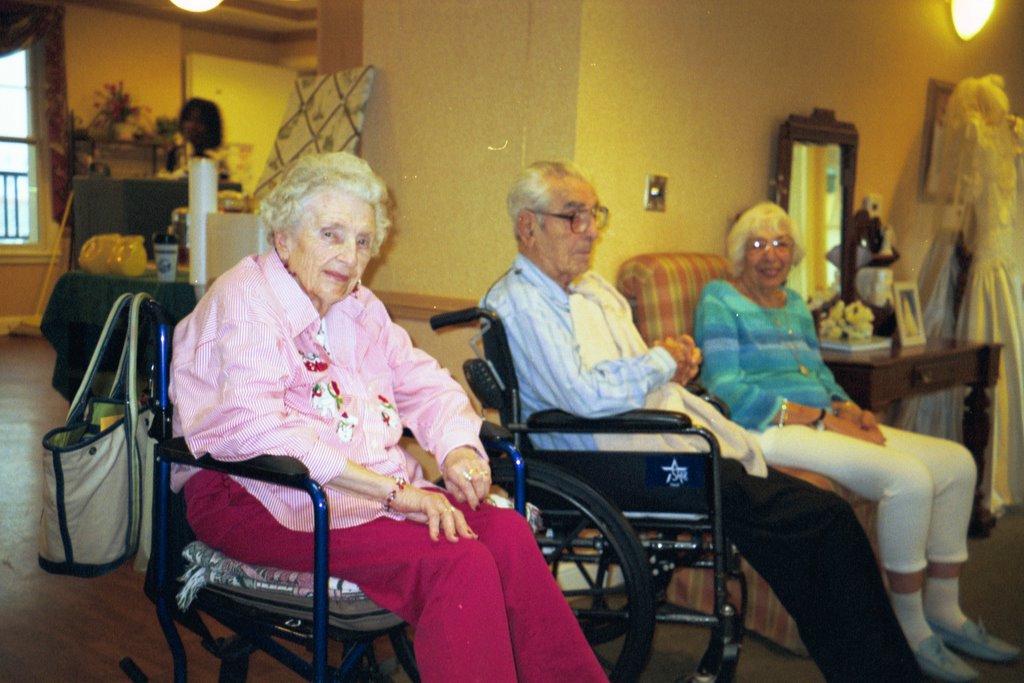
When I arrived at 3:15 pm, Mom was sitting in her recliner in her room watching television. She was upset.
"Anne, this is a terrible show about dinosaurs that swallow people. Turn it off!"
I checked the television; it was the National Geographic channel with a show about crocodiles. I turned it off.
"It's just a show about crocodiles, Mom."
"You came late. I've been sitting here too long watching this television. When I'm here alone, things get scary."
She was absolutely accurate about those statements. She had been alone since 2 pm, apparently not sleeping, and her mind takes her to strange places when she is alone.
I helped her walk with her walker to the toilet, but for some reason she could barely do it today. After walking one hundred feet to the dining room yesterday for breakfast, and one hundred feet back, today she could not place her right foot firmly on the ground. Instead she put only her toes down, walking well with her left foot but taking only small steps with her right foot and never letting her heel touch the ground.
Next we worked on sending valentines to all her children and grandchildren, and her sister-in-law as well. She did fine at signing her name as coached.
When we got to her grandson in the Naval Academy, I told her to write, "I'm proud of you. I was in the Navy too." She wrote, "I'm proud of you! I was a Navy Nurse!"
When we got to her oldest grandchild, Jennifer, she started writing a note, completely uncoached:
"Buy yourself something pretty and useless. I'm so proud what you are doing at Crested Butte. I'm just now learning to walk again with help from your Aunt Anne! Love, Grandma Gussie."
A moment of clarity! She knew where Jennifer lives and that she's working in adaptive sports there. And she proudly added her news about walking.
Because she apparently wanted to give Jennifer some money, I slipped a $20 bill inside the card before sealing it.
On all the notes to grandchildren she used her nickname, Gussie, from her teen years as Evelyn Gustafson. (Twenty-four years ago I had encouraged her to become "Grandma Gussie" because she didn't like the name "Grandma Eggebroten"--it reminded her of her mother-in-law.)
After doing the Valentines, when I tried to get her to walk to dinner, she could barely do fifty feet. She was limping along not putting her right foot down completely--but did not complain of any pain in her feet or legs. A caregiver brought us the wheelchair.
Julie A., meanwhile, was pushing her walker to dinner behind us and yelling "I wish I were dead! I wish I were dead!"
(Lunacy or clarity? You decide.)
At dinner Mom sat down next to Howard and Jeannie, the new sweethearts on the floor. Jeannie has a sharp tongue but for some reason was adopted by Howard, who only arrived a month or two ago, as his surrogate spouse. Howard is a gentle ex-businessman who walks around trying to making phone calls and keep appointments. He seems very happy with his arm around Jeannie.
"Okay, Mom, enjoy your dinner. I'm leaving now."
"You're not going, are you? Don't leave me alone! They never take me back to my room after dinner."
"Now, Mom, Connie will be here any minute. She'll take you back to your room. I have to leave."
"I don't like the way you speak to your child!" interrupted Jeannie, glaring at me. "You shouldn't talk to her that way. She'll never grow up."
"I'm sorry, Jeannie," I said. "Goodbye, Mom."
I went back to her room to get the pants we bought yesterday, which I will take to a tailor to be shortened.
When I passed the dining room on my way out, I heard Mom loudly singing, "Jesus loves me, this I know, for the Bible tells me so. Little ones to him belong; they are weak, but he is strong. Yes, Jesus loves me! Yes, Jesus loves me...."
Mom was never particularly religious during the first sixty years of her life, though she did get to church once a month or so, and more often after she retired.
Punching in the code to open the door to leave, I sighed with relief.
Lunacy--with flashes of clarity.
Note: The mystery of why she was singing was partly answered four days later when I took her to dinner. Another private caregiver then said to her, "Sing, Evelyn. Are you going to sing for me?
And Mom started singing "Jesus loves me."
At least there's a reason why she suddenly was singing... She had done it on some occasion before, so now someone prompts her to do it.
CDs are always played during dinner, everything from Diana Ross to church music. Sometimes various caregivers or residents sing along. I feel better knowing that Mom's singing on this occasion was not completely out of the blue.
Sunday, February 05, 2006
Seeing Spots and Crooked Stems
Small spots on the floor or rug worry Mom. In fact, anything that is uneven or out of place worries her.
Because it is Sunday, I arrive just after 6 am to be her caregiver until 2 pm.
She wakes at 6:45 and I help her to sit up in bed and then to stand at her walker.
As I escort her into the bathroom, she comments about a small dark spot on the floor.
"I hate that black thing on the floor, and the other spots too --the dogs eat them and get poisoned and die."
I've noticed that spot for a while and tried to clean it up before without success.
Today it has to go. I start scraping at it with sharp scissors and 409 and a powdered cleanser. It turns out to be a bit of chewing gum. I get it all off and scrub a few other spots and streaks on the floor as well.
We drive to church and have a nice time. As we are driving home, she suddenly speaks.
"These stems are so crooked!"
"What stems?" I ask.
After a few more questions, I realize she is talking about the long row of palm trees outlined against the sky as we drive west on Santa Monica Boulevard. Yes, their tall trunks are all slightly crooked, not quite parallel to each other.
Yesterday it was a bit of white tissue on the rug that caught her attention, started a story in her mind, and had to be picked up and disposed of.
Last June when I posted a big note on her cupboard door outlining the rules for eating and swallowing after her hospitalization, it seemed to her to be a threatening note from bad people who were going to do something to her. I removed it.
A week ago the red light in a surge protector on the floor was the sign of danger.
When she uses her walker, the little zip pouch for things she might need has to hang exactly in the center of the front bar of the walker.
When she stands or sits, grabbing onto a bar in the bathroom or onto her walker, her rings have to be adjusted first. The stones might have slipped inside to her palm, but she moves each around: the diamond ring, the pearls, the opal.
As William Carlos Williams wrote in "The Red Wheelbarrow," so much depends on those rings being in the right place.
So much depends on there being no odd spots on the floor or pieces of paper posted anywhere in the room.
Because it is Sunday, I arrive just after 6 am to be her caregiver until 2 pm.
She wakes at 6:45 and I help her to sit up in bed and then to stand at her walker.
As I escort her into the bathroom, she comments about a small dark spot on the floor.
"I hate that black thing on the floor, and the other spots too --the dogs eat them and get poisoned and die."
I've noticed that spot for a while and tried to clean it up before without success.
Today it has to go. I start scraping at it with sharp scissors and 409 and a powdered cleanser. It turns out to be a bit of chewing gum. I get it all off and scrub a few other spots and streaks on the floor as well.
We drive to church and have a nice time. As we are driving home, she suddenly speaks.
"These stems are so crooked!"
"What stems?" I ask.
After a few more questions, I realize she is talking about the long row of palm trees outlined against the sky as we drive west on Santa Monica Boulevard. Yes, their tall trunks are all slightly crooked, not quite parallel to each other.
Yesterday it was a bit of white tissue on the rug that caught her attention, started a story in her mind, and had to be picked up and disposed of.
Last June when I posted a big note on her cupboard door outlining the rules for eating and swallowing after her hospitalization, it seemed to her to be a threatening note from bad people who were going to do something to her. I removed it.
A week ago the red light in a surge protector on the floor was the sign of danger.
When she uses her walker, the little zip pouch for things she might need has to hang exactly in the center of the front bar of the walker.
When she stands or sits, grabbing onto a bar in the bathroom or onto her walker, her rings have to be adjusted first. The stones might have slipped inside to her palm, but she moves each around: the diamond ring, the pearls, the opal.
As William Carlos Williams wrote in "The Red Wheelbarrow," so much depends on those rings being in the right place.
So much depends on there being no odd spots on the floor or pieces of paper posted anywhere in the room.
Saturday, February 04, 2006
Caregiver Charades
The two keys to my sanity are Mom's residence and her private caregivers.
Ocean View Assisted Living is an excellent facility--newly built, beautifully decorated, with great food and a staff of kind and loving people.
But soon after Mom moved in, I realized she needed a private caregiver. She preferred sitting in her own room with her own television rather than being out in the common area. Yet she needed someone to talk to, and she had to be kept from trying to walk and falling. Bathing each night and dressing each morning were also areas where having a private caregiver would be better than depending on a staff of 4-5 responsible for 28 residents.
Ocean View gave me a list of private agencies, and I chose one.
It has worked out well, for the most part. The agency is Filipina-owned and operated, so all the caregivers have been Filipinas.
Jona works the day shift, 6 am to 2 pm, six days per week. I do Sundays.
For over a year Connie worked the night shift Monday through Friday, 6 pm to 6 am, and Racquel worked Saturday and Sunday nights, staying until 8 am on Sundays so I didn't have to arrive earlier. She was very devoted to Mom, fussing over her and waiting on her hand and foot. She also substituted whenever Connie or Jona needed a night or day off.
Whenever there was a holiday and no one else wanted to work, Racquel was given the job. Other caregivers appeared (such as a friend of Connie) and were given preference to Racquel.
It soon became apparent that Racquel was lowest on the agency's list, perhaps because she was the most recent immigrant and her English was not as good, or perhaps because of status distinctions within Filipino culture.
In January, however, I cut back the night shift hours, deciding that the Ocean View staff could keep an eye on Mom from 10 pm to 6 am. I changed Connie and Racquel's hours to 2 pm to 10 pm.
This created a scenario out of the book Who Stole My Cheese?
Anna, the scheduler at the agency, gave Saturday night to Connie to boost her income. (Connie and her husband had just bought a house.)
That change left Racquel with one night per week, only 8 hours instead of the 26 hours she had had earlier.
I told Anna that Racquel should still have two nights, 16 hours, but Anna insisted on scheduling Connie, and I accepted her decision.
Until today.
In the past week Anna has made three scheduling errors.
#1 On Thursday night a week ago she left me a message saying "Jona won't work Friday because of her grandmother's funeral service, and Racquel can't substitute." That meant I would have to show up at 6 am Friday, but I knew Anna was wrong. The funeral was Saturday. I knew Jona was working Friday. Instead of showing up early Friday, I came Saturday and did the am shift.
#2 But then on Sunday I learned that Racquel actually could have worked Saturday. I could have had the whole day to myself. Anna had not checked with Racquel for several days and did not realize she was actually available.
(Racquel had begun working for another agency because she got so few hours from Anna. Her hospice patient from that agency had died on Tuesday; she had attended the funeral Wednesday, and she had not called Anna to request more work. She avoids calling Anna because Anna speaks harshly to her.)
#3 Then Anna called me Thursday night this week and said, "Connie will not be working tomorrow. Racquel will work instead."
"Oh--what hours will Racquel be working?" I asked. Connie usually comes at 5 pm on Friday instead of 2 pm.
"2 to 10 pm," Anna reported.
"Great," I answered. That meant I could leave Mom with Racquel immediately after the P.E.O. meeting, rather than caring for her until 5 pm.
When Racquel wasn't there exactly at 2 pm, I kept waiting but then left, confident she'd arrive soon.
She arrived at 2:25 pm but another caregiver from the agency noticed and told her that Connie was coming. Racquel then received a call from Anna saying that she should go home--Connie was planning to be there at 5 pm.
"It's Saturday that Connie is going to be off, not today," Anna told her.
Obediently, Racquel started back home, two bus rides away.
Mom was alone from 3 to 5 pm, except for the Sunrise staff. When I called at 4 pm to make sure Racquel was there, an Ocean View staff member told me she hadn't come.
I called Anna, who said, "Connie is coming today. It's tomorrow that Racquel will be working."
She didn't apologize for giving me the wrong information.
"Anna, I waited an hour for Racquel. I would have made other arrangements if I knew Connie was coming. I need to hear you say 'I'm sorry.'"
Anna apologized but did not reveal that she had actually given Racquel misinformation too and sent her home.
When I found out today that Racquel had been sent back, I called Anna again.
"Anna, I hear you sent Racquel home yesterday," I began.
She answered cheerfully, speaking as if it had been Racquel's error.
"Anna, do you plan to pay Racquel for her time yesterday?" I then asked. "She took two buses to get to work, stayed an hour, and took two buses home."
"No, because I don't want to charge you," she said.
"Look, Anna, that's not fair. I am going to pay Racquel for her time, and I don't want this to happen again. From now on Racquel works Saturday and Sunday 2 pm to 10 pm. Connie works Monday through Friday, as before. I can't have you calling with misinformation and then not paying Racquel for her time."
"But Connie needs the hours--she might not continue to work for you if she can't work Saturday night," Anna protested.
"That's okay--if Connie can't work, I'll give her shift to the Ocean View staff. But I can't have changes every week in the schedule and have you giving wrong information to me. It costs me time and money when you make these mistakes. Connie has a family and can't really work six nights. If she has just five nights, she'll be less likely to change the schedule. I hope this kind of a mix-up will not happen again."
That's the end of the story--I hope.
But my long-term goal, if Mom declines in her activity level, requiring less care, is to eliminate the private caregivers completely. She won't like that--she's still mad at me for taking away her nighttime caregivers.
Ocean View Assisted Living is an excellent facility--newly built, beautifully decorated, with great food and a staff of kind and loving people.
But soon after Mom moved in, I realized she needed a private caregiver. She preferred sitting in her own room with her own television rather than being out in the common area. Yet she needed someone to talk to, and she had to be kept from trying to walk and falling. Bathing each night and dressing each morning were also areas where having a private caregiver would be better than depending on a staff of 4-5 responsible for 28 residents.
Ocean View gave me a list of private agencies, and I chose one.
It has worked out well, for the most part. The agency is Filipina-owned and operated, so all the caregivers have been Filipinas.
Jona works the day shift, 6 am to 2 pm, six days per week. I do Sundays.
For over a year Connie worked the night shift Monday through Friday, 6 pm to 6 am, and Racquel worked Saturday and Sunday nights, staying until 8 am on Sundays so I didn't have to arrive earlier. She was very devoted to Mom, fussing over her and waiting on her hand and foot. She also substituted whenever Connie or Jona needed a night or day off.
Whenever there was a holiday and no one else wanted to work, Racquel was given the job. Other caregivers appeared (such as a friend of Connie) and were given preference to Racquel.
It soon became apparent that Racquel was lowest on the agency's list, perhaps because she was the most recent immigrant and her English was not as good, or perhaps because of status distinctions within Filipino culture.
In January, however, I cut back the night shift hours, deciding that the Ocean View staff could keep an eye on Mom from 10 pm to 6 am. I changed Connie and Racquel's hours to 2 pm to 10 pm.
This created a scenario out of the book Who Stole My Cheese?
Anna, the scheduler at the agency, gave Saturday night to Connie to boost her income. (Connie and her husband had just bought a house.)
That change left Racquel with one night per week, only 8 hours instead of the 26 hours she had had earlier.
I told Anna that Racquel should still have two nights, 16 hours, but Anna insisted on scheduling Connie, and I accepted her decision.
Until today.
In the past week Anna has made three scheduling errors.
#1 On Thursday night a week ago she left me a message saying "Jona won't work Friday because of her grandmother's funeral service, and Racquel can't substitute." That meant I would have to show up at 6 am Friday, but I knew Anna was wrong. The funeral was Saturday. I knew Jona was working Friday. Instead of showing up early Friday, I came Saturday and did the am shift.
#2 But then on Sunday I learned that Racquel actually could have worked Saturday. I could have had the whole day to myself. Anna had not checked with Racquel for several days and did not realize she was actually available.
(Racquel had begun working for another agency because she got so few hours from Anna. Her hospice patient from that agency had died on Tuesday; she had attended the funeral Wednesday, and she had not called Anna to request more work. She avoids calling Anna because Anna speaks harshly to her.)
#3 Then Anna called me Thursday night this week and said, "Connie will not be working tomorrow. Racquel will work instead."
"Oh--what hours will Racquel be working?" I asked. Connie usually comes at 5 pm on Friday instead of 2 pm.
"2 to 10 pm," Anna reported.
"Great," I answered. That meant I could leave Mom with Racquel immediately after the P.E.O. meeting, rather than caring for her until 5 pm.
When Racquel wasn't there exactly at 2 pm, I kept waiting but then left, confident she'd arrive soon.
She arrived at 2:25 pm but another caregiver from the agency noticed and told her that Connie was coming. Racquel then received a call from Anna saying that she should go home--Connie was planning to be there at 5 pm.
"It's Saturday that Connie is going to be off, not today," Anna told her.
Obediently, Racquel started back home, two bus rides away.
Mom was alone from 3 to 5 pm, except for the Sunrise staff. When I called at 4 pm to make sure Racquel was there, an Ocean View staff member told me she hadn't come.
I called Anna, who said, "Connie is coming today. It's tomorrow that Racquel will be working."
She didn't apologize for giving me the wrong information.
"Anna, I waited an hour for Racquel. I would have made other arrangements if I knew Connie was coming. I need to hear you say 'I'm sorry.'"
Anna apologized but did not reveal that she had actually given Racquel misinformation too and sent her home.
When I found out today that Racquel had been sent back, I called Anna again.
"Anna, I hear you sent Racquel home yesterday," I began.
She answered cheerfully, speaking as if it had been Racquel's error.
"Anna, do you plan to pay Racquel for her time yesterday?" I then asked. "She took two buses to get to work, stayed an hour, and took two buses home."
"No, because I don't want to charge you," she said.
"Look, Anna, that's not fair. I am going to pay Racquel for her time, and I don't want this to happen again. From now on Racquel works Saturday and Sunday 2 pm to 10 pm. Connie works Monday through Friday, as before. I can't have you calling with misinformation and then not paying Racquel for her time."
"But Connie needs the hours--she might not continue to work for you if she can't work Saturday night," Anna protested.
"That's okay--if Connie can't work, I'll give her shift to the Ocean View staff. But I can't have changes every week in the schedule and have you giving wrong information to me. It costs me time and money when you make these mistakes. Connie has a family and can't really work six nights. If she has just five nights, she'll be less likely to change the schedule. I hope this kind of a mix-up will not happen again."
That's the end of the story--I hope.
But my long-term goal, if Mom declines in her activity level, requiring less care, is to eliminate the private caregivers completely. She won't like that--she's still mad at me for taking away her nighttime caregivers.
Friday, February 03, 2006
P.E.O. and JPL
Today we attended our first P.E.O. meeting since early December.
When my children were home from college for a month around Christmas, I didn't have time to get Mom to a meeting, and she didn't need it. For outings she found plenty of excitement just sitting in our kitchen, watching the kids and their friends and boyfriends storm in and out.
But today we went to the P.E.O. meeting to socialize and hear Robert Chandler, Director of Graphics for the Jet Propulsion Laboratory in Pasadena, speak about his work.
He is the older brother, 81 years old, of one of the P.E.O. members, Louise Taylor. He had just driven about a hundred miles, from Coto de Caza (south of Mission Viejo) to Pasadena to Santa Irena. Afterward he had several stops to make before heading home.
I managed to get find the home and get there by 10 am. While driving, I coaxed Mom on her behavior during the hour I would not be at her side.
"Remember the rule that Serena--your mother--had when she was at the Chapter House in Colorado Springs? She was afraid of saying something that might make her look confused or senile, so she didn't talk if she could help it while she was at dinner there."
"Yes, she was a clever one," Mom said. "She died in my arms in Telluride."
"No, she died of a stroke one morning in the bathroom at the Chapter House. You drove down to the hospital to see her. But her mother, Grandma Brown, died in her arms in Telluride. You tend to put events from her life or from other people's lives or from tv into your own life story. That's why it's a good idea not to talk much at these meetings."
She seemed to be thinking about this issue.
After arriving, we had a rocky time getting the wheelchair in by the side gate of the yard, past a pile of construction materials, and into the patio meeting room. (Trying to get up the front steps would not have worked.)
Mom slept through the business meeting, while I and two other women who have resisted joining P.E.O. sat in another room talking with Louise's daughter Carol and her brother Robert. It turned out that he is the father of a nine-year-old, with whom he plays ball and goes camping. Amazing picture of health and mobility for 81 years! He and Louise grew up in Venice in the 1920s and 30s, attended Venice High School.
When the program began, he spoke about his work printing photos of planets, galaxies, nebulae, and other phenomena in outer space. He passed out two sets of ten lithographs, one of the solar system and each object in it, one of Mars and the Mars rovers. He also gave us beautiful prints of nebulae, book marks, Christmas cards about space made from children's art, including that of his son. "Not bad for someone with only a high school diploma," Louise commented.
Only two or three times did Mom interrupt with an odd question.
While he was talking about Mars, Mom asked, "Were there any people out there?"
"No, these were unmanned space explorations," Robert answered. "That's very important--the big difference between JPL and NASA. JPL does only unmanned exploration."
Whew.
Later she asked, "Didn't Diane Sawyer go on one of those trips?"
Dorothy B., the P.E.O. friend sitting next to Mom, tried to hush her up as I slipped out of my chair, two seats away from Mom, and went to convince her not to speak. "Right now it's his turn to talk, Mom. When he's done and they have a time for questions, you can talk then."
She accepted it.
Then the meeting was over and we had negotiated our way through the back yard to return to the car. She had enjoyed being at the meeting and having P.E.O. in her life again.
But then she became reflective.
"They don't want any religion in any of this outer space stuff," she commented.
"No, they don't," I answered.
"But I think God is out there somewhere," she concluded.
When my children were home from college for a month around Christmas, I didn't have time to get Mom to a meeting, and she didn't need it. For outings she found plenty of excitement just sitting in our kitchen, watching the kids and their friends and boyfriends storm in and out.
But today we went to the P.E.O. meeting to socialize and hear Robert Chandler, Director of Graphics for the Jet Propulsion Laboratory in Pasadena, speak about his work.
He is the older brother, 81 years old, of one of the P.E.O. members, Louise Taylor. He had just driven about a hundred miles, from Coto de Caza (south of Mission Viejo) to Pasadena to Santa Irena. Afterward he had several stops to make before heading home.
I managed to get find the home and get there by 10 am. While driving, I coaxed Mom on her behavior during the hour I would not be at her side.
"Remember the rule that Serena--your mother--had when she was at the Chapter House in Colorado Springs? She was afraid of saying something that might make her look confused or senile, so she didn't talk if she could help it while she was at dinner there."
"Yes, she was a clever one," Mom said. "She died in my arms in Telluride."
"No, she died of a stroke one morning in the bathroom at the Chapter House. You drove down to the hospital to see her. But her mother, Grandma Brown, died in her arms in Telluride. You tend to put events from her life or from other people's lives or from tv into your own life story. That's why it's a good idea not to talk much at these meetings."
She seemed to be thinking about this issue.
After arriving, we had a rocky time getting the wheelchair in by the side gate of the yard, past a pile of construction materials, and into the patio meeting room. (Trying to get up the front steps would not have worked.)
Mom slept through the business meeting, while I and two other women who have resisted joining P.E.O. sat in another room talking with Louise's daughter Carol and her brother Robert. It turned out that he is the father of a nine-year-old, with whom he plays ball and goes camping. Amazing picture of health and mobility for 81 years! He and Louise grew up in Venice in the 1920s and 30s, attended Venice High School.
When the program began, he spoke about his work printing photos of planets, galaxies, nebulae, and other phenomena in outer space. He passed out two sets of ten lithographs, one of the solar system and each object in it, one of Mars and the Mars rovers. He also gave us beautiful prints of nebulae, book marks, Christmas cards about space made from children's art, including that of his son. "Not bad for someone with only a high school diploma," Louise commented.
Only two or three times did Mom interrupt with an odd question.
While he was talking about Mars, Mom asked, "Were there any people out there?"
"No, these were unmanned space explorations," Robert answered. "That's very important--the big difference between JPL and NASA. JPL does only unmanned exploration."
Whew.
Later she asked, "Didn't Diane Sawyer go on one of those trips?"
Dorothy B., the P.E.O. friend sitting next to Mom, tried to hush her up as I slipped out of my chair, two seats away from Mom, and went to convince her not to speak. "Right now it's his turn to talk, Mom. When he's done and they have a time for questions, you can talk then."
She accepted it.
Then the meeting was over and we had negotiated our way through the back yard to return to the car. She had enjoyed being at the meeting and having P.E.O. in her life again.
But then she became reflective.
"They don't want any religion in any of this outer space stuff," she commented.
"No, they don't," I answered.
"But I think God is out there somewhere," she concluded.
Thursday, February 02, 2006
Old Lady Shoes
All her life Mom has loved high heels.
When she moved from Boulder to California in November 2003, we had to bring all her favorite shoes. The heels weren't too high any more, and we tried to make sure she didn't wear them too often, but we had to keep many of them.
Two years later, the heels were gone, replaced by a collection of elegant flat shoes and open-toed sandals.
In December, however, Mom had another mild sprain to her left ankle, the second in two years. She was told to visit a technician specializing in orthotics and braces, and he recommended shoes that lace up around the ankle and provide support.
Goodby, pretty shoes of any kind. Even SAS shoes.
Hello, old lady shoes.
We went to a special store called Foot Solutions, where Mom was fitted for solid sensible shoes that laced all the way up to the ankle, six inches deep. The only color available was black. We had to place the order and wait two weeks.
Somehow we got through the day without the word ugly being spoken.
When I went to pick up the shoes, I schemed about how to get her to accept wearing them.
First of all, we didn't wear them to the big doctor appointment yesterday.
But when we got home from it, I did put on the new shoes and lace them up tightly. Then I had her walk with her walker into the dining room.
"New shoes!" I kept repeating. "They lace up high to make sure you don't get another sprained ankle."
"But they hurt," Mom commented after successfully walking one hundred feet to the dining room.
"That's because they have to be broken in," I countered. "All new shoes have to be broken in."
And I left her for the evening.
The next morning--today--she had physical therapy at 10 am.
When I arrived, lo and behold! She was wearing the new black shoes, not the white New Balance sneakers she usually wears to her PT. I hadn't left instructions with the caregiver to try to accomplish this change, so I was surprised.
"You're wearing your new shoes!" I commented.
"I had to fight for them," Mom answered. "The girl wanted me to wear the other ones, but I told her I had to wear these."
"Oh, I see," I echoed.
The physical therapist, Michael, also commented on the new shoes.
"I had to fight for them," Mom said again. "They always want me to wear high heels."
"Oh, high heels aren't safe," he said. "You could get a broken ankle. These are much better."
"Yes, they are!" Mom said.
Case closed.
When she moved from Boulder to California in November 2003, we had to bring all her favorite shoes. The heels weren't too high any more, and we tried to make sure she didn't wear them too often, but we had to keep many of them.
Two years later, the heels were gone, replaced by a collection of elegant flat shoes and open-toed sandals.
In December, however, Mom had another mild sprain to her left ankle, the second in two years. She was told to visit a technician specializing in orthotics and braces, and he recommended shoes that lace up around the ankle and provide support.
Goodby, pretty shoes of any kind. Even SAS shoes.
Hello, old lady shoes.
We went to a special store called Foot Solutions, where Mom was fitted for solid sensible shoes that laced all the way up to the ankle, six inches deep. The only color available was black. We had to place the order and wait two weeks.
Somehow we got through the day without the word ugly being spoken.
When I went to pick up the shoes, I schemed about how to get her to accept wearing them.
First of all, we didn't wear them to the big doctor appointment yesterday.
But when we got home from it, I did put on the new shoes and lace them up tightly. Then I had her walk with her walker into the dining room.
"New shoes!" I kept repeating. "They lace up high to make sure you don't get another sprained ankle."
"But they hurt," Mom commented after successfully walking one hundred feet to the dining room.
"That's because they have to be broken in," I countered. "All new shoes have to be broken in."
And I left her for the evening.
The next morning--today--she had physical therapy at 10 am.
When I arrived, lo and behold! She was wearing the new black shoes, not the white New Balance sneakers she usually wears to her PT. I hadn't left instructions with the caregiver to try to accomplish this change, so I was surprised.
"You're wearing your new shoes!" I commented.
"I had to fight for them," Mom answered. "The girl wanted me to wear the other ones, but I told her I had to wear these."
"Oh, I see," I echoed.
The physical therapist, Michael, also commented on the new shoes.
"I had to fight for them," Mom said again. "They always want me to wear high heels."
"Oh, high heels aren't safe," he said. "You could get a broken ankle. These are much better."
"Yes, they are!" Mom said.
Case closed.
Wednesday, February 01, 2006
Is It Really Lewy Body?
One of the problems when a family member has a "probable diagnosis of Lewy Body Dementia" is the uncertainty. The diagnosis can only be confirmed by an autopsy of the brain after death.
Meanwhile, decisions about care and medications have to be made, as well as long-term financial planning.
Today my sister and I took our mother to a neuropsychologist for her annual or semi-annual check up.
She did very well. On the Mini-Mental, she scored 19, the same as a year ago. On the memory tests, showing her a list of ten words and askng her to recall them five minutes later, she did better than she had last July. Her scores last time were 2, 5, and 2 out of ten, but today they were 3, 5, and 5. After twenty minutes, she recalled one out of ten words last July but four out of ten today.
"It's a wonder!" the doctor and Emily and I said.
On the test of visual/spatial skills, planning, and organization, she did not do as well. For example, she had difficulty when asked to draw the face of a clock. In fact, she pulled up her sleeve to copy her watch until told that doing so would be cheating.
When mentioning one of her granddaughters, she used the name "Stephanie" instead of the correct name, Meridith.
"So is it really Lewy Body?" I asked the doctor. "If she's doing so well and not really declining, maybe she just has dementia caused by TIAs or by her ambulance accident--being in a coma--in 1945. And if she doesn't have an illness with a 5-7 year life expectancy after diagnosis, we need to plan financially. We've been hiring 'round-the-clock caregivers in addition to Ocean View Assisted Living, but if she is going to live ten more years, we need to cut back."
At this point Dr. Claudia Kawas, a neuropsychologist at the University of California, Irvine, explained the tentative nature of all expectations with Lewy Body patients.
"The life expectancy of someone 87 years old is four years," she began. "Dementias shorten the life expectancy in younger people, but there's a wide range of life expectancy in dementias. If you get a dementia when you are older, it doesn't progress as fast as in a younger person."
"So the 5-7 year life expectancy for Lewy Body is really longer in older people?" I asked.
"Yes," she said. "Those figures are just a mean for LBD patients of all ages. And people in their nineties and one hundreds are the fastest growing segment of the population."
"Interesting," I said. "If you didn't get cancer or some other disease earlier in life, you can do pretty well in your nineties."
"Alzheimer's Disease was discovered one hundred years ago," she continued. "I have a paper coming out soon in a centennial commemorative journal. But when Alois Alzheimer first identified these symptoms as a disease, he was describing a patient who was 49 years old. It was believed to be an illness occurring in people 49 to 53 years old. Then it was observed in people in their sixties, seventies, and eighties.
"I'm conducting a study of 1,151 people in the nineties and older age group. Some of them are normal in their behavior, some have Alzheimer's, and some are diagnosed with other kinds of dementia. So far 35 of this group have died, and we have examined their brains.
"In studying the 13 brains of people who had been diagnosed with Alzheimer's or some other form of dementia, we found that 50% had no physical differences in their brain that would explain the dementia. Yet their median score on the Mini Mental test was zero. In the group with no dementia, the median score was 17.
"You mean these people who had been diagnosed as having Alzheimer's or Lewy Body or something else actually did not have these diseases? Their brains looked okay?"
"Yes," she said. "We looked for other differences between the groups to try to explain the difference in scores. The only big difference we could find was self-reported TIAs. So vascular events that don't show up in brain autopsies could be a main cause of dementia.
"In comparing the living subjects, we found another major difference: oxygen levels in the blood. Those with good levels of oxygen do well on the mental tests; those with low oxygen levels do worse."
I asked Dr. Kawas where I could read about her research, and she directed me to reports coming out in the Journal of Menopause and in the American Journal of Longevity.
Then we went back to the specifics of how to manage Mom's illness, whether it turns out to be Lewy Body or caused by TIAs or by some other unknown factor.
Emily and I explained that Mom's main problem right now is vivid dreams or hallucinations at night that cause agitation. She also has extremely sleepy days once or twice a week and agitated days once a month or so. Most of her days are normal with only brief periods of agitation or sleepiness.
"She's doing great," we reported. "All her medications and vitamins seem to be just right. She's been at an equilibrium for several months."
"Excellent," responded Dr. Kawas. "We won't try to medicate her out of the sleepiness or agitation unless we have to. So she's been happy, not depressed? Is she on any anti-depressants?"
"She was on Celexa, but that was discontinued last June when she had her allergic reaction," Emily and I said. "Now she's on Remeron (mirtazapine)."
"We could also consider the older, tricyclic antidepressants,"Dr. Kawas said. "Because they suppress dreams to some extent, which would help with her hallucinations. I see that she had Ativan briefly in May, 2004, and didn't do well with it."
"It was terrible," we said. "She was so sound asleep she could hardly sit up."
"That outcome would be expected with Lewy Body," said Dr. Kawas. "We also won't use any of the antipsychotics if we can help it."
Mom held up pretty well during this two hours plus series of tests and conversations. She panicked at one point and demanded an immediate trip to the restroom, where I changed her Depend, but she did not otherwise use the toilet.
At another point a young intern being trained by Dr. Kawas encouraged Mom to play Bingo at her residence and participate in exercises such as ball tossing.
"Wearing high heels like that and talking like that to me!" Mom fumed after Dr. Rublesky left the room. Mom was wearing sensible shoes but still misses her high heels.
"You are a vision in pink," Dr. Kawas smiled, enjoying the spectacle of this patient, fiery and opinionated in her pearls, earrings, bracelet, and hairdo, with an elegant rose-and-black-patterned rayon blouse and skirt topped by a pink tailored jacket.
After the appointment we left, pushing Mom in her wheelchair, impressed by Dr. Kawas's kindness to Mom and to us.
"She's so popular," said Emily. "The doctors and caregivers all love her."
"Amazing," I answered.
We drove back to Santa Irena, but only after stopping for her reward: one scoop of butter pecan ice cream in a plain cone at Baskin-Robbins.
Meanwhile, decisions about care and medications have to be made, as well as long-term financial planning.
Today my sister and I took our mother to a neuropsychologist for her annual or semi-annual check up.
She did very well. On the Mini-Mental, she scored 19, the same as a year ago. On the memory tests, showing her a list of ten words and askng her to recall them five minutes later, she did better than she had last July. Her scores last time were 2, 5, and 2 out of ten, but today they were 3, 5, and 5. After twenty minutes, she recalled one out of ten words last July but four out of ten today.
"It's a wonder!" the doctor and Emily and I said.
On the test of visual/spatial skills, planning, and organization, she did not do as well. For example, she had difficulty when asked to draw the face of a clock. In fact, she pulled up her sleeve to copy her watch until told that doing so would be cheating.
When mentioning one of her granddaughters, she used the name "Stephanie" instead of the correct name, Meridith.
"So is it really Lewy Body?" I asked the doctor. "If she's doing so well and not really declining, maybe she just has dementia caused by TIAs or by her ambulance accident--being in a coma--in 1945. And if she doesn't have an illness with a 5-7 year life expectancy after diagnosis, we need to plan financially. We've been hiring 'round-the-clock caregivers in addition to Ocean View Assisted Living, but if she is going to live ten more years, we need to cut back."
At this point Dr. Claudia Kawas, a neuropsychologist at the University of California, Irvine, explained the tentative nature of all expectations with Lewy Body patients.
"The life expectancy of someone 87 years old is four years," she began. "Dementias shorten the life expectancy in younger people, but there's a wide range of life expectancy in dementias. If you get a dementia when you are older, it doesn't progress as fast as in a younger person."
"So the 5-7 year life expectancy for Lewy Body is really longer in older people?" I asked.
"Yes," she said. "Those figures are just a mean for LBD patients of all ages. And people in their nineties and one hundreds are the fastest growing segment of the population."
"Interesting," I said. "If you didn't get cancer or some other disease earlier in life, you can do pretty well in your nineties."
"Alzheimer's Disease was discovered one hundred years ago," she continued. "I have a paper coming out soon in a centennial commemorative journal. But when Alois Alzheimer first identified these symptoms as a disease, he was describing a patient who was 49 years old. It was believed to be an illness occurring in people 49 to 53 years old. Then it was observed in people in their sixties, seventies, and eighties.
"I'm conducting a study of 1,151 people in the nineties and older age group. Some of them are normal in their behavior, some have Alzheimer's, and some are diagnosed with other kinds of dementia. So far 35 of this group have died, and we have examined their brains.
"In studying the 13 brains of people who had been diagnosed with Alzheimer's or some other form of dementia, we found that 50% had no physical differences in their brain that would explain the dementia. Yet their median score on the Mini Mental test was zero. In the group with no dementia, the median score was 17.
"You mean these people who had been diagnosed as having Alzheimer's or Lewy Body or something else actually did not have these diseases? Their brains looked okay?"
"Yes," she said. "We looked for other differences between the groups to try to explain the difference in scores. The only big difference we could find was self-reported TIAs. So vascular events that don't show up in brain autopsies could be a main cause of dementia.
"In comparing the living subjects, we found another major difference: oxygen levels in the blood. Those with good levels of oxygen do well on the mental tests; those with low oxygen levels do worse."
I asked Dr. Kawas where I could read about her research, and she directed me to reports coming out in the Journal of Menopause and in the American Journal of Longevity.
Then we went back to the specifics of how to manage Mom's illness, whether it turns out to be Lewy Body or caused by TIAs or by some other unknown factor.
Emily and I explained that Mom's main problem right now is vivid dreams or hallucinations at night that cause agitation. She also has extremely sleepy days once or twice a week and agitated days once a month or so. Most of her days are normal with only brief periods of agitation or sleepiness.
"She's doing great," we reported. "All her medications and vitamins seem to be just right. She's been at an equilibrium for several months."
"Excellent," responded Dr. Kawas. "We won't try to medicate her out of the sleepiness or agitation unless we have to. So she's been happy, not depressed? Is she on any anti-depressants?"
"She was on Celexa, but that was discontinued last June when she had her allergic reaction," Emily and I said. "Now she's on Remeron (mirtazapine)."
"We could also consider the older, tricyclic antidepressants,"Dr. Kawas said. "Because they suppress dreams to some extent, which would help with her hallucinations. I see that she had Ativan briefly in May, 2004, and didn't do well with it."
"It was terrible," we said. "She was so sound asleep she could hardly sit up."
"That outcome would be expected with Lewy Body," said Dr. Kawas. "We also won't use any of the antipsychotics if we can help it."
Mom held up pretty well during this two hours plus series of tests and conversations. She panicked at one point and demanded an immediate trip to the restroom, where I changed her Depend, but she did not otherwise use the toilet.
At another point a young intern being trained by Dr. Kawas encouraged Mom to play Bingo at her residence and participate in exercises such as ball tossing.
"Wearing high heels like that and talking like that to me!" Mom fumed after Dr. Rublesky left the room. Mom was wearing sensible shoes but still misses her high heels.
"You are a vision in pink," Dr. Kawas smiled, enjoying the spectacle of this patient, fiery and opinionated in her pearls, earrings, bracelet, and hairdo, with an elegant rose-and-black-patterned rayon blouse and skirt topped by a pink tailored jacket.
After the appointment we left, pushing Mom in her wheelchair, impressed by Dr. Kawas's kindness to Mom and to us.
"She's so popular," said Emily. "The doctors and caregivers all love her."
"Amazing," I answered.
We drove back to Santa Irena, but only after stopping for her reward: one scoop of butter pecan ice cream in a plain cone at Baskin-Robbins.
Political Commentary: State of the Union
Mom and I had an hour's drive in the car today to see a neurologist at UC Irivine. That meant a lot of time for conversation.
Somehow she was telling me that she saw President Bush on television last night.
"Oh, did you listen to the State of the Union speech?" I asked her.
"Yes, it wasn't very good--I mean the country," she commented.
"Oh," I said, amazed that she had been able to make this accurate assessment.
"He's broken the will of the Constitution, and no other president except Reagan did that," she added.
"Yes, he has," I responded, not sure exactly what she meant, but still more amazed at the general accuracy.
She was a Democrat for the first fifty years of her life, then a staunch Republican for the last 37 years.
Where she got this current perspective on Bush and the State of the Union, I don't know. I don't discuss politics with her.
Somehow she was telling me that she saw President Bush on television last night.
"Oh, did you listen to the State of the Union speech?" I asked her.
"Yes, it wasn't very good--I mean the country," she commented.
"Oh," I said, amazed that she had been able to make this accurate assessment.
"He's broken the will of the Constitution, and no other president except Reagan did that," she added.
"Yes, he has," I responded, not sure exactly what she meant, but still more amazed at the general accuracy.
She was a Democrat for the first fifty years of her life, then a staunch Republican for the last 37 years.
Where she got this current perspective on Bush and the State of the Union, I don't know. I don't discuss politics with her.
Tuesday, January 31, 2006
The High Cost of Aging
Which will give out first, Mom's health or her assets?
Financial matters are hard to talk about when caring for an elderly parent. Living arrangements, care, and medications are more commonly discussed.
Leave it to the Wall Street Journal to tackle the financial issues head on. On January 23, 2006, the WSJ printed a fascinating portrait of Milo Tedstrom, who lived 104 years, and of the various housing and financial arrangements that made his later years happy and comfortable. Order the article by Kelly Greene for $4.95 at http://online.wsj.com/public/page/3_0466.html?KEYWORDS=Learning+from+a+Long+Life&x=3&y=6.
Greene reports, "In the end, Dr. Tedstrom's body gave out before his assets did."
That's the goal my siblings and I hope for--to keep Mom in a cheerful, comfortable residence all the way to the end, even if it drains her resources to nearly zero.
The big question is: what if her assets reach zero a year or two before she dies?
Would we pay her expenses ourselves, or would we move her to a residence whose cost matches her monthly income?
In any case, we would have to eliminate the personal caregivers who chat with her, give her daily baths, and tend to her needs, so she doesn't have to wait her turn as a staff of 4-5 care for the 28 residents on her floor.
Currently we keep caregivers with her 6 am to 2 pm and 2 pm to 10 pm for $14 per hour at a weekly cost of $1,456 or about $6,000 per month, plus the Ocean View Assisted Living fee of about $6800 per month.
Her monthly income is $4862, so we are draining her resources at a rapid rate.
When my siblings and I sold her house in 2002 and moved her into an independent living residence, I thought she had a good nest egg that would enable her to live comfortably and give each of her children a six-figure inheritance.
But my brother Bill, a doctor, predicted that she would run right through the whole amount in medical and living expenses before she died. He had seen it happen before to countless patients, many of them paying huge medical expenses in the final weeks of life.
I didn't believe him then, but now I am convinced he was right.
The ideal would be for her to live off her monthly income and not touch her CDs, but there are only two ways to do that:
1) Place her in a nursing home, without personal caregivers.
2) Move her to live with one of her children, with 10-12 hours of assistance per day from caregivers.
The first option would probably be miserable for her at this point. Skilled nursing facililities are fairly grim and hospital-like compared to the nicer assisted living residences.
The second option would require me or one of my siblings to be her caregiver for the remaining 10-12 hours, and it would change the family life of whichever one of us took on the job.
We'd rather see her use up her financial resources than go to either of these options.
One thing we could do, however, is try to wean her off the caregivers she has in addition to her Ocean View Assisted Living expense.
If we succeed in doing that, we would save $6,000 per month. She wouldn't like it, but we could try. She would have a bath only four times per week, and she would have to wait her turn to get dressed in the morning, be taken to meals, and get her bath in the evening.
The worst part would be that she would either have to sit in the living room/recreation area all day with the other residents, or she would have to sit alone in her room in front of her television.
She doesn't like either option, but as she sleeps more and becomes less likely to try to get out of her chair when alone, it could be done.
Unless she has another health crisis that lands her in a nursing home with no debate.
Stay tuned for the next chapter of the story.
Financial matters are hard to talk about when caring for an elderly parent. Living arrangements, care, and medications are more commonly discussed.
Leave it to the Wall Street Journal to tackle the financial issues head on. On January 23, 2006, the WSJ printed a fascinating portrait of Milo Tedstrom, who lived 104 years, and of the various housing and financial arrangements that made his later years happy and comfortable. Order the article by Kelly Greene for $4.95 at http://online.wsj.com/public/page/3_0466.html?KEYWORDS=Learning+from+a+Long+Life&x=3&y=6.
Greene reports, "In the end, Dr. Tedstrom's body gave out before his assets did."
That's the goal my siblings and I hope for--to keep Mom in a cheerful, comfortable residence all the way to the end, even if it drains her resources to nearly zero.
The big question is: what if her assets reach zero a year or two before she dies?
Would we pay her expenses ourselves, or would we move her to a residence whose cost matches her monthly income?
In any case, we would have to eliminate the personal caregivers who chat with her, give her daily baths, and tend to her needs, so she doesn't have to wait her turn as a staff of 4-5 care for the 28 residents on her floor.
Currently we keep caregivers with her 6 am to 2 pm and 2 pm to 10 pm for $14 per hour at a weekly cost of $1,456 or about $6,000 per month, plus the Ocean View Assisted Living fee of about $6800 per month.
Her monthly income is $4862, so we are draining her resources at a rapid rate.
When my siblings and I sold her house in 2002 and moved her into an independent living residence, I thought she had a good nest egg that would enable her to live comfortably and give each of her children a six-figure inheritance.
But my brother Bill, a doctor, predicted that she would run right through the whole amount in medical and living expenses before she died. He had seen it happen before to countless patients, many of them paying huge medical expenses in the final weeks of life.
I didn't believe him then, but now I am convinced he was right.
The ideal would be for her to live off her monthly income and not touch her CDs, but there are only two ways to do that:
1) Place her in a nursing home, without personal caregivers.
2) Move her to live with one of her children, with 10-12 hours of assistance per day from caregivers.
The first option would probably be miserable for her at this point. Skilled nursing facililities are fairly grim and hospital-like compared to the nicer assisted living residences.
The second option would require me or one of my siblings to be her caregiver for the remaining 10-12 hours, and it would change the family life of whichever one of us took on the job.
We'd rather see her use up her financial resources than go to either of these options.
One thing we could do, however, is try to wean her off the caregivers she has in addition to her Ocean View Assisted Living expense.
If we succeed in doing that, we would save $6,000 per month. She wouldn't like it, but we could try. She would have a bath only four times per week, and she would have to wait her turn to get dressed in the morning, be taken to meals, and get her bath in the evening.
The worst part would be that she would either have to sit in the living room/recreation area all day with the other residents, or she would have to sit alone in her room in front of her television.
She doesn't like either option, but as she sleeps more and becomes less likely to try to get out of her chair when alone, it could be done.
Unless she has another health crisis that lands her in a nursing home with no debate.
Stay tuned for the next chapter of the story.
Monday, January 30, 2006
Diplomacy in Demitting
Dear Evelyn,
Thank you for your note wishing to join Chapter R. We read your request at our January meeting and we will vote March 6. For now you are still a dues paying member of Chapter DV.
And no! we will never lose touch with you. You belong.
Love in P.E.O.,
Beth Hayward, Pres.
Thank you for your note wishing to join Chapter R. We read your request at our January meeting and we will vote March 6. For now you are still a dues paying member of Chapter DV.
And no! we will never lose touch with you. You belong.
Love in P.E.O.,
Beth Hayward, Pres.
Sunday, January 29, 2006
The Bulletin Board in Heaven
These days Mom doesn't think much about her husband of 47 years, Kermit.
When his name comes up, however, Mom has confidence that she will see him again in heaven.
She sometimes wonders how he will find her when she is newly arrived to the heavenly scene, but then she resolves the question.
"I'm sure they have a board there," she says. "He's watching the board to see who's new."
When his name comes up, however, Mom has confidence that she will see him again in heaven.
She sometimes wonders how he will find her when she is newly arrived to the heavenly scene, but then she resolves the question.
"I'm sure they have a board there," she says. "He's watching the board to see who's new."
Wednesday, January 25, 2006
A Goofy Day
Mom had three appointments today, quite a big day for someone with Lewy Body Dementia.
First was the dental appointment at 10 am to have a new partial lower plate made. (See blog entries for last December when she lost the plate by placing it under her pillow sometime in the night.) Yes, all efforts to locate it had failed.
Both the dentist and I were apprehensive about making a new plate. Would she be able to tolerate holding cement in her mouth for two minutes to make an impression of her gums? And then again to make an impression of the teeth above? After all, last spring she had swallowed a tooth while sitting in the dental chair.
The whole event was by definition embarrassing to me, but I survived. She began by telling him that she didn't really want a new lower partial plate. "I'm doing fine without it." But he knew we had made the decision to do it, so he pressed on. She did pretty well with the sticky compounds in her mouth, cooperating but complaining all the way.
The worst moment was when she asked Dr. Feder if he was Jewish.
"Yes," he answered.
"Oh well, you're a nice man," she said, forgiving him.
After we returned to the waiting room and were paying the bill (a mere $1755), she was talking again, out of his hearing, about Jewish people and hooked noses and how she would never have married a man with a hooked nose etc. Absolutely mortifying, but I think no one but me heard her. Note: I never heard her say anything like this during the first 80 years of her life.
Second was her appointment for physical therapy for the first time since her mild sprain of the left ankle in mid-December. Emily came to relieve me shortly after 2 pm, so we were both present for the beginning of this appointment.
The worst moment was when the therapist was trying to get Mom to push herself to standing from her wheelchair to a walker. She was taking Mom through the various steps involved--scooting her seat to the edge of the chair, pulling her feet under her, putting her hands on the arms of the wheelchair, and next--.
"What do you do with your nose?" Suzanne asked, trying to help Mom remember the next step, putting her "nose over toes."
"You clean it if it's not already clean," Mom answered quickly and contemptuously, moving her hand up to pick her nose. She knew the answer to that one.
Emily and I broke into hysterical, embarrassed laughter. I went home.
Third was her trip to the lab to have her blood tested for its clotting time (because she is on Coumadin). Fortunately, I wasn't around for this one. For full details, check the comment from Emily soon to appear on this blog entry.
Anyway, Mom was chatty and on edge. If she had had a diagnosis of manic-depressive disorder, I would have classed her as manic all day long.
Somehow, as she was finishing up after having her blood drawn, she was talking about an interesting event (if it happened) from her childhood when her grandmother had chickens and was trying to increase egg production, or perhaps from living on her uncle's farm during a couple of summers.
"We would take the males and stimulate them and then place them on the females," Mom was saying. But she didn't say the word chickens anywhere near this sentence.
Emily recognized what was coming, grabbed the wheelchair, and pushed Mom out the door just as she was getting to this point, leaving the phlebotomist standing with shocked look on her face.
Just another goofy day in the life of someone with Lewy Body Dementia.
First was the dental appointment at 10 am to have a new partial lower plate made. (See blog entries for last December when she lost the plate by placing it under her pillow sometime in the night.) Yes, all efforts to locate it had failed.
Both the dentist and I were apprehensive about making a new plate. Would she be able to tolerate holding cement in her mouth for two minutes to make an impression of her gums? And then again to make an impression of the teeth above? After all, last spring she had swallowed a tooth while sitting in the dental chair.
The whole event was by definition embarrassing to me, but I survived. She began by telling him that she didn't really want a new lower partial plate. "I'm doing fine without it." But he knew we had made the decision to do it, so he pressed on. She did pretty well with the sticky compounds in her mouth, cooperating but complaining all the way.
The worst moment was when she asked Dr. Feder if he was Jewish.
"Yes," he answered.
"Oh well, you're a nice man," she said, forgiving him.
After we returned to the waiting room and were paying the bill (a mere $1755), she was talking again, out of his hearing, about Jewish people and hooked noses and how she would never have married a man with a hooked nose etc. Absolutely mortifying, but I think no one but me heard her. Note: I never heard her say anything like this during the first 80 years of her life.
Second was her appointment for physical therapy for the first time since her mild sprain of the left ankle in mid-December. Emily came to relieve me shortly after 2 pm, so we were both present for the beginning of this appointment.
The worst moment was when the therapist was trying to get Mom to push herself to standing from her wheelchair to a walker. She was taking Mom through the various steps involved--scooting her seat to the edge of the chair, pulling her feet under her, putting her hands on the arms of the wheelchair, and next--.
"What do you do with your nose?" Suzanne asked, trying to help Mom remember the next step, putting her "nose over toes."
"You clean it if it's not already clean," Mom answered quickly and contemptuously, moving her hand up to pick her nose. She knew the answer to that one.
Emily and I broke into hysterical, embarrassed laughter. I went home.
Third was her trip to the lab to have her blood tested for its clotting time (because she is on Coumadin). Fortunately, I wasn't around for this one. For full details, check the comment from Emily soon to appear on this blog entry.
Anyway, Mom was chatty and on edge. If she had had a diagnosis of manic-depressive disorder, I would have classed her as manic all day long.
Somehow, as she was finishing up after having her blood drawn, she was talking about an interesting event (if it happened) from her childhood when her grandmother had chickens and was trying to increase egg production, or perhaps from living on her uncle's farm during a couple of summers.
"We would take the males and stimulate them and then place them on the females," Mom was saying. But she didn't say the word chickens anywhere near this sentence.
Emily recognized what was coming, grabbed the wheelchair, and pushed Mom out the door just as she was getting to this point, leaving the phlebotomist standing with shocked look on her face.
Just another goofy day in the life of someone with Lewy Body Dementia.
Monday, January 23, 2006
Burn Out
They say the first rule of caregiving is to take care of yourself, so you don't ruin your own health and sanity. But random events this week made that difficult.
On Thursday and Friday I was doing caregiving because Jona's grandmother died.
Then Saturday night was an emergency--Mom's bad dreams and hallucinations.
Sunday was my usual day to be the caregiver. We drove to Claremont for WomenChurch. Mom was fairly lucid, speaking only when it was her turn as we went around the circle, and being both brief and appropriate in her comments. People were reporting on their Christmas activities and events since November; Mom reported having gone to my house for Christmas.
On Sunday 2 pm to 10 pm the usual caregiver, Racquel, could not work. I had to cover that shift. I left Mom with Ocean View from 4 pm to 6:30, but then I had to return to shower her, sit with her until her meds at 9 pm, and put her to bed.
This all went fairly well, with the usual ups and downs.
Mom was delivering her usual string of ultimatums about her care--put the night socks on this way, those nightgowns are all ragged, I need to go buy some new clothes--and she complained when I told her I had to leave at 9 pm.
All of a sudden it hit me: I could just walk out of this room and never come back.
I knew I could do it. I didn't say anything to Mom, except that I was more impatient in helping her into bed. She complained about having to wear the foot guards to prevent inversion, and I cut her off.
I was angry, completely burned out, but nothing really happened.
I couldn't figure out how to set up the Motorola walkie-talkies so one would be constantly transmitting the room's sounds to the other, which I would give to a caregiver, so I didn't leave until almost 10 pm.
Eventually I got home, thinking with relief that Jona would report for work at 6 am, and that Connie would be doing the shower and bedtime work tomorrow night.
The next day I drove to Ojai for a friend's memorial Mass. I turned my cell phone to silent and took the whole day to drive and reflect and enjoy the view of coastal mountains and sand dunes.
But at 5 pm I checked my cell phone and listened to a new message:
Connie would not be coming to work this evening. She had her period with menstrual cramps.
I was on again. There was no time to try to get anyone else.
On Thursday and Friday I was doing caregiving because Jona's grandmother died.
Then Saturday night was an emergency--Mom's bad dreams and hallucinations.
Sunday was my usual day to be the caregiver. We drove to Claremont for WomenChurch. Mom was fairly lucid, speaking only when it was her turn as we went around the circle, and being both brief and appropriate in her comments. People were reporting on their Christmas activities and events since November; Mom reported having gone to my house for Christmas.
On Sunday 2 pm to 10 pm the usual caregiver, Racquel, could not work. I had to cover that shift. I left Mom with Ocean View from 4 pm to 6:30, but then I had to return to shower her, sit with her until her meds at 9 pm, and put her to bed.
This all went fairly well, with the usual ups and downs.
Mom was delivering her usual string of ultimatums about her care--put the night socks on this way, those nightgowns are all ragged, I need to go buy some new clothes--and she complained when I told her I had to leave at 9 pm.
All of a sudden it hit me: I could just walk out of this room and never come back.
I knew I could do it. I didn't say anything to Mom, except that I was more impatient in helping her into bed. She complained about having to wear the foot guards to prevent inversion, and I cut her off.
I was angry, completely burned out, but nothing really happened.
I couldn't figure out how to set up the Motorola walkie-talkies so one would be constantly transmitting the room's sounds to the other, which I would give to a caregiver, so I didn't leave until almost 10 pm.
Eventually I got home, thinking with relief that Jona would report for work at 6 am, and that Connie would be doing the shower and bedtime work tomorrow night.
The next day I drove to Ojai for a friend's memorial Mass. I turned my cell phone to silent and took the whole day to drive and reflect and enjoy the view of coastal mountains and sand dunes.
But at 5 pm I checked my cell phone and listened to a new message:
Connie would not be coming to work this evening. She had her period with menstrual cramps.
I was on again. There was no time to try to get anyone else.
Sunday, January 22, 2006
Oh Deer!
"Anne! There's a deer outside! I've got to let him in and give him some water."
I roll out of the futon where I have been sleeping and answer her. "Hi Mom. Good morning. It's 7:30."
"Right now! I have to go out there."
"Okay, let's get you out of bed."
I don't have the energy to argue with her, not after trying to talk her out of the murder scenario last night. I push the button on the electric bed until it lifts her torso up nearly to a sitting position. I transfer her 130 pounds from the bed to the wheelchair and push her into the hall outside her room, where I pause, waiting for her to realize there is no deer.
"What are you waiting for? Take me to the elevator!" she commands.
"Mom, you're not dressed."
"Anne! Take me right now."
"Okay, but we'll have to get dressed first."
"Grab any clothes you can find. Maybe somebody else will get to him first. I've got to get him some water and get him in a chair."
"A deer in a chair?"
"Well, maybe I'll have to pick him up."
Fifteen minutes later we are outside on the street in front of Ocean View Assisted Living. It is a quiet, cool morning, sunny.
"He's not here," she says with surprise. "Somebody else got here first. He was by the flowers, eating flowers. Maybe they put him in assisted living."
"Who? The deer?"
"Yes." She sits in her wheelchair looking around at the empty sidewalk bordered by flowers on one side, by grass on the other. Then she announces, "Somebody else got to him first. You took too much time getting me dressed."
My mood goes down a notch. No gratitude here, just blame. I start wheeling her back into the building, past the dining room for the first and second floor residents, who do not have dementia.
"Maybe he's in here," she comments.
Then we are back in her bedroom, putting on her earrings and necklace, combing her hair.
"You want some water?" she says suddenly.
"What?" I ask. Then I realize she is not speaking to me.
We're both silent for a few moments, sorting through reality as we know it.
"What was that little animal--did I say it was a fox?" she asks. "Somebody else got to him before I did. You took too much time getting me dressed."
I take her to the dining room for breakfast and leave her there, gratefully escaping back to her room to shower and dress.
After breakfast we are getting ready to leave for church.
"I think if we fool around long enough he'll show up," she comments.
I don't answer, but as we leave the building, I explain to the morning caregivers why I spent the night and why we toured the front sidewalk this morning. "She had these dreams," I begin. I don't try to keep her from hearing me.
A few hours later, in the afternoon, she comments, "You don't really believe there was a deer, do you."
"No," I say.
"You think I was dreaming."
"Yes," I say.
We are both silent as she reflects on the real and the unreal.
I recall the pamphlets and websites: "Dementia with Lewy Bodies... Visual hallucinations may be one of the first symptoms noted, and patients may suffer from other psychiatric disturbances such as delusions and depression." (www.ninds.nih.gov/disorders)
I roll out of the futon where I have been sleeping and answer her. "Hi Mom. Good morning. It's 7:30."
"Right now! I have to go out there."
"Okay, let's get you out of bed."
I don't have the energy to argue with her, not after trying to talk her out of the murder scenario last night. I push the button on the electric bed until it lifts her torso up nearly to a sitting position. I transfer her 130 pounds from the bed to the wheelchair and push her into the hall outside her room, where I pause, waiting for her to realize there is no deer.
"What are you waiting for? Take me to the elevator!" she commands.
"Mom, you're not dressed."
"Anne! Take me right now."
"Okay, but we'll have to get dressed first."
"Grab any clothes you can find. Maybe somebody else will get to him first. I've got to get him some water and get him in a chair."
"A deer in a chair?"
"Well, maybe I'll have to pick him up."
Fifteen minutes later we are outside on the street in front of Ocean View Assisted Living. It is a quiet, cool morning, sunny.
"He's not here," she says with surprise. "Somebody else got here first. He was by the flowers, eating flowers. Maybe they put him in assisted living."
"Who? The deer?"
"Yes." She sits in her wheelchair looking around at the empty sidewalk bordered by flowers on one side, by grass on the other. Then she announces, "Somebody else got to him first. You took too much time getting me dressed."
My mood goes down a notch. No gratitude here, just blame. I start wheeling her back into the building, past the dining room for the first and second floor residents, who do not have dementia.
"Maybe he's in here," she comments.
Then we are back in her bedroom, putting on her earrings and necklace, combing her hair.
"You want some water?" she says suddenly.
"What?" I ask. Then I realize she is not speaking to me.
We're both silent for a few moments, sorting through reality as we know it.
"What was that little animal--did I say it was a fox?" she asks. "Somebody else got to him before I did. You took too much time getting me dressed."
I take her to the dining room for breakfast and leave her there, gratefully escaping back to her room to shower and dress.
After breakfast we are getting ready to leave for church.
"I think if we fool around long enough he'll show up," she comments.
I don't answer, but as we leave the building, I explain to the morning caregivers why I spent the night and why we toured the front sidewalk this morning. "She had these dreams," I begin. I don't try to keep her from hearing me.
A few hours later, in the afternoon, she comments, "You don't really believe there was a deer, do you."
"No," I say.
"You think I was dreaming."
"Yes," I say.
We are both silent as she reflects on the real and the unreal.
I recall the pamphlets and websites: "Dementia with Lewy Bodies... Visual hallucinations may be one of the first symptoms noted, and patients may suffer from other psychiatric disturbances such as delusions and depression." (www.ninds.nih.gov/disorders)
Murder, She Dreamed
At 11:45 pm my cell phone rings, but I've been asleep for fifteen minutes and fumble for the house phone beside my bed before I realize the noise is my cell, also by my bed.
"Hello?" I ask.
"Hi, this is Kim. Your mother is frightened. She says someone is going to murder her. Could you speak with her?"
I thank Kim, one of the two night caregivers at Ocean View, and agree to talk with my mother.
"Hi, Mom. How are you?" This is how I open all conversations with her.
"I'm scared to death! There's a note under my bed that says they're going to come back and murder me. I have to escape."
"Mom, there is no note under your bed."
"Yes, there is! You just ask Emily. I told her about it, and she knows."
"No one is going to murder you."
"Yes, they are--because of what I told Emily. I was spread-eagled on the bed and I screamed and my mother came and she divorced him, but they're going to come back and murder me."
"Okay, let me talk to Kim."
"Who's Kim?"
"The nice lady who is with you."
"Okay."
"Kim, where is my mother? Did you have to bring her out to the dining room?"
"Yes, she's out here with us but she's very frightened. She's shaking."
"Okay--I'll be right over."
Mom has gone over two weeks now without a personal caregiver at night, and the two Ocean View people in charge of the whole floor of 28 residents have never yet called me at night. They have just dealt with whatever problems my mother has had in the wee hours of the morning, so I know they wouldn't call for a minor event. I want them to know I will come when needed. It's just ten minutes away.
Because I was already planning to be there at 6 am (to provide care whenever she wakes up, dress and take her to breakfast, and take her to church), I decide to spend the night. Sunday is always my day to be the 6 am to 2 pm caregiver.
As I'm pulling sweatpants over my pajamas, I explain to John. He doesn't complain (at least we went to see a film, New World, this evening between my trip to her room at 6 pm and this call now).
At Ocean View, I find Mom sitting in her wheelchair in the dining room quietly sipping tea. One of her dolls is propped before her on the table. Kim and Toni are talking with her.
"Aren't you spoiled, sitting here sipping tea at midnight!" I comment.
She laughs. She knows it's true.
"She was upset," explains Kim. "She sat up in bed, and when I arrived, she was getting out of there."
"Did the Posey alarm go off?" I ask.
"Yes, " says Kim. At their recommendation, I had bought an alarm to place under Mom's mattress pad. When she sits up, a loud beep begins, transmitted to the caregivers by the Motorola walkie-talkie.
"She was shaking, just sitting here. She was so scared."
"Mom, you were just dreaming," I tell her. "You have an illness, Lewy Body Disease, that makes your dreams seem very real to you."
She thinks about that. She has heard me say it before.
"Okay, let's go back to the room," I conclude. "Thank you so much."
In a quieter voice I tell Kim and Toni, "I'm going to spend the night because I have to be here at 6 am anyway."
Back in her room, I start to take her to the toilet and discover that she's wearing a loose bathrobe but no nightgown.
"Why are you just in a bathrobe?" I ask.
"I took off my nightgown," she says. "I was going to catch a cab to get to your house."
"You want to keep your clothes on if you're doing that," I argue, but I know it's pointless to do so.
After toileting, Mom gives orders on the nightgown. "No, not that one. It's too short. They're all getting ragged, but you don't take me shopping."
It's almost 1 am. I find and remove one that is ragged, but my patience is wearing thin. I get the gown on her.
"Okay, let's go to bed," I say, pushing her wheelchair to the bed.
"No--there's a note under the bed!" she cries out.
"There's nothing under the bed!" I yell.
"Yes, there is--you just look! Do you see that?"
"There's a light blinking--it's your surge protector," I sigh wearily.
Somehow in another ten minutes she is in bed, surrounded by pillows and the safety bar, with a soothing CD on her CD player.
I don't tell her I am spending the night. I don't want her to think I will run over and spend the night every time she imagines something.
I get the futon out and settle down to sleep.
She sleeps soundly until 7:30 am. I am grateful.
"Hello?" I ask.
"Hi, this is Kim. Your mother is frightened. She says someone is going to murder her. Could you speak with her?"
I thank Kim, one of the two night caregivers at Ocean View, and agree to talk with my mother.
"Hi, Mom. How are you?" This is how I open all conversations with her.
"I'm scared to death! There's a note under my bed that says they're going to come back and murder me. I have to escape."
"Mom, there is no note under your bed."
"Yes, there is! You just ask Emily. I told her about it, and she knows."
"No one is going to murder you."
"Yes, they are--because of what I told Emily. I was spread-eagled on the bed and I screamed and my mother came and she divorced him, but they're going to come back and murder me."
"Okay, let me talk to Kim."
"Who's Kim?"
"The nice lady who is with you."
"Okay."
"Kim, where is my mother? Did you have to bring her out to the dining room?"
"Yes, she's out here with us but she's very frightened. She's shaking."
"Okay--I'll be right over."
Mom has gone over two weeks now without a personal caregiver at night, and the two Ocean View people in charge of the whole floor of 28 residents have never yet called me at night. They have just dealt with whatever problems my mother has had in the wee hours of the morning, so I know they wouldn't call for a minor event. I want them to know I will come when needed. It's just ten minutes away.
Because I was already planning to be there at 6 am (to provide care whenever she wakes up, dress and take her to breakfast, and take her to church), I decide to spend the night. Sunday is always my day to be the 6 am to 2 pm caregiver.
As I'm pulling sweatpants over my pajamas, I explain to John. He doesn't complain (at least we went to see a film, New World, this evening between my trip to her room at 6 pm and this call now).
At Ocean View, I find Mom sitting in her wheelchair in the dining room quietly sipping tea. One of her dolls is propped before her on the table. Kim and Toni are talking with her.
"Aren't you spoiled, sitting here sipping tea at midnight!" I comment.
She laughs. She knows it's true.
"She was upset," explains Kim. "She sat up in bed, and when I arrived, she was getting out of there."
"Did the Posey alarm go off?" I ask.
"Yes, " says Kim. At their recommendation, I had bought an alarm to place under Mom's mattress pad. When she sits up, a loud beep begins, transmitted to the caregivers by the Motorola walkie-talkie.
"She was shaking, just sitting here. She was so scared."
"Mom, you were just dreaming," I tell her. "You have an illness, Lewy Body Disease, that makes your dreams seem very real to you."
She thinks about that. She has heard me say it before.
"Okay, let's go back to the room," I conclude. "Thank you so much."
In a quieter voice I tell Kim and Toni, "I'm going to spend the night because I have to be here at 6 am anyway."
Back in her room, I start to take her to the toilet and discover that she's wearing a loose bathrobe but no nightgown.
"Why are you just in a bathrobe?" I ask.
"I took off my nightgown," she says. "I was going to catch a cab to get to your house."
"You want to keep your clothes on if you're doing that," I argue, but I know it's pointless to do so.
After toileting, Mom gives orders on the nightgown. "No, not that one. It's too short. They're all getting ragged, but you don't take me shopping."
It's almost 1 am. I find and remove one that is ragged, but my patience is wearing thin. I get the gown on her.
"Okay, let's go to bed," I say, pushing her wheelchair to the bed.
"No--there's a note under the bed!" she cries out.
"There's nothing under the bed!" I yell.
"Yes, there is--you just look! Do you see that?"
"There's a light blinking--it's your surge protector," I sigh wearily.
Somehow in another ten minutes she is in bed, surrounded by pillows and the safety bar, with a soothing CD on her CD player.
I don't tell her I am spending the night. I don't want her to think I will run over and spend the night every time she imagines something.
I get the futon out and settle down to sleep.
She sleeps soundly until 7:30 am. I am grateful.
Saturday, January 21, 2006
Another Death
"Jona won't be coming in tomorrow or Saturday," reported Ana from Caregivers Services, the agency that provides personal caregivers for my mother in addition to the staff at Ocean View Assisted Living. "Her grandmother died."
Jona is the daytime caregiver for my mother. She's about 28 years old and has showed up at 6 am in my mother's room at Ocean View Assisted Living every day except Sundays for a year and four months. Maybe she has had a week or two off during all that time--the week when my mother was in the hospital, and a few other 3- or 4-day weekends.
First she worked 6 am to 2 pm. Then last June when Mom nearly died, I asked Jona to work 6 am to 6 pm, which she did for six months. In December I cut her hours so she could leave at 4 pm, and since January 1 she has been leaving at 2 pm--because I need to reduce Mom's expenses and because Mom now seems to be familiar enough with the routine that she can be left with the Ocean View staff for longer periods, without a private attention.
Nevertheless, I feel guilty about how many hours Jona works. After attending college in computer science in the Philippines, Jona now sits cooped up with my mother in a small room or takes her out on errands. Until she gets full legal residency status, she can't afford college in the US.
This death creates a new irony for Jona: after giving months and months of loving care to my mother, she will never be giving that kind of care to her own grandmother. Instead of years of dementia, her grandmother suffered a stroke, was hospitalized, and died three days later.
Thinking of these things, I was determined that Jona would get enough time off to be with her family and cope with this loss.
Usually Ana can find a replacement when Jona or Connie, the night caregiver, needs a night off. But Raquel wasn't available this time, and I was not willing to train a new person. (My goal is to continue to reduce the private caregiving hours, not begin relationships with new people.)
In a nutshell, I was facing Thursday and Saturday with myself and Sunrise as the only caregivers for the 6 am to 2 pm shift. Still I assured Jona that she didn't need to show up Friday; she should be with her family, flying in from around the country and from the Philippines.
On Thursday evening I learned that Jona would indeed be taking Friday off.
I ended up going in at 6 am on Thursday and Friday. On Thursday I took desk work with me to work on and stayed until 2 pm, but on Friday I left by 10 am. Connie, the 2 pm to 10 pm caregiver, volunteered to come back at 6 am Saturday and stay until 10 pm, a double shift. I came in late Saturday afternoon and gave her a couple hours of break.
By Saturday night I was grateful for a few hours to go out to see a film.
Conclusion: I'm glad to be saving money, but I don't want to be doing so much care giving.
I need to transition Mom to more and more time with the Ocean View staff, even though the ratio of 4-5 people for 28 residents doesn't allow for the TLC and personal conversation Mom is used to.
I started the personal caregivers to keep her from falling as she recuperated from a broken hip. Because I had heard that 50% of people in their eighties who break a hip die within a year, my goal was to keep her comfortable for about a year.
Now I realize that the other 50% may live five or ten years--and need to conserve their financial resources to last that long.
Jona is the daytime caregiver for my mother. She's about 28 years old and has showed up at 6 am in my mother's room at Ocean View Assisted Living every day except Sundays for a year and four months. Maybe she has had a week or two off during all that time--the week when my mother was in the hospital, and a few other 3- or 4-day weekends.
First she worked 6 am to 2 pm. Then last June when Mom nearly died, I asked Jona to work 6 am to 6 pm, which she did for six months. In December I cut her hours so she could leave at 4 pm, and since January 1 she has been leaving at 2 pm--because I need to reduce Mom's expenses and because Mom now seems to be familiar enough with the routine that she can be left with the Ocean View staff for longer periods, without a private attention.
Nevertheless, I feel guilty about how many hours Jona works. After attending college in computer science in the Philippines, Jona now sits cooped up with my mother in a small room or takes her out on errands. Until she gets full legal residency status, she can't afford college in the US.
This death creates a new irony for Jona: after giving months and months of loving care to my mother, she will never be giving that kind of care to her own grandmother. Instead of years of dementia, her grandmother suffered a stroke, was hospitalized, and died three days later.
Thinking of these things, I was determined that Jona would get enough time off to be with her family and cope with this loss.
Usually Ana can find a replacement when Jona or Connie, the night caregiver, needs a night off. But Raquel wasn't available this time, and I was not willing to train a new person. (My goal is to continue to reduce the private caregiving hours, not begin relationships with new people.)
In a nutshell, I was facing Thursday and Saturday with myself and Sunrise as the only caregivers for the 6 am to 2 pm shift. Still I assured Jona that she didn't need to show up Friday; she should be with her family, flying in from around the country and from the Philippines.
On Thursday evening I learned that Jona would indeed be taking Friday off.
I ended up going in at 6 am on Thursday and Friday. On Thursday I took desk work with me to work on and stayed until 2 pm, but on Friday I left by 10 am. Connie, the 2 pm to 10 pm caregiver, volunteered to come back at 6 am Saturday and stay until 10 pm, a double shift. I came in late Saturday afternoon and gave her a couple hours of break.
By Saturday night I was grateful for a few hours to go out to see a film.
Conclusion: I'm glad to be saving money, but I don't want to be doing so much care giving.
I need to transition Mom to more and more time with the Ocean View staff, even though the ratio of 4-5 people for 28 residents doesn't allow for the TLC and personal conversation Mom is used to.
I started the personal caregivers to keep her from falling as she recuperated from a broken hip. Because I had heard that 50% of people in their eighties who break a hip die within a year, my goal was to keep her comfortable for about a year.
Now I realize that the other 50% may live five or ten years--and need to conserve their financial resources to last that long.
Saturday, January 14, 2006
Death Envy
Today my friend Lee reported to me that her mother had died. She will be flying back to Virginia with her children for the memorial service.
"What happened?" I asked with sympathy. Her mother been in assisted living and was about the same age as my mother but did not have dementia.
"It was sudden--congestive heart failure," she reported.
"When did you last see her?" I asked.
"Three and a half years ago," she admitted. Lee is a single mother, intermittently employed, raising two children in 7th and 9th grades. There is just no money for flights from California to Virginia.
But still it hit me: a pang of envy.
Lee, an only child, did not have to do years of elder care. Her mother did not want to move to California when she got to the age where she needed help with the activities of daily living, ADLs as they are called. So Lee had located assisted living for her in Virginia and kept in touch by phone. Lee's cousin did things that needed to be done locally.
I expressed sympathy for her loss, but what I was really feeling was more complicated than sympathy.
"Am I crazy?" I was thinking. "Why am I putting two or more hours a day into care of my mother? She's in assisted living--why don't I just leave her to the staff at Ocean View? There must be something wrong with me--codependency or whatever. I've got to change something. And why can some people escape elder care completely? Lee's mother just up and dies, after several years of fairly comfortable living in a senior residence, no dementia. How many more years will my mother live? How long will I continue to lose a fair chunk of my time, at an age when the number of productive years I have left is shrinking rapidly?"
After these thoughts, of course, I felt guilt.
"What happened?" I asked with sympathy. Her mother been in assisted living and was about the same age as my mother but did not have dementia.
"It was sudden--congestive heart failure," she reported.
"When did you last see her?" I asked.
"Three and a half years ago," she admitted. Lee is a single mother, intermittently employed, raising two children in 7th and 9th grades. There is just no money for flights from California to Virginia.
But still it hit me: a pang of envy.
Lee, an only child, did not have to do years of elder care. Her mother did not want to move to California when she got to the age where she needed help with the activities of daily living, ADLs as they are called. So Lee had located assisted living for her in Virginia and kept in touch by phone. Lee's cousin did things that needed to be done locally.
I expressed sympathy for her loss, but what I was really feeling was more complicated than sympathy.
"Am I crazy?" I was thinking. "Why am I putting two or more hours a day into care of my mother? She's in assisted living--why don't I just leave her to the staff at Ocean View? There must be something wrong with me--codependency or whatever. I've got to change something. And why can some people escape elder care completely? Lee's mother just up and dies, after several years of fairly comfortable living in a senior residence, no dementia. How many more years will my mother live? How long will I continue to lose a fair chunk of my time, at an age when the number of productive years I have left is shrinking rapidly?"
After these thoughts, of course, I felt guilt.
Friday, January 13, 2006
Nude Man Walking
"It's a full moon," says Kim. "That's why."
It's 11:30 pm, but the Reminiscence Neighborhood is restless.
Julie has been yelling: "Help me! Will anybody come to help me? Anyone at all?"
Kim has gone to her room to calm her down and get her back in bed. She leaves the door wide open to hear when Julie calls again.
I have come to talk with the night shift caregivers, Rose and Kim, because I heard today that my mother was agitated on Tuesday night. I want to hear the full story and assure Rose and Kim that I appreciate their work with her and the other 27 residents on the third floor.
It's Thursday night, nearly Friday. The calendar shows Saturday as the full moon.
Marnie, the lead caregiver of the previous shift, is still here waiting for her husband to pick her up. She is finishing her entries of notable events and health issues on the 2-10 pm shift.
Rose is entertaining me with her story of my mother on Tuesday night at 2 am, when Mom was demanding that she be allowed to get up and be wheeled into the kitchen-dining area.
"People are waiting for me out there," she had insisted. "They are hungry. I need to go feed them." For persons with Lewy Body Dementia, dreams are real. Waking up means carrying on with the activity of the dream.
"They are already fed," Rose had argued. "Would you like a sip of orange juice?"
But Mom was persistent. At last Rose and Ade had helped her out of bed into her wheelchair and taken her to the kitchen.
"Nobody here," Rose had announced on arriving.
"It's dark," Mom had commented with surprise.
"Everybody's asleep," Rose confirmed. But instead of wheeling Mom back to her bedroom, Rose had parked her in front of the television until finally she grew tired of sitting there.
"I want to go back to bed," she had announced.
"Are you sure? You don't want to stay with us?" Rose had asked, cleverly.
But Mom had given up and was ready to go back to bed, if not to sleep. Eventually she went to sleep.
Meanwhile, in the present, Julie yells again. Kim and Rose don't respond at first; after all, they have a guest who is appreciative of their stories.
But all of a sudden Kim takes off down the hall toward Julie's room like a firefighter after an alarm. Apparently she has glanced down the hall and seen a problem.
I turn and look in that direction.
Dr. Lewis, buck naked, is pushing his wheelchair back out of Julie's room, escorted by Kim. [Note: He is a retired physician and member of the Reminiscence Neighborhood, usually addressed as "Dr. Lewis" by the caregivers. I have never seen a practicing doctor visit Ocean View, except for a psychiatrist.]
"Get out of my room!" Julie is yelling. "Get the hell out of here!"
"I just double-diapered him and got his pajamas on him again, fifteen minutes ago," Kim reports. "But here he is."
She disappears to reapply the diapers and pajamas.
"Full moon," comments Rose. She continues to tell me what my mother had told her two nights ago.
"This is Civil War--between whites and blacks," Mom had said. She is white; Rose and Kim are African-American.
"Do you have any issue with blacks?" Rose had asked.
"No, you've been kind," Mom had said. "I love everybody."
Kim returns. All is quiet.
Then within ten minutes Dr. Lewis returns, pushing his wheelchair toward us in the dining area, clad only in his pajama top.
Kim gets up again, wearily, once again to take him back to his room, double-diaper him, and dress him.
I decide to go home and go to bed myself, thanking Rose and Kim.
They have their hands full, and I am a distraction.
I have learned, however, that Mom is not their greatest problem.
It's 11:30 pm, but the Reminiscence Neighborhood is restless.
Julie has been yelling: "Help me! Will anybody come to help me? Anyone at all?"
Kim has gone to her room to calm her down and get her back in bed. She leaves the door wide open to hear when Julie calls again.
I have come to talk with the night shift caregivers, Rose and Kim, because I heard today that my mother was agitated on Tuesday night. I want to hear the full story and assure Rose and Kim that I appreciate their work with her and the other 27 residents on the third floor.
It's Thursday night, nearly Friday. The calendar shows Saturday as the full moon.
Marnie, the lead caregiver of the previous shift, is still here waiting for her husband to pick her up. She is finishing her entries of notable events and health issues on the 2-10 pm shift.
Rose is entertaining me with her story of my mother on Tuesday night at 2 am, when Mom was demanding that she be allowed to get up and be wheeled into the kitchen-dining area.
"People are waiting for me out there," she had insisted. "They are hungry. I need to go feed them." For persons with Lewy Body Dementia, dreams are real. Waking up means carrying on with the activity of the dream.
"They are already fed," Rose had argued. "Would you like a sip of orange juice?"
But Mom was persistent. At last Rose and Ade had helped her out of bed into her wheelchair and taken her to the kitchen.
"Nobody here," Rose had announced on arriving.
"It's dark," Mom had commented with surprise.
"Everybody's asleep," Rose confirmed. But instead of wheeling Mom back to her bedroom, Rose had parked her in front of the television until finally she grew tired of sitting there.
"I want to go back to bed," she had announced.
"Are you sure? You don't want to stay with us?" Rose had asked, cleverly.
But Mom had given up and was ready to go back to bed, if not to sleep. Eventually she went to sleep.
Meanwhile, in the present, Julie yells again. Kim and Rose don't respond at first; after all, they have a guest who is appreciative of their stories.
But all of a sudden Kim takes off down the hall toward Julie's room like a firefighter after an alarm. Apparently she has glanced down the hall and seen a problem.
I turn and look in that direction.
Dr. Lewis, buck naked, is pushing his wheelchair back out of Julie's room, escorted by Kim. [Note: He is a retired physician and member of the Reminiscence Neighborhood, usually addressed as "Dr. Lewis" by the caregivers. I have never seen a practicing doctor visit Ocean View, except for a psychiatrist.]
"Get out of my room!" Julie is yelling. "Get the hell out of here!"
"I just double-diapered him and got his pajamas on him again, fifteen minutes ago," Kim reports. "But here he is."
She disappears to reapply the diapers and pajamas.
"Full moon," comments Rose. She continues to tell me what my mother had told her two nights ago.
"This is Civil War--between whites and blacks," Mom had said. She is white; Rose and Kim are African-American.
"Do you have any issue with blacks?" Rose had asked.
"No, you've been kind," Mom had said. "I love everybody."
Kim returns. All is quiet.
Then within ten minutes Dr. Lewis returns, pushing his wheelchair toward us in the dining area, clad only in his pajama top.
Kim gets up again, wearily, once again to take him back to his room, double-diaper him, and dress him.
I decide to go home and go to bed myself, thanking Rose and Kim.
They have their hands full, and I am a distraction.
I have learned, however, that Mom is not their greatest problem.
Sunday, December 25, 2005
Christmas Photos


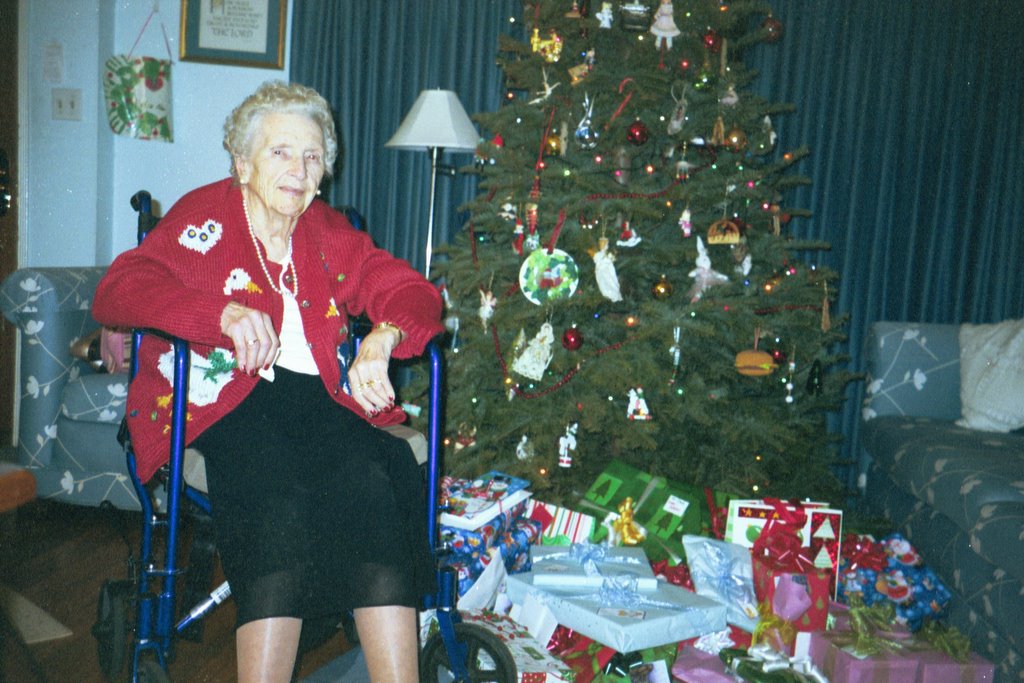
For Christmas Mom had a mini-vacation from Ocean View Assisted Living, spending two days and one night at our house. She enjoyed the Christmas tree, presents, food, and excitement of three granddaughters coming and going.
On Christmas Eve she wanted to open one present, the biggest and most intriguing one.
It turned out to be a portrait of her, drawn by an artist in the Philippines from a photo and beautifully framed, a gift from the caregiving agency.
However, the black and white drawing featured wrinkles and was not flattering.
"This is terrible!" Mom exclaimed. "I don't want it."
Fortunately, she slept well that night, so I got enough sleep too (on a mattress in the same room with her, lest she try to get out of bed in the night).
The next day turned out better, especially with the fun of Christmas dinner.
Tuesday, December 20, 2005
A Christmas Story
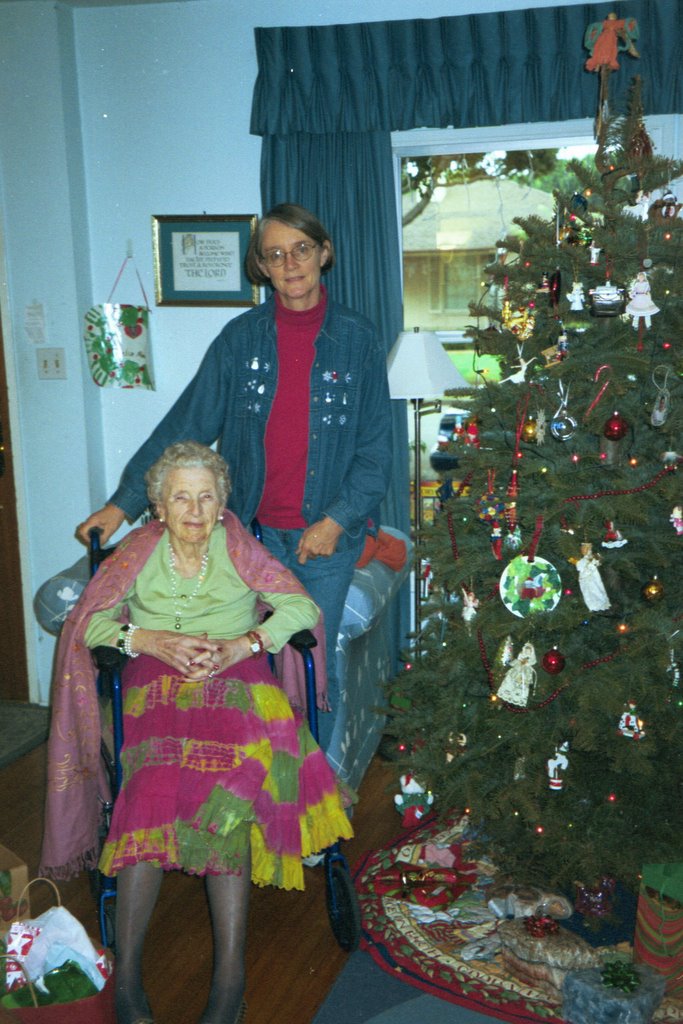
I made the mistake of giving Mom the Madame Alexander Doll catalogue and asking her which doll she would like for Christmas. Most dolls cost $60-$70, so I thought it would be a reasonable gift she would enjoy.
What she wanted, however, was the nativity set of Mary and Joseph with Jesus in the manger, sheep, a cow, and the surrounding stable--$300, not counting the angel doll she wanted to go with the others.
I spent a couple weeks trying to talk her into other dolls, but finally on the day after Thanksgiving I decided to order the nativity set.
"We're sold out on that, ma'am," said the salesperson when I finally courageously called in my order.
But then I felt terrible for postponing the order for so long.
What to do?
I ended up taking Beth and Laurie from her Little Women collection of Madame Alexander dolls and fashioning costumes to make them look like Mary and Joseph, and dressing a tiny baby doll as Jesus. I borrowed the stable roof from a wooden nativity set and found some sheep.
She loved her nativity set. It occupied the table in her room at Ocean View Assisted Living for the whole month of December.
Monday, December 12, 2005
To Demit or Not To Demit
Dear Harriet,
I believe you are membership chair for Chapter DV of P.E.O. in Boulder, Colorado. If not, please pass on this note.
My mother, Evelyn, has attended two meetings of a local P.E.O. chapter here in Santa Monica--Chapter R. She wants to join their group and attend regularly, but she does not want to demit from the Boulder chapter. She says her mother never demitted from the Telluride chapter when she moved to the Chapter House in Colorado Springs.
I told her she has to demit from DV in order to join Chapter R in California.
However, she believes (unrealistically) that she might someday return to live in Boulder.
Could you suggest a way for her to affiliate with Chapter R without losing touch with Chapter DV?
Perhaps she should be demitted without being told she has formally demitted. I'll leave it up to you.
The P.E.O. sisters here in Santa Monica are very kind. We met them through the Presbyterian church.
Sincerely,
Anne Eggebroten
I believe you are membership chair for Chapter DV of P.E.O. in Boulder, Colorado. If not, please pass on this note.
My mother, Evelyn, has attended two meetings of a local P.E.O. chapter here in Santa Monica--Chapter R. She wants to join their group and attend regularly, but she does not want to demit from the Boulder chapter. She says her mother never demitted from the Telluride chapter when she moved to the Chapter House in Colorado Springs.
I told her she has to demit from DV in order to join Chapter R in California.
However, she believes (unrealistically) that she might someday return to live in Boulder.
Could you suggest a way for her to affiliate with Chapter R without losing touch with Chapter DV?
Perhaps she should be demitted without being told she has formally demitted. I'll leave it up to you.
The P.E.O. sisters here in Santa Monica are very kind. We met them through the Presbyterian church.
Sincerely,
Anne Eggebroten
Sunday, December 11, 2005
Sick and Tired
All the experts advise caregivers: "Take care of yourself. Don't overdo it. Meet your own needs."
I do that by keeping my mother in an assisted living residence and by hiring a personal assistant for her six days a week, 22 hours a day. On Sunday I care for my mother, and on other days I try to visit her from 4 to 6 pm.
But this week I came down with a virus, about the same time as I finally located a flu shot for myself.
By Sunday morning, I was dragging. Instead of being at Ocean View by 9 am, I was still home eating breakfast, deciding to take Mom to the 11 am church service instead of the 9:30 service.
The phone rang loud and demanding in the quiet house, where John was still sleeping.
"Anne! Where are you? You're not here yet."
I reassured her and promised to be right over, reminding her that I have a cold.
But I felt angry. I know it's foolish to get upset with the behavior of someone who has dementia, but her phone call had pushed some old buttons from twenty or thirty years ago: the time I went on a hike and returned to the trail head to find her sitting in a car, furious, waiting for me. The time Emily drove across the country and did not call daily, only to have Mom report her to the highway patrol as a missing person.
When I got to Ocean View, everything was fine. Mom used a walker to walk from the dining area to her room. Then we went to a supermarket to buy a cake for the church luncheon and arrived at the 11 am service in time for the first Christmas carol.
We attended the TOPS luncheon (Terrific Older Presbyterian Something--Singles? Seniors?), where the entertainment was 45 minutes of Christmas songs.
Luckily Mom declined a bathroom visits, so we were on time to our next event, "Fa La La L.A.," a performance in Los Feliz of the West Coast Singers, the third oldest gay/lesbian mixed voice choir in the nation. All handicapped parking was taken by the time we arrived, but another spot miraculously appeared and I was able to get Mom into her wheelchair, through the will-call line, down the elevator, and into the wheelchair access area of the theatre by 3 pm.
Mom was stunned to be sitting under the noses of a choir of 60 as they sang their opening carol down close to the audience.
We got through the first half just fine, enjoying the rock 'n roll spoofs "Proud Mary Had a Baby" and "Giving Birth Is Hard to Do."
Mom was did well during the intermission and second half, until the closing number when the choir sang and signed "Silent Night," with some in the audience singing along.
On the last verse, however, they signed without singing as a cultural experience.
One voice in the theatre continued to sing until I clamped my hand over her mouth. I didn't try to explain this one to her.
Afterward I managed to get to the crowded bathroom, which was almost wheelchair inaccessible, without Mom knowing and demanding a visit. Her Depends would have to do their job.
I returned and mumbled something about having talked to a friend.
"Oh, you were talking to Grace Eggebroten?" she asked. Grace was her sister-in-law, who died earlier this year at age 96.
I didn't try to correct her. By this time it was 5:30 pm and my only goal was to get her back to Ocean View by 6 pm.
We would have made it, but I stopped at Sav-On to buy Depends and a few other things. I also called John and offered to buy something to make dinner, but he suggested going to Coco's. I accepted with relief.
At 6:15 pm as I loaded her out of the car into her wheelchair, hung the various plastic bags of Depends and Kleenex boxes from the wheelchair handles, and proceeded to the elevator of the parking garage, I was beat.
After the second elevator, we got to the third floor, where her evening caregiver was waiting.
"I looked for her lower plate but couldn't find it," Racquel explained.
"Thank you," I said. "I just don't know where it could be."
"It's a secret," commented Mom.
Racquel and I both did a double take.
"What do you mean?" I asked.
"I put it in the bathroom, in that little bag where you keep things," Mom answered.
I fell for this one and searched the various drawers and cupboards and bags of her bathroom before realizing she must have made this idea up on the spot.
Meanwhile, I realized I had left the foot supports of her walker in the car. Jona would need them to take her to physical therapy tomorrow at 9 am.
I walked back down the halls and took the two elevators back to the parking garage.
By the time I finally drove home, I was a wreck; my cold had become a sinus infection.
Nevertheless, I was careful to be cheerful to John when I walked in the door. He resents all the time I put into my mother, and if I return obviously tired and irritable, it makes things worse.
I sneezed a few times, however, and John quickly decided that I would not be good dinner company.
I ate a bowl of soup and went to bed, finally taking care of myself.
My brother Bill called an hour later and said he had talked to Mom.
"She sounded great, fairly coherent, better than six months ago. Had a lot to talk about. Said she was walking."
I tried to explain to him that when she gets out and about, taking part in things, her mind stays sharper, she's happier, and she's healthier.
I came across a quote to that effect tonight in a book I'm reading, What God Has Joined Together? A Christian Case for Gay Marriage. It came out this summer, written by my friend Letha Dawson Scanzoni and her friend David Myers.
"... social support--feeling liked, affirmed, and encouraged by intimate friends and family--predicts a lessened risk of ill health and premature death" (p. 19). If this is true for people of all ages, it must be true for older people with dementia.
I know exactly why Mom is doing so well. She has a personal caregiver to talk to around the clock, and she has a fair amount of contact with her family.
But I also know it's taking a toll on me.
I do that by keeping my mother in an assisted living residence and by hiring a personal assistant for her six days a week, 22 hours a day. On Sunday I care for my mother, and on other days I try to visit her from 4 to 6 pm.
But this week I came down with a virus, about the same time as I finally located a flu shot for myself.
By Sunday morning, I was dragging. Instead of being at Ocean View by 9 am, I was still home eating breakfast, deciding to take Mom to the 11 am church service instead of the 9:30 service.
The phone rang loud and demanding in the quiet house, where John was still sleeping.
"Anne! Where are you? You're not here yet."
I reassured her and promised to be right over, reminding her that I have a cold.
But I felt angry. I know it's foolish to get upset with the behavior of someone who has dementia, but her phone call had pushed some old buttons from twenty or thirty years ago: the time I went on a hike and returned to the trail head to find her sitting in a car, furious, waiting for me. The time Emily drove across the country and did not call daily, only to have Mom report her to the highway patrol as a missing person.
When I got to Ocean View, everything was fine. Mom used a walker to walk from the dining area to her room. Then we went to a supermarket to buy a cake for the church luncheon and arrived at the 11 am service in time for the first Christmas carol.
We attended the TOPS luncheon (Terrific Older Presbyterian Something--Singles? Seniors?), where the entertainment was 45 minutes of Christmas songs.
Luckily Mom declined a bathroom visits, so we were on time to our next event, "Fa La La L.A.," a performance in Los Feliz of the West Coast Singers, the third oldest gay/lesbian mixed voice choir in the nation. All handicapped parking was taken by the time we arrived, but another spot miraculously appeared and I was able to get Mom into her wheelchair, through the will-call line, down the elevator, and into the wheelchair access area of the theatre by 3 pm.
Mom was stunned to be sitting under the noses of a choir of 60 as they sang their opening carol down close to the audience.
We got through the first half just fine, enjoying the rock 'n roll spoofs "Proud Mary Had a Baby" and "Giving Birth Is Hard to Do."
Mom was did well during the intermission and second half, until the closing number when the choir sang and signed "Silent Night," with some in the audience singing along.
On the last verse, however, they signed without singing as a cultural experience.
One voice in the theatre continued to sing until I clamped my hand over her mouth. I didn't try to explain this one to her.
Afterward I managed to get to the crowded bathroom, which was almost wheelchair inaccessible, without Mom knowing and demanding a visit. Her Depends would have to do their job.
I returned and mumbled something about having talked to a friend.
"Oh, you were talking to Grace Eggebroten?" she asked. Grace was her sister-in-law, who died earlier this year at age 96.
I didn't try to correct her. By this time it was 5:30 pm and my only goal was to get her back to Ocean View by 6 pm.
We would have made it, but I stopped at Sav-On to buy Depends and a few other things. I also called John and offered to buy something to make dinner, but he suggested going to Coco's. I accepted with relief.
At 6:15 pm as I loaded her out of the car into her wheelchair, hung the various plastic bags of Depends and Kleenex boxes from the wheelchair handles, and proceeded to the elevator of the parking garage, I was beat.
After the second elevator, we got to the third floor, where her evening caregiver was waiting.
"I looked for her lower plate but couldn't find it," Racquel explained.
"Thank you," I said. "I just don't know where it could be."
"It's a secret," commented Mom.
Racquel and I both did a double take.
"What do you mean?" I asked.
"I put it in the bathroom, in that little bag where you keep things," Mom answered.
I fell for this one and searched the various drawers and cupboards and bags of her bathroom before realizing she must have made this idea up on the spot.
Meanwhile, I realized I had left the foot supports of her walker in the car. Jona would need them to take her to physical therapy tomorrow at 9 am.
I walked back down the halls and took the two elevators back to the parking garage.
By the time I finally drove home, I was a wreck; my cold had become a sinus infection.
Nevertheless, I was careful to be cheerful to John when I walked in the door. He resents all the time I put into my mother, and if I return obviously tired and irritable, it makes things worse.
I sneezed a few times, however, and John quickly decided that I would not be good dinner company.
I ate a bowl of soup and went to bed, finally taking care of myself.
My brother Bill called an hour later and said he had talked to Mom.
"She sounded great, fairly coherent, better than six months ago. Had a lot to talk about. Said she was walking."
I tried to explain to him that when she gets out and about, taking part in things, her mind stays sharper, she's happier, and she's healthier.
I came across a quote to that effect tonight in a book I'm reading, What God Has Joined Together? A Christian Case for Gay Marriage. It came out this summer, written by my friend Letha Dawson Scanzoni and her friend David Myers.
"... social support--feeling liked, affirmed, and encouraged by intimate friends and family--predicts a lessened risk of ill health and premature death" (p. 19). If this is true for people of all ages, it must be true for older people with dementia.
I know exactly why Mom is doing so well. She has a personal caregiver to talk to around the clock, and she has a fair amount of contact with her family.
But I also know it's taking a toll on me.
Saturday, December 10, 2005
The Whole 39 Yards
When Mom was first evaluated by Suzanne, the physical therapist, on Nov. 23, her diagnosis was "gait instability." With great effort Suzanne had pulled the safety belt to hoist Mom to her feet. At the parallel bars, Mom took baby steps.
Michael, the PTA, saw her on Wednesday, Nov. 30. By the following Monday, he commented, "She's doing a lot better today."
Jona reported this to me--I don't go to the PT sessions if I can help it.
By Thursday, Dec. 8, when Suzanne saw her for the third time, she was impressed.
"You're doing much better than a few weeks ago," she said. "You're doing most of the work, Evelyn."
She meant: "I don't have to pull you up out of the wheelchair."
Mom stood up, took a couple of steps, and sat down, five times in a row. Then she walked twenty feet using the walker while Suzanne held the safety belt. Then she stood up another five times.
No need to work at the parallel bars--Mom was beyond that.
[Footnote: Mom was talking a blue streak while doing all this.
First "Anne lost my lower plate."
Then "I left it under my pillow for the tooth fairy."
Then "Connie is so mean to me! She said I was going to go to hell if I didn't mind her. I asked for orange juice but she said, 'Shut up! I put you to bed and you're going to stay there. I'm not going to give you a damn thing.' I started crying, and she said, 'Shut up!'"]
On Friday Mom didn't go to physical therapy because of the P.E.O. meeting, and I didn't take time to help her walk at all that day. (I had a cold and was barely able to take her out for three hours to P.E.O.)
When I came to see her Saturday afternoon at 4 pm, she was sleepy, talking to me with closed eyes. I figured she would probably not be alert enough to walk, but we tried a test run from her chair to the bathroom.
She did fine, so I put her wheelchair around the corner and halfway down the hall, hoping to get her to walk further than she had ever walked since June 1.
She did great again and in fact walked past the wheelchair and into the dining room--maybe about 100 feet. I'll have to measure it.
I sang "Walking in a Winter Wonderland," again and again, to distract her from how difficult it was. She kind of sang along with me.
After dinner, I thought "Why not?" and pulled her up to stand at her walker.
She walked all the way back to her room and collapsed into her pink recliner.
I was singing all the way--"Winter Wonderland," "Frosty the Snowman."
The hall sure looked long as we left the living room and inched toward the laundry room.
"There must have been some magic in that old top hat we found...."
Either magic or a miracle.
She hasn't walked that far since arriving at Ocean View, October 1, 2004.
Michael, the PTA, saw her on Wednesday, Nov. 30. By the following Monday, he commented, "She's doing a lot better today."
Jona reported this to me--I don't go to the PT sessions if I can help it.
By Thursday, Dec. 8, when Suzanne saw her for the third time, she was impressed.
"You're doing much better than a few weeks ago," she said. "You're doing most of the work, Evelyn."
She meant: "I don't have to pull you up out of the wheelchair."
Mom stood up, took a couple of steps, and sat down, five times in a row. Then she walked twenty feet using the walker while Suzanne held the safety belt. Then she stood up another five times.
No need to work at the parallel bars--Mom was beyond that.
[Footnote: Mom was talking a blue streak while doing all this.
First "Anne lost my lower plate."
Then "I left it under my pillow for the tooth fairy."
Then "Connie is so mean to me! She said I was going to go to hell if I didn't mind her. I asked for orange juice but she said, 'Shut up! I put you to bed and you're going to stay there. I'm not going to give you a damn thing.' I started crying, and she said, 'Shut up!'"]
On Friday Mom didn't go to physical therapy because of the P.E.O. meeting, and I didn't take time to help her walk at all that day. (I had a cold and was barely able to take her out for three hours to P.E.O.)
When I came to see her Saturday afternoon at 4 pm, she was sleepy, talking to me with closed eyes. I figured she would probably not be alert enough to walk, but we tried a test run from her chair to the bathroom.
She did fine, so I put her wheelchair around the corner and halfway down the hall, hoping to get her to walk further than she had ever walked since June 1.
She did great again and in fact walked past the wheelchair and into the dining room--maybe about 100 feet. I'll have to measure it.
I sang "Walking in a Winter Wonderland," again and again, to distract her from how difficult it was. She kind of sang along with me.
After dinner, I thought "Why not?" and pulled her up to stand at her walker.
She walked all the way back to her room and collapsed into her pink recliner.
I was singing all the way--"Winter Wonderland," "Frosty the Snowman."
The hall sure looked long as we left the living room and inched toward the laundry room.
"There must have been some magic in that old top hat we found...."
Either magic or a miracle.
She hasn't walked that far since arriving at Ocean View, October 1, 2004.
Reward! $200
Calling all unemployed, homeless, or other persons interested in earning a few bucks before Christmas!
You are invited to search Room 369 of Ocean View Assisted Living, Santa Irena, California, for a missing set of false teeth. This partial lower plate includes two molar teeth on each side of a pink plastic plate with a gold bracket on each side for securing it against the front ten teeth, which remain in the owner's mouth.
This lower plate has been missing since about 8:30 am, Thursday. Having ransacked the room, the family is becoming desperate to locate the teeth and avoid trips to the dentist to replace the plate.
Anyone with information or ideas is asked to call 1-800-MY-TEETH.
Note: Racquel, the weekend night caregiver, reports that Evelyn routinely takes her lower plate out at night and puts it under a pillow. Therefore, Racquel does not let her sleep with her false teeth in. The family will adopt this policy if and when the lower plate is located.
If you are not available to join in the search, your prayers would be much appreciated!
You are invited to search Room 369 of Ocean View Assisted Living, Santa Irena, California, for a missing set of false teeth. This partial lower plate includes two molar teeth on each side of a pink plastic plate with a gold bracket on each side for securing it against the front ten teeth, which remain in the owner's mouth.
This lower plate has been missing since about 8:30 am, Thursday. Having ransacked the room, the family is becoming desperate to locate the teeth and avoid trips to the dentist to replace the plate.
Anyone with information or ideas is asked to call 1-800-MY-TEETH.
Note: Racquel, the weekend night caregiver, reports that Evelyn routinely takes her lower plate out at night and puts it under a pillow. Therefore, Racquel does not let her sleep with her false teeth in. The family will adopt this policy if and when the lower plate is located.
If you are not available to join in the search, your prayers would be much appreciated!
Friday, December 09, 2005
Carrying on with Courage
"Old age--it ain't for sissies!" quipped Mae West many years ago.
When I showed up with Mom at 519 Ninth Street for the P.E.O. meeting today, I was expecting a nice social club for old ladies, not a demonstration of courage against all odds.
I parked and pushed Mom's wheel chair up the driveway, then turned her around and entered the front door backwards, hoisting the chair up a four-inch step to a porch area, then up another small step into the house, then up six inches more into the dining room near a lovely table spread with Christmas goodies.
In the living room was a big tree beautifully decorated for the holidays, but I didn't meet Eileen, whose home it was, until later. She was resting in another room, then talking with a few of us. She had either a cold or some other ailment--perhaps just tired from the effort of decorating her house for the P.E.O. party. On a side table was a photo of her husband, recently deceased.
I placed Mom near Darlene, the only other person in a wheelchair. Darlene chatted cheerfully as she and Mom enjoyed refreshments and compared notes on the events that had cost them their mobility. For Darlene (about Mom's age) it was a broken thigh bone that had taken a long time to heal.
Dorothy, meanwhile, answered questions about how her husband was doing.
"He gets up for breakfast and for dinner, but otherwise he's in bed all day long," she said. "We can watch tv in the evenings, but if he sees a fire on the television, he gets anxious. He thinks we are in danger. I have to explain to him that we're okay."
"Oh, a touch of Alzheimer's," commented Darlene.
I now understood Dorothy's generosity toward Mom in inviting her to the meeting; she deals with dementia on a daily basis.
When it was time to move to another room for the entertainment and business meeting, Darlene carefully stood up and stepped down the six-inch step; then we moved her wheelchair down the step. Mom had to be bumped down the step in her wheelchair.
After the meeting, as people were talking and starting to leave, we heard a loud thunk that shook the floor a little.
Darlene had been negotiating the threshold and the edge of the front porch, but she had fallen. She now lay on her back on the porch, 180 pounds and immobile.
Everyone rushed to her aid.
"They'll take care of her," Mom said. "P.E.O.s take care of each other."
Darlene seemed to be okay, just shaken. After a few moments' rest, we lifted her up into her wheelchair with the help of a young man in the house.
Someone went to get ice for the back of her head, where there was a two-inch straight cut, vertical, bleeding a fair amount.
"You'll have to have stitches," I commented.
Then Mom went down the same steps, backwards in her wheelchair, ignominious but safe.
As we drove home, I reflected on my new respect for the P.E.O.s. They are battling death, dementia, and disability with great courage.
In their seventies and eighties, they gather as they have for forty or fifty years, affirming their sisterhood against all odds--not sissies but sisters.
When I showed up with Mom at 519 Ninth Street for the P.E.O. meeting today, I was expecting a nice social club for old ladies, not a demonstration of courage against all odds.
I parked and pushed Mom's wheel chair up the driveway, then turned her around and entered the front door backwards, hoisting the chair up a four-inch step to a porch area, then up another small step into the house, then up six inches more into the dining room near a lovely table spread with Christmas goodies.
In the living room was a big tree beautifully decorated for the holidays, but I didn't meet Eileen, whose home it was, until later. She was resting in another room, then talking with a few of us. She had either a cold or some other ailment--perhaps just tired from the effort of decorating her house for the P.E.O. party. On a side table was a photo of her husband, recently deceased.
I placed Mom near Darlene, the only other person in a wheelchair. Darlene chatted cheerfully as she and Mom enjoyed refreshments and compared notes on the events that had cost them their mobility. For Darlene (about Mom's age) it was a broken thigh bone that had taken a long time to heal.
Dorothy, meanwhile, answered questions about how her husband was doing.
"He gets up for breakfast and for dinner, but otherwise he's in bed all day long," she said. "We can watch tv in the evenings, but if he sees a fire on the television, he gets anxious. He thinks we are in danger. I have to explain to him that we're okay."
"Oh, a touch of Alzheimer's," commented Darlene.
I now understood Dorothy's generosity toward Mom in inviting her to the meeting; she deals with dementia on a daily basis.
When it was time to move to another room for the entertainment and business meeting, Darlene carefully stood up and stepped down the six-inch step; then we moved her wheelchair down the step. Mom had to be bumped down the step in her wheelchair.
After the meeting, as people were talking and starting to leave, we heard a loud thunk that shook the floor a little.
Darlene had been negotiating the threshold and the edge of the front porch, but she had fallen. She now lay on her back on the porch, 180 pounds and immobile.
Everyone rushed to her aid.
"They'll take care of her," Mom said. "P.E.O.s take care of each other."
Darlene seemed to be okay, just shaken. After a few moments' rest, we lifted her up into her wheelchair with the help of a young man in the house.
Someone went to get ice for the back of her head, where there was a two-inch straight cut, vertical, bleeding a fair amount.
"You'll have to have stitches," I commented.
Then Mom went down the same steps, backwards in her wheelchair, ignominious but safe.
As we drove home, I reflected on my new respect for the P.E.O.s. They are battling death, dementia, and disability with great courage.
In their seventies and eighties, they gather as they have for forty or fifty years, affirming their sisterhood against all odds--not sissies but sisters.
Thursday, December 08, 2005
The Case(s) of the Missing Teeth
Case 1
What: Mom's lower partial plate--two molar teeth each on the left and right on a pink plate with a gold bracket to attach them to her central teeth (still rooted in her jaw).
When discovered missing: Tuesday night, 7:30 pm, by Connie, the night caregiver
Mom's reaction: Laughter as we search. "This is so ridiculous! No, I don't know where they are." But isn't all the excitement fun!
Anne's reaction: $$$ How could they vanish during the three hours I took her out? Did she take them out and leave them on the plate at the buffet reception at UCLA? I wasn't watching her closely--I was talking with other people. What if we can't find them? How much will it cost to replace them? Can I face another encounter with the dentist after the embarrassing visit last week?
When found: Wednesday morning, 8 am, by Jona, the day caregiver, while emptying the small waste basket by Mom's recliner. They were on the floor between the waste basket and the chair.
Case 2
What: same item
When discovered missing: Thursday morning, 7:30 am, by Jona.
Mom's reaction: More excitement! "I don't where they are. I put them under my pillow for the tooth fairy."
Anne's reaction: "At least you have not left the room. They have to be here somewhere. Why did you take them out? If we can't find them, you will be back on a pureed diet, like Sue. You will be eating pureed food for the rest of your life."
Mom's secondary reaction: Dismay. Then "You probably put them somewhere."
Jona's reaction: Comforting Mom.
When found: ???
What: Mom's lower partial plate--two molar teeth each on the left and right on a pink plate with a gold bracket to attach them to her central teeth (still rooted in her jaw).
When discovered missing: Tuesday night, 7:30 pm, by Connie, the night caregiver
Mom's reaction: Laughter as we search. "This is so ridiculous! No, I don't know where they are." But isn't all the excitement fun!
Anne's reaction: $$$ How could they vanish during the three hours I took her out? Did she take them out and leave them on the plate at the buffet reception at UCLA? I wasn't watching her closely--I was talking with other people. What if we can't find them? How much will it cost to replace them? Can I face another encounter with the dentist after the embarrassing visit last week?
When found: Wednesday morning, 8 am, by Jona, the day caregiver, while emptying the small waste basket by Mom's recliner. They were on the floor between the waste basket and the chair.
Case 2
What: same item
When discovered missing: Thursday morning, 7:30 am, by Jona.
Mom's reaction: More excitement! "I don't where they are. I put them under my pillow for the tooth fairy."
Anne's reaction: "At least you have not left the room. They have to be here somewhere. Why did you take them out? If we can't find them, you will be back on a pureed diet, like Sue. You will be eating pureed food for the rest of your life."
Mom's secondary reaction: Dismay. Then "You probably put them somewhere."
Jona's reaction: Comforting Mom.
When found: ???
Saturday, December 03, 2005
Old Moon in the New Moon's Arms
Tonight at 5 pm as I drove to visit Mom, I saw the new crescent moon in the sunset sky near Venus--a lovely sight, similar to a few days ago at 5 am when I saw the crescent waning moon halfway between Jupiter and Spica.
I found Mom in the dining room shortly after 5 pm and saw that she was feeling sorry for herself because I had come so late--not at 2 pm or 4 pm.
As the dinner hour dragged on, I commented to Bob, sitting next to Mom, "There's such a pretty sky tonight. We should go out on the patio and see the crescent moon, just a skinny slice, next to Venus." He enjoys going out on the patio sometimes, but I knew Mom never wanted to go out there.
"It's too cold out there," Mom commented, rejecting the idea as if I had proposed it to her.
She ate her soup, mixed fruit, and cottage cheese but refused the cheese blintz. When I tried to get her to eat it, she emphatically refused.
Pushing her wheelchair back to her room, I was careless and bumped the back of an armchair, smacking her arm against the chair.
She screeched in pain, and an Ocean View caregiver came running.
"Oh, I'm sorry, Mom" I began apologizing. "I wasn't looking where I was going."
Back in the room, Racquel, her private caregiver arrived, and I insisted that Mom do her daily exercise of walking fifteen feet to the bathroom and back.
She did fine with it but complained noisily as we pulled her up to walking position again after a rest: "In my own house, I get tortured."
I realized that her emotional energy had dropped because of the bumped arm, added to the fact that 8 am is a better time to do this daily walk. (Evening is more convenient for me.)
Within minutes Mom was at meltdown, the way my teenagers get when they are too tired.
"I don't want a shower--I already had one," she claimed, whimpering. But Racquel and I insisted that she had to have a shower and started undressing her.
"In my own house--I get tortured again," she said, now crying.
"It's just a shower--the warm water will feel good," I urged, but her desolation touched me.
"I just want to go to your house," she said.
"You're coming to my house tomorrow," I countered. "We'll have raisin toast. Tomorrow is Sunday, and we're going to church."
She continued crying. I told her goodnight and left her in the shower chair being soaped by her caregiver.
Driving out of the parking garage, I felt so guilty.
There she is, alone with caregivers for 23 hours, and the one hour I am there, I bump her arm, make her try to walk at the end of the day, and overrule her wish to skip the evening shower. Then I leave her with a caregiver.
Venus caught my eye, and I wondered if the moon had set beneath the ocean yet. I drove to the palisades above the beach and parked.
The crescent moon, now a brilliant orange, was still visible in the dark sky just above the black ocean. I watched it sink slowly into the ocean, its orange tip dipping into the black, then shrinking to a comet pointed into the ocean, then vanishing.
"The old moon in the new moon's arms," they call this sight.
My old mother in my arms, both of us sinking into the darkness.
I found Mom in the dining room shortly after 5 pm and saw that she was feeling sorry for herself because I had come so late--not at 2 pm or 4 pm.
As the dinner hour dragged on, I commented to Bob, sitting next to Mom, "There's such a pretty sky tonight. We should go out on the patio and see the crescent moon, just a skinny slice, next to Venus." He enjoys going out on the patio sometimes, but I knew Mom never wanted to go out there.
"It's too cold out there," Mom commented, rejecting the idea as if I had proposed it to her.
She ate her soup, mixed fruit, and cottage cheese but refused the cheese blintz. When I tried to get her to eat it, she emphatically refused.
Pushing her wheelchair back to her room, I was careless and bumped the back of an armchair, smacking her arm against the chair.
She screeched in pain, and an Ocean View caregiver came running.
"Oh, I'm sorry, Mom" I began apologizing. "I wasn't looking where I was going."
Back in the room, Racquel, her private caregiver arrived, and I insisted that Mom do her daily exercise of walking fifteen feet to the bathroom and back.
She did fine with it but complained noisily as we pulled her up to walking position again after a rest: "In my own house, I get tortured."
I realized that her emotional energy had dropped because of the bumped arm, added to the fact that 8 am is a better time to do this daily walk. (Evening is more convenient for me.)
Within minutes Mom was at meltdown, the way my teenagers get when they are too tired.
"I don't want a shower--I already had one," she claimed, whimpering. But Racquel and I insisted that she had to have a shower and started undressing her.
"In my own house--I get tortured again," she said, now crying.
"It's just a shower--the warm water will feel good," I urged, but her desolation touched me.
"I just want to go to your house," she said.
"You're coming to my house tomorrow," I countered. "We'll have raisin toast. Tomorrow is Sunday, and we're going to church."
She continued crying. I told her goodnight and left her in the shower chair being soaped by her caregiver.
Driving out of the parking garage, I felt so guilty.
There she is, alone with caregivers for 23 hours, and the one hour I am there, I bump her arm, make her try to walk at the end of the day, and overrule her wish to skip the evening shower. Then I leave her with a caregiver.
Venus caught my eye, and I wondered if the moon had set beneath the ocean yet. I drove to the palisades above the beach and parked.
The crescent moon, now a brilliant orange, was still visible in the dark sky just above the black ocean. I watched it sink slowly into the ocean, its orange tip dipping into the black, then shrinking to a comet pointed into the ocean, then vanishing.
"The old moon in the new moon's arms," they call this sight.
My old mother in my arms, both of us sinking into the darkness.
Friday, December 02, 2005
"You're Ugly"
When I take my mother anywhere, I know a few embarrassing events will happen.
Today it was my sister's turn. Emily took Mom to the physical therapist, where she is learning how to walk again after time in the hospital and convalescence.
Mom was precariously balanced at her walker, holding onto the side grips in a crouched over position, looking at the ground.
"Stand up straight, Evelyn," said Michael, the therapist, facing her. "Nose over toes."
"I know, I'm trying," she answered.
"Look at me," he said, still trying to get her to turn her head up.
"Why should I?" she shot back. "You're ugly."
He laughed and continued patiently working with Mom.
Emily laughed--one more dementia moment, an instance when Mom said or did something she never would have done a few years ago.
Yesterday I took Mom to the dentist for her regular tooth cleaning.
She and I usually sing a chorus of "We're off to see the wizard, the wonderful wizard of Oz" as we set out on these little adventures. I'm thinking, "Anything could happen. Who knows what it will be today?"
We arrived and managed to get her transferred from the wheelchair to the dentist's chair.
"Has anything changed in her health status since her last visit?" the dental technician asked.
I started reciting the changes in the last three months: "She has a pacemaker now. She started Coumadin in September because they found a pulmonary embolism."
"Oh!" The technician seemed amazed at these events. "We'll have to call to find out whether we can clean her teeth. Do you have the phone number of the doctor who put in the pacemaker? "
"But she only has six teeth," I said. "Why would it matter?"
"When I clean her teeth, her gums will bleed not only into her mouth but internally, and it could cause a small blood clot that could cause problems."
"Okay, I see," I said, and for the next twenty minutes I located phone numbers for her surgeon, the pacemaker clinic, and her internist while the technician tried to reach any one of them. Finally a partner of her internist gave the green light for the tooth cleaning.
I retreated to the lobby for a few moments of peace and quiet while the cleaning went on, but then I felt guilty and went back to monitor the situation.
Mom was doing fine and the cleaning was almost over.
Then Mom announced, "I'm peeing in my pants."
"That's okay," I said. "You're wearing Depends. We can change them later."
I didn't say, "Please don't announce these events to the dental hygienist! She doesn't need to know."
Another moment like this occurred two days earlier when we went to the Pacemaker Clinic for a check-up.
The doctor made the mistake of asking her, "How are you doing?"
Wrong. With a dementia patient, you don't want to offer that broad an opening. You want to say, "I'm here to check on your pacemaker. How is your heart doing? Do you have enough energy?"
Mom saw his question as an opportunity to complain about the problem on her mind that day:
"I'm okay, but I don't like to be spread-eagled at night when they clean me--"
She had been telling me about this problem on the drive from her residence to the clinic. I cut her off: "Mom, he's here to check on your pacemaker. He can't do anything about your care at night."
I don't know what I can do about the changing of her Depends at night by the caregivers. Apparently it feels to her like a rape, having her perineum and vulva wiped at night when her Depends are changed.
(The caregiver writes each event down in her night log, noting "Perennial care." I read the log and think, "Yes, perineal and perennial.")
All in all, there's plenty of room for embarrassment. We just need to be prepared for it and take it in stride. But somehow each time there's that moment of surprise and wanting to vanish.
Today it was my sister's turn. Emily took Mom to the physical therapist, where she is learning how to walk again after time in the hospital and convalescence.
Mom was precariously balanced at her walker, holding onto the side grips in a crouched over position, looking at the ground.
"Stand up straight, Evelyn," said Michael, the therapist, facing her. "Nose over toes."
"I know, I'm trying," she answered.
"Look at me," he said, still trying to get her to turn her head up.
"Why should I?" she shot back. "You're ugly."
He laughed and continued patiently working with Mom.
Emily laughed--one more dementia moment, an instance when Mom said or did something she never would have done a few years ago.
Yesterday I took Mom to the dentist for her regular tooth cleaning.
She and I usually sing a chorus of "We're off to see the wizard, the wonderful wizard of Oz" as we set out on these little adventures. I'm thinking, "Anything could happen. Who knows what it will be today?"
We arrived and managed to get her transferred from the wheelchair to the dentist's chair.
"Has anything changed in her health status since her last visit?" the dental technician asked.
I started reciting the changes in the last three months: "She has a pacemaker now. She started Coumadin in September because they found a pulmonary embolism."
"Oh!" The technician seemed amazed at these events. "We'll have to call to find out whether we can clean her teeth. Do you have the phone number of the doctor who put in the pacemaker? "
"But she only has six teeth," I said. "Why would it matter?"
"When I clean her teeth, her gums will bleed not only into her mouth but internally, and it could cause a small blood clot that could cause problems."
"Okay, I see," I said, and for the next twenty minutes I located phone numbers for her surgeon, the pacemaker clinic, and her internist while the technician tried to reach any one of them. Finally a partner of her internist gave the green light for the tooth cleaning.
I retreated to the lobby for a few moments of peace and quiet while the cleaning went on, but then I felt guilty and went back to monitor the situation.
Mom was doing fine and the cleaning was almost over.
Then Mom announced, "I'm peeing in my pants."
"That's okay," I said. "You're wearing Depends. We can change them later."
I didn't say, "Please don't announce these events to the dental hygienist! She doesn't need to know."
Another moment like this occurred two days earlier when we went to the Pacemaker Clinic for a check-up.
The doctor made the mistake of asking her, "How are you doing?"
Wrong. With a dementia patient, you don't want to offer that broad an opening. You want to say, "I'm here to check on your pacemaker. How is your heart doing? Do you have enough energy?"
Mom saw his question as an opportunity to complain about the problem on her mind that day:
"I'm okay, but I don't like to be spread-eagled at night when they clean me--"
She had been telling me about this problem on the drive from her residence to the clinic. I cut her off: "Mom, he's here to check on your pacemaker. He can't do anything about your care at night."
I don't know what I can do about the changing of her Depends at night by the caregivers. Apparently it feels to her like a rape, having her perineum and vulva wiped at night when her Depends are changed.
(The caregiver writes each event down in her night log, noting "Perennial care." I read the log and think, "Yes, perineal and perennial.")
All in all, there's plenty of room for embarrassment. We just need to be prepared for it and take it in stride. But somehow each time there's that moment of surprise and wanting to vanish.
Subscribe to:
Posts (Atom)