Sunday, December 25, 2005

Christmas Photos


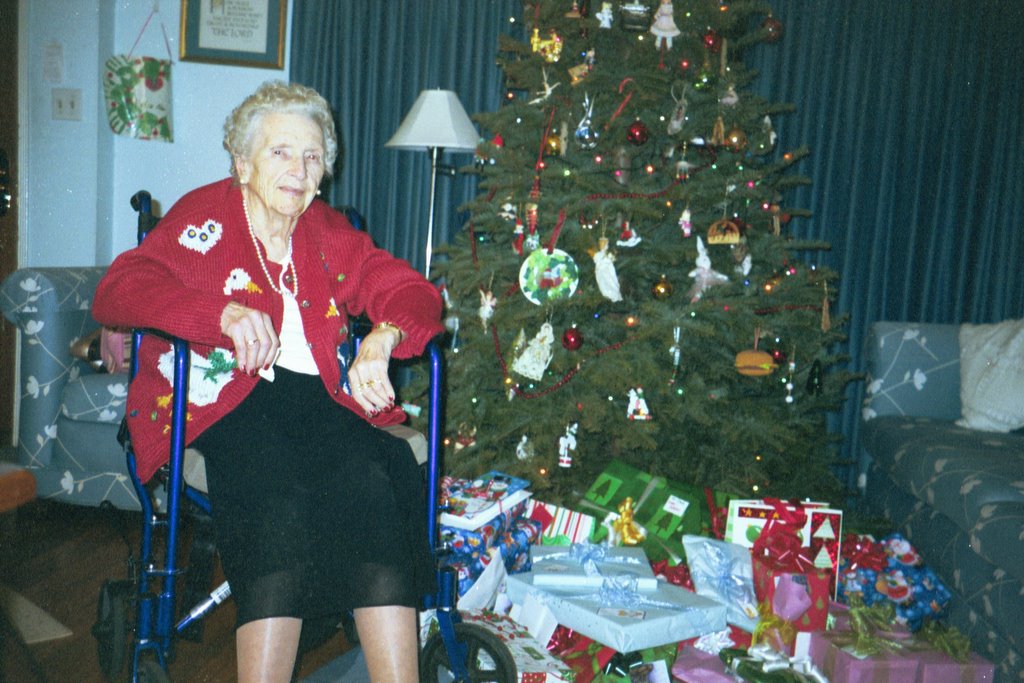
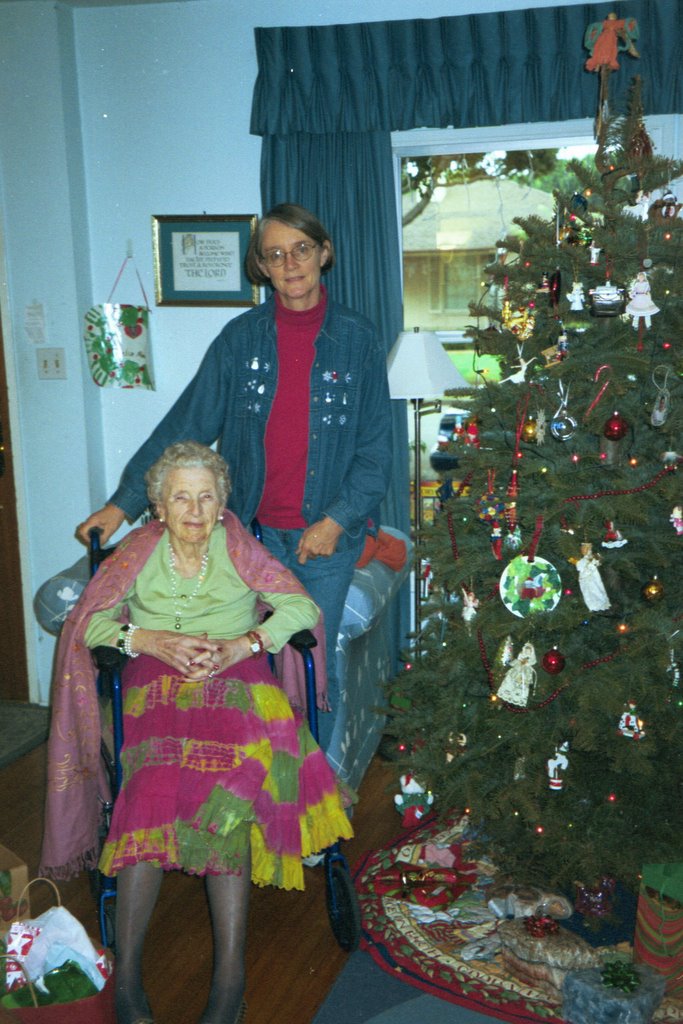
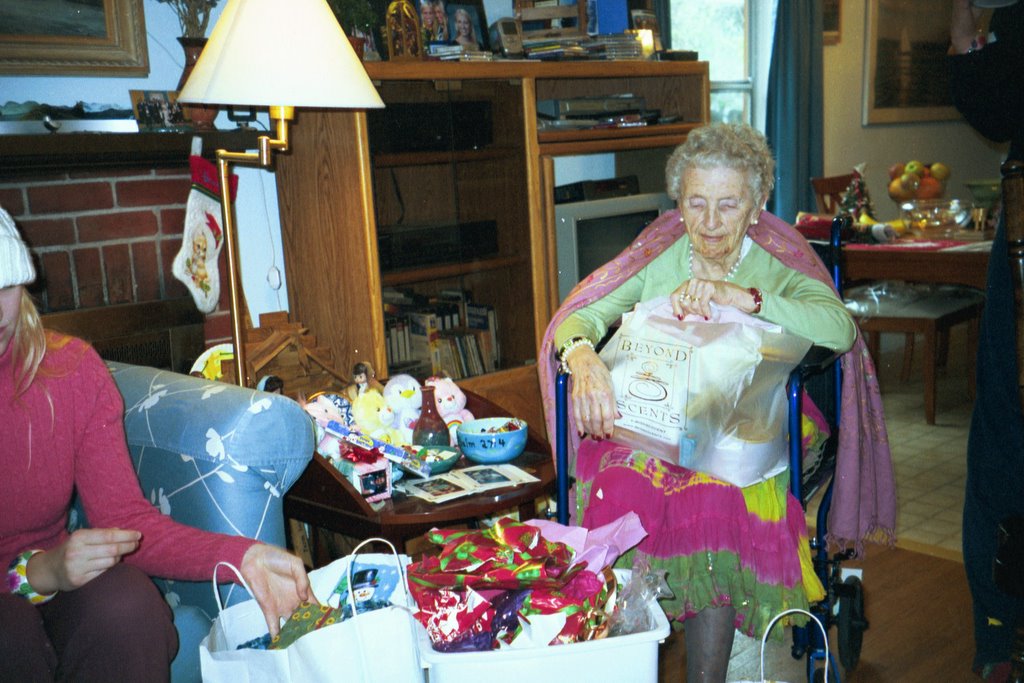
For Christmas Mom had a mini-vacation from Ocean View Assisted Living, spending two days and one night at our house. She enjoyed the Christmas tree, presents, food, and excitement of three granddaughters coming and going.
On Christmas Eve she wanted to open one present, the biggest and most intriguing one.
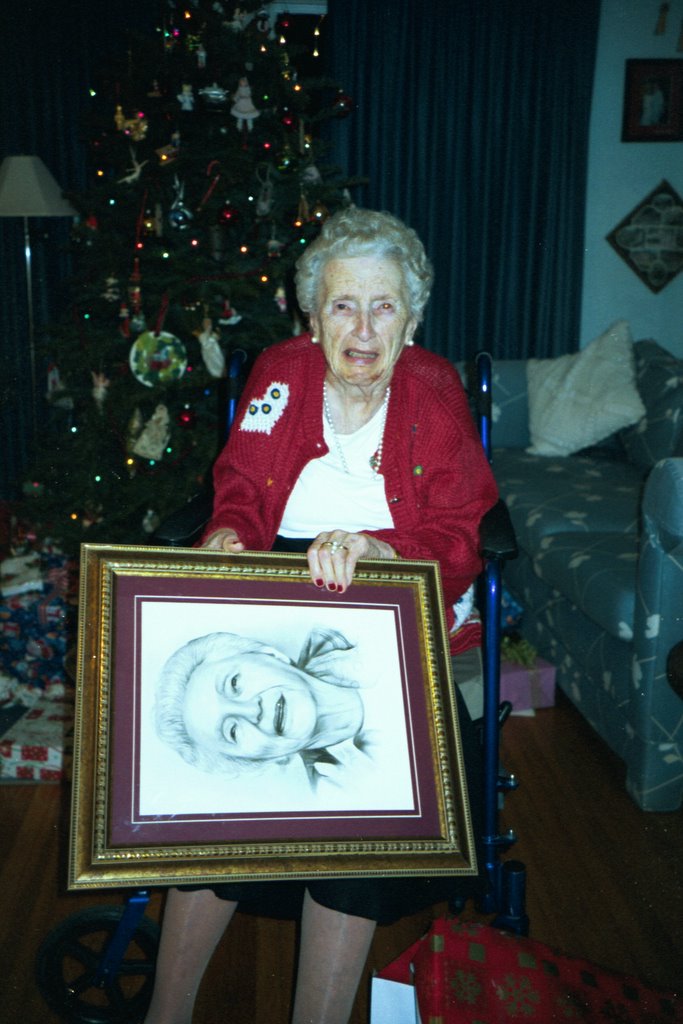
It turned out to be a portrait of her, drawn by an artist in the Philippines from a photo and beautifully framed, a gift from the caregiving agency.
However, the black and white drawing featured wrinkles and was not flattering.
"This is terrible!" Mom exclaimed. "I don't want it."
Fortunately, she slept well that night, so I got enough sleep too (on a mattress in the same room with her, lest she try to get out of bed in the night).
The next day turned out better, especially with the fun of Christmas dinner.

Tuesday, December 20, 2005

A Christmas Story


I made the mistake of giving Mom the Madame Alexander Doll catalogue and asking her which doll she would like for Christmas. Most dolls cost $60-$70, so I thought it would be a reasonable gift she would enjoy.
What she wanted, however, was the nativity set of Mary and Joseph with Jesus in the manger, sheep, a cow, and the surrounding stable--$300, not counting the angel doll she wanted to go with the others.
I spent a couple weeks trying to talk her into other dolls, but finally on the day after Thanksgiving I decided to order the nativity set.
"We're sold out on that, ma'am," said the salesperson when I finally courageously called in my order.
But then I felt terrible for postponing the order for so long.
What to do?
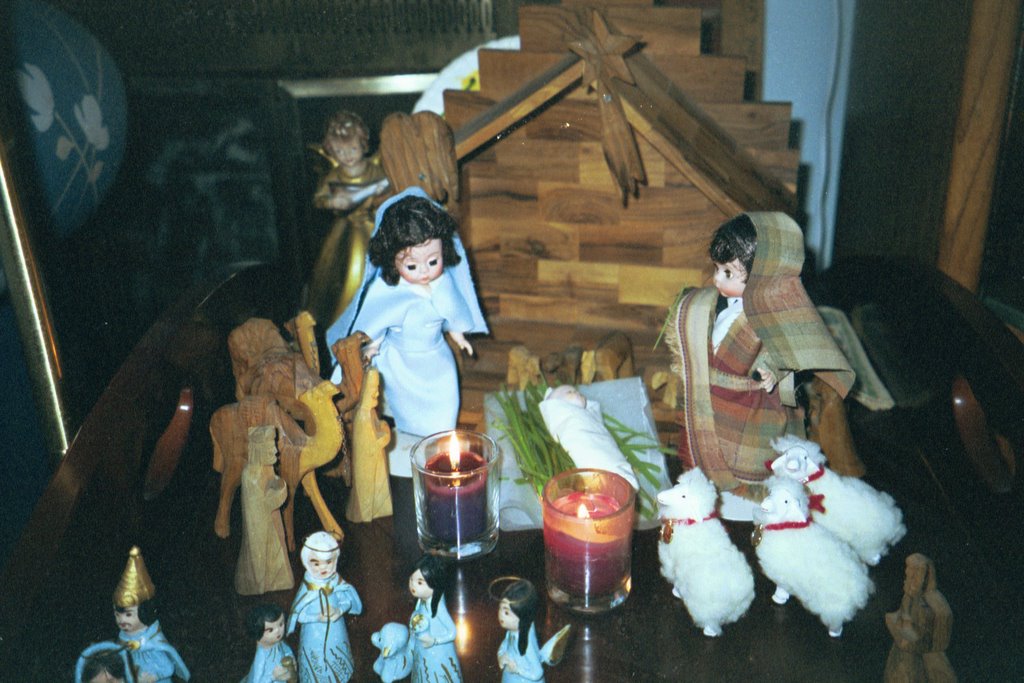
I ended up taking Beth and Laurie from her Little Women collection of Madame Alexander dolls and fashioning costumes to make them look like Mary and Joseph, and dressing a tiny baby doll as Jesus. I borrowed the stable roof from a wooden nativity set and found some sheep.
She loved her nativity set. It occupied the table in her room at Ocean View Assisted Living for the whole month of December.

Monday, December 12, 2005

To Demit or Not To Demit

Dear Harriet,

I believe you are membership chair for Chapter DV of P.E.O. in Boulder, Colorado. If not, please pass on this note.

My mother, Evelyn, has attended two meetings of a local P.E.O. chapter here in Santa Monica--Chapter R. She wants to join their group and attend regularly, but she does not want to demit from the Boulder chapter. She says her mother never demitted from the Telluride chapter when she moved to the Chapter House in Colorado Springs.

I told her she has to demit from DV in order to join Chapter R in California.

However, she believes (unrealistically) that she might someday return to live in Boulder.

Could you suggest a way for her to affiliate with Chapter R without losing touch with Chapter DV?

Perhaps she should be demitted without being told she has formally demitted. I'll leave it up to you.

The P.E.O. sisters here in Santa Monica are very kind. We met them through the Presbyterian church.

Sincerely,

Anne Eggebroten

Sunday, December 11, 2005

Sick and Tired

All the experts advise caregivers: "Take care of yourself. Don't overdo it. Meet your own needs."
I do that by keeping my mother in an assisted living residence and by hiring a personal assistant for her six days a week, 22 hours a day. On Sunday I care for my mother, and on other days I try to visit her from 4 to 6 pm.
But this week I came down with a virus, about the same time as I finally located a flu shot for myself.
By Sunday morning, I was dragging. Instead of being at Ocean View by 9 am, I was still home eating breakfast, deciding to take Mom to the 11 am church service instead of the 9:30 service.
The phone rang loud and demanding in the quiet house, where John was still sleeping.
"Anne! Where are you? You're not here yet."
I reassured her and promised to be right over, reminding her that I have a cold.
But I felt angry. I know it's foolish to get upset with the behavior of someone who has dementia, but her phone call had pushed some old buttons from twenty or thirty years ago: the time I went on a hike and returned to the trail head to find her sitting in a car, furious, waiting for me. The time Emily drove across the country and did not call daily, only to have Mom report her to the highway patrol as a missing person.
When I got to Ocean View, everything was fine. Mom used a walker to walk from the dining area to her room. Then we went to a supermarket to buy a cake for the church luncheon and arrived at the 11 am service in time for the first Christmas carol.
We attended the TOPS luncheon (Terrific Older Presbyterian Something--Singles? Seniors?), where the entertainment was 45 minutes of Christmas songs.
Luckily Mom declined a bathroom visits, so we were on time to our next event, "Fa La La L.A.," a performance in Los Feliz of the West Coast Singers, the third oldest gay/lesbian mixed voice choir in the nation. All handicapped parking was taken by the time we arrived, but another spot miraculously appeared and I was able to get Mom into her wheelchair, through the will-call line, down the elevator, and into the wheelchair access area of the theatre by 3 pm.
Mom was stunned to be sitting under the noses of a choir of 60 as they sang their opening carol down close to the audience.
We got through the first half just fine, enjoying the rock 'n roll spoofs "Proud Mary Had a Baby" and "Giving Birth Is Hard to Do."
Mom was did well during the intermission and second half, until the closing number when the choir sang and signed "Silent Night," with some in the audience singing along.
On the last verse, however, they signed without singing as a cultural experience.
One voice in the theatre continued to sing until I clamped my hand over her mouth. I didn't try to explain this one to her.
Afterward I managed to get to the crowded bathroom, which was almost wheelchair inaccessible, without Mom knowing and demanding a visit. Her Depends would have to do their job.
I returned and mumbled something about having talked to a friend.
"Oh, you were talking to Grace Eggebroten?" she asked. Grace was her sister-in-law, who died earlier this year at age 96.
I didn't try to correct her. By this time it was 5:30 pm and my only goal was to get her back to Ocean View by 6 pm.
We would have made it, but I stopped at Sav-On to buy Depends and a few other things. I also called John and offered to buy something to make dinner, but he suggested going to Coco's. I accepted with relief.
At 6:15 pm as I loaded her out of the car into her wheelchair, hung the various plastic bags of Depends and Kleenex boxes from the wheelchair handles, and proceeded to the elevator of the parking garage, I was beat.
After the second elevator, we got to the third floor, where her evening caregiver was waiting.
"I looked for her lower plate but couldn't find it," Racquel explained.
"Thank you," I said. "I just don't know where it could be."
"It's a secret," commented Mom.
Racquel and I both did a double take.
"What do you mean?" I asked.
"I put it in the bathroom, in that little bag where you keep things," Mom answered.
I fell for this one and searched the various drawers and cupboards and bags of her bathroom before realizing she must have made this idea up on the spot.
Meanwhile, I realized I had left the foot supports of her walker in the car. Jona would need them to take her to physical therapy tomorrow at 9 am.
I walked back down the halls and took the two elevators back to the parking garage.
By the time I finally drove home, I was a wreck; my cold had become a sinus infection.
Nevertheless, I was careful to be cheerful to John when I walked in the door. He resents all the time I put into my mother, and if I return obviously tired and irritable, it makes things worse.
I sneezed a few times, however, and John quickly decided that I would not be good dinner company.
I ate a bowl of soup and went to bed, finally taking care of myself.
My brother Bill called an hour later and said he had talked to Mom.
"She sounded great, fairly coherent, better than six months ago. Had a lot to talk about. Said she was walking."
I tried to explain to him that when she gets out and about, taking part in things, her mind stays sharper, she's happier, and she's healthier.
I came across a quote to that effect tonight in a book I'm reading, What God Has Joined Together? A Christian Case for Gay Marriage. It came out this summer, written by my friend Letha Dawson Scanzoni and her friend David Myers.
"... social support--feeling liked, affirmed, and encouraged by intimate friends and family--predicts a lessened risk of ill health and premature death" (p. 19). If this is true for people of all ages, it must be true for older people with dementia.
I know exactly why Mom is doing so well. She has a personal caregiver to talk to around the clock, and she has a fair amount of contact with her family.
But I also know it's taking a toll on me.
Saturday, December 10, 2005

The Whole 39 Yards

When Mom was first evaluated by Suzanne, the physical therapist, on Nov. 23, her diagnosis was "gait instability." With great effort Suzanne had pulled the safety belt to hoist Mom to her feet. At the parallel bars, Mom took baby steps.
Michael, the PTA, saw her on Wednesday, Nov. 30. By the following Monday, he commented, "She's doing a lot better today."
Jona reported this to me--I don't go to the PT sessions if I can help it.
By Thursday, Dec. 8, when Suzanne saw her for the third time, she was impressed.
"You're doing much better than a few weeks ago," she said. "You're doing most of the work, Evelyn."
She meant: "I don't have to pull you up out of the wheelchair."
Mom stood up, took a couple of steps, and sat down, five times in a row. Then she walked twenty feet using the walker while Suzanne held the safety belt. Then she stood up another five times.
No need to work at the parallel bars--Mom was beyond that.

[Footnote: Mom was talking a blue streak while doing all this.
First "Anne lost my lower plate."
Then "I left it under my pillow for the tooth fairy."
Then "Connie is so mean to me! She said I was going to go to hell if I didn't mind her. I asked for orange juice but she said, 'Shut up! I put you to bed and you're going to stay there. I'm not going to give you a damn thing.' I started crying, and she said, 'Shut up!'"]

On Friday Mom didn't go to physical therapy because of the P.E.O. meeting, and I didn't take time to help her walk at all that day. (I had a cold and was barely able to take her out for three hours to P.E.O.)
When I came to see her Saturday afternoon at 4 pm, she was sleepy, talking to me with closed eyes. I figured she would probably not be alert enough to walk, but we tried a test run from her chair to the bathroom.
She did fine, so I put her wheelchair around the corner and halfway down the hall, hoping to get her to walk further than she had ever walked since June 1.
She did great again and in fact walked past the wheelchair and into the dining room--maybe about 100 feet. I'll have to measure it.
I sang "Walking in a Winter Wonderland," again and again, to distract her from how difficult it was. She kind of sang along with me.
After dinner, I thought "Why not?" and pulled her up to stand at her walker.
She walked all the way back to her room and collapsed into her pink recliner.
I was singing all the way--"Winter Wonderland," "Frosty the Snowman."
The hall sure looked long as we left the living room and inched toward the laundry room.
"There must have been some magic in that old top hat we found...."
Either magic or a miracle.
She hasn't walked that far since arriving at Ocean View, October 1, 2004.

Reward! $200

Calling all unemployed, homeless, or other persons interested in earning a few bucks before Christmas!

You are invited to search Room 369 of Ocean View Assisted Living, Santa Irena, California, for a missing set of false teeth. This partial lower plate includes two molar teeth on each side of a pink plastic plate with a gold bracket on each side for securing it against the front ten teeth, which remain in the owner's mouth.

This lower plate has been missing since about 8:30 am, Thursday. Having ransacked the room, the family is becoming desperate to locate the teeth and avoid trips to the dentist to replace the plate.

Anyone with information or ideas is asked to call 1-800-MY-TEETH.

Note: Racquel, the weekend night caregiver, reports that Evelyn routinely takes her lower plate out at night and puts it under a pillow. Therefore, Racquel does not let her sleep with her false teeth in. The family will adopt this policy if and when the lower plate is located.

If you are not available to join in the search, your prayers would be much appreciated!

Friday, December 09, 2005

Carrying on with Courage

"Old age--it ain't for sissies!" quipped Mae West many years ago.
When I showed up with Mom at 519 Ninth Street for the P.E.O. meeting today, I was expecting a nice social club for old ladies, not a demonstration of courage against all odds.
I parked and pushed Mom's wheel chair up the driveway, then turned her around and entered the front door backwards, hoisting the chair up a four-inch step to a porch area, then up another small step into the house, then up six inches more into the dining room near a lovely table spread with Christmas goodies.
In the living room was a big tree beautifully decorated for the holidays, but I didn't meet Eileen, whose home it was, until later. She was resting in another room, then talking with a few of us. She had either a cold or some other ailment--perhaps just tired from the effort of decorating her house for the P.E.O. party. On a side table was a photo of her husband, recently deceased.
I placed Mom near Darlene, the only other person in a wheelchair. Darlene chatted cheerfully as she and Mom enjoyed refreshments and compared notes on the events that had cost them their mobility. For Darlene (about Mom's age) it was a broken thigh bone that had taken a long time to heal.
Dorothy, meanwhile, answered questions about how her husband was doing.
"He gets up for breakfast and for dinner, but otherwise he's in bed all day long," she said. "We can watch tv in the evenings, but if he sees a fire on the television, he gets anxious. He thinks we are in danger. I have to explain to him that we're okay."
"Oh, a touch of Alzheimer's," commented Darlene.
I now understood Dorothy's generosity toward Mom in inviting her to the meeting; she deals with dementia on a daily basis.
When it was time to move to another room for the entertainment and business meeting, Darlene carefully stood up and stepped down the six-inch step; then we moved her wheelchair down the step. Mom had to be bumped down the step in her wheelchair.
After the meeting, as people were talking and starting to leave, we heard a loud thunk that shook the floor a little.
Darlene had been negotiating the threshold and the edge of the front porch, but she had fallen. She now lay on her back on the porch, 180 pounds and immobile.
Everyone rushed to her aid.
"They'll take care of her," Mom said. "P.E.O.s take care of each other."
Darlene seemed to be okay, just shaken. After a few moments' rest, we lifted her up into her wheelchair with the help of a young man in the house.
Someone went to get ice for the back of her head, where there was a two-inch straight cut, vertical, bleeding a fair amount.
"You'll have to have stitches," I commented.
Then Mom went down the same steps, backwards in her wheelchair, ignominious but safe.
As we drove home, I reflected on my new respect for the P.E.O.s. They are battling death, dementia, and disability with great courage.
In their seventies and eighties, they gather as they have for forty or fifty years, affirming their sisterhood against all odds--not sissies but sisters.

Thursday, December 08, 2005

The Case(s) of the Missing Teeth

Case 1

What: Mom's lower partial plate--two molar teeth each on the left and right on a pink plate with a gold bracket to attach them to her central teeth (still rooted in her jaw).

When discovered missing: Tuesday night, 7:30 pm, by Connie, the night caregiver

Mom's reaction: Laughter as we search. "This is so ridiculous! No, I don't know where they are." But isn't all the excitement fun!

Anne's reaction: $$$ How could they vanish during the three hours I took her out? Did she take them out and leave them on the plate at the buffet reception at UCLA? I wasn't watching her closely--I was talking with other people. What if we can't find them? How much will it cost to replace them? Can I face another encounter with the dentist after the embarrassing visit last week?

When found: Wednesday morning, 8 am, by Jona, the day caregiver, while emptying the small waste basket by Mom's recliner. They were on the floor between the waste basket and the chair.

Case 2

What: same item

When discovered missing: Thursday morning, 7:30 am, by Jona.

Mom's reaction: More excitement! "I don't where they are. I put them under my pillow for the tooth fairy."

Anne's reaction: "At least you have not left the room. They have to be here somewhere. Why did you take them out? If we can't find them, you will be back on a pureed diet, like Sue. You will be eating pureed food for the rest of your life."

Mom's secondary reaction: Dismay. Then "You probably put them somewhere."

Jona's reaction: Comforting Mom.

When found: ???

Saturday, December 03, 2005

Old Moon in the New Moon's Arms

Tonight at 5 pm as I drove to visit Mom, I saw the new crescent moon in the sunset sky near Venus--a lovely sight, similar to a few days ago at 5 am when I saw the crescent waning moon halfway between Jupiter and Spica.
I found Mom in the dining room shortly after 5 pm and saw that she was feeling sorry for herself because I had come so late--not at 2 pm or 4 pm.
As the dinner hour dragged on, I commented to Bob, sitting next to Mom, "There's such a pretty sky tonight. We should go out on the patio and see the crescent moon, just a skinny slice, next to Venus." He enjoys going out on the patio sometimes, but I knew Mom never wanted to go out there.
"It's too cold out there," Mom commented, rejecting the idea as if I had proposed it to her.
She ate her soup, mixed fruit, and cottage cheese but refused the cheese blintz. When I tried to get her to eat it, she emphatically refused.
Pushing her wheelchair back to her room, I was careless and bumped the back of an armchair, smacking her arm against the chair.
She screeched in pain, and an Ocean View caregiver came running.
"Oh, I'm sorry, Mom" I began apologizing. "I wasn't looking where I was going."
Back in the room, Racquel, her private caregiver arrived, and I insisted that Mom do her daily exercise of walking fifteen feet to the bathroom and back.
She did fine with it but complained noisily as we pulled her up to walking position again after a rest: "In my own house, I get tortured."
I realized that her emotional energy had dropped because of the bumped arm, added to the fact that 8 am is a better time to do this daily walk. (Evening is more convenient for me.)
Within minutes Mom was at meltdown, the way my teenagers get when they are too tired.
"I don't want a shower--I already had one," she claimed, whimpering. But Racquel and I insisted that she had to have a shower and started undressing her.
"In my own house--I get tortured again," she said, now crying.
"It's just a shower--the warm water will feel good," I urged, but her desolation touched me.
"I just want to go to your house," she said.
"You're coming to my house tomorrow," I countered. "We'll have raisin toast. Tomorrow is Sunday, and we're going to church."
She continued crying. I told her goodnight and left her in the shower chair being soaped by her caregiver.
Driving out of the parking garage, I felt so guilty.
There she is, alone with caregivers for 23 hours, and the one hour I am there, I bump her arm, make her try to walk at the end of the day, and overrule her wish to skip the evening shower. Then I leave her with a caregiver.
Venus caught my eye, and I wondered if the moon had set beneath the ocean yet. I drove to the palisades above the beach and parked.
The crescent moon, now a brilliant orange, was still visible in the dark sky just above the black ocean. I watched it sink slowly into the ocean, its orange tip dipping into the black, then shrinking to a comet pointed into the ocean, then vanishing.
"The old moon in the new moon's arms," they call this sight.
My old mother in my arms, both of us sinking into the darkness.

Friday, December 02, 2005

"You're Ugly"

When I take my mother anywhere, I know a few embarrassing events will happen.
Today it was my sister's turn. Emily took Mom to the physical therapist, where she is learning how to walk again after time in the hospital and convalescence.
Mom was precariously balanced at her walker, holding onto the side grips in a crouched over position, looking at the ground.
"Stand up straight, Evelyn," said Michael, the therapist, facing her. "Nose over toes."
"I know, I'm trying," she answered.
"Look at me," he said, still trying to get her to turn her head up.
"Why should I?" she shot back. "You're ugly."
He laughed and continued patiently working with Mom.
Emily laughed--one more dementia moment, an instance when Mom said or did something she never would have done a few years ago.
Yesterday I took Mom to the dentist for her regular tooth cleaning.
She and I usually sing a chorus of "We're off to see the wizard, the wonderful wizard of Oz" as we set out on these little adventures. I'm thinking, "Anything could happen. Who knows what it will be today?"
We arrived and managed to get her transferred from the wheelchair to the dentist's chair.
"Has anything changed in her health status since her last visit?" the dental technician asked.
I started reciting the changes in the last three months: "She has a pacemaker now. She started Coumadin in September because they found a pulmonary embolism."
"Oh!" The technician seemed amazed at these events. "We'll have to call to find out whether we can clean her teeth. Do you have the phone number of the doctor who put in the pacemaker? "
"But she only has six teeth," I said. "Why would it matter?"
"When I clean her teeth, her gums will bleed not only into her mouth but internally, and it could cause a small blood clot that could cause problems."
"Okay, I see," I said, and for the next twenty minutes I located phone numbers for her surgeon, the pacemaker clinic, and her internist while the technician tried to reach any one of them. Finally a partner of her internist gave the green light for the tooth cleaning.
I retreated to the lobby for a few moments of peace and quiet while the cleaning went on, but then I felt guilty and went back to monitor the situation.
Mom was doing fine and the cleaning was almost over.
Then Mom announced, "I'm peeing in my pants."
"That's okay," I said. "You're wearing Depends. We can change them later."
I didn't say, "Please don't announce these events to the dental hygienist! She doesn't need to know."
Another moment like this occurred two days earlier when we went to the Pacemaker Clinic for a check-up.
The doctor made the mistake of asking her, "How are you doing?"
Wrong. With a dementia patient, you don't want to offer that broad an opening. You want to say, "I'm here to check on your pacemaker. How is your heart doing? Do you have enough energy?"
Mom saw his question as an opportunity to complain about the problem on her mind that day:
"I'm okay, but I don't like to be spread-eagled at night when they clean me--"
She had been telling me about this problem on the drive from her residence to the clinic. I cut her off: "Mom, he's here to check on your pacemaker. He can't do anything about your care at night."
I don't know what I can do about the changing of her Depends at night by the caregivers. Apparently it feels to her like a rape, having her perineum and vulva wiped at night when her Depends are changed.
(The caregiver writes each event down in her night log, noting "Perennial care." I read the log and think, "Yes, perineal and perennial.")
All in all, there's plenty of room for embarrassment. We just need to be prepared for it and take it in stride. But somehow each time there's that moment of surprise and wanting to vanish.

Saturday, November 19, 2005

Why Do It? (If She Can't Remember)

"You never come to see me," Mom said today when I showed up at 4:15 pm. "I sit here all day and wait for you and you never come. I'm not happy unless I can see your face."
"What do you mean I never come to see you?" I asked, laughing in exasperation. "We went to a P.E.O. meeting yesterday. It took all morning. Don't you remember?"
"Oh, yes," she said. "We did."
"Did you enjoy it?"
"Yes, but these people here aren't nice to me. They order me around, and they don't do what I want them to."
"Oh, they don't? Well, I guess that's hard to put up with. But didn't we have a nice day yesterday? Did you enjoy meeting those ladies?"
"Yes, they were very nice."
"Do you want to join their chapter and demit from Chapter DV in Boulder?"
"No, I don't want to demit."
"You don't?" I asked, bewildered. "Why not?"
"Because I'm going back to Boulder."
"Oh," I said and changed the subject.
I don't tell her, "You're never returning to Boulder. I don't know how I would get you on and off an airplane. Our last plane trip was disaster."
I reflect on whether taking her to a P.E.O. meeting is worth the effort when she barely thinks of it the next day, unless reminded.
Daniel Berrigan quotes Gandhi in saying, during his efforts peacefully to overthrow British rule in India, "The means and end must be the same, and if they are the same, the end is already achieved."
I don't know if this can be applied to the care of a person with dementia, but I'll give it a try.
The end is that Mom be relatively happy and continue her usual way of life as much as possible.
The means is frequently offering her normal activities such as going out to dinner, visiting my house, going shopping, going to church, attending P.E.O. meetings.
I'm not sure if the end is achieved, however, when she can't recall what she did yesterday or review her life accurately: "I live with caretakers, but I do get out and do a lot of normal things."
One part of a normal life is knowing that you have a normal life.
Does it count if I know that she has a pretty normal life--for someone in her circumstances?
Her view of her life can be pretty skewed.
As we drove to the P.E.O. meeting yesterday, her eyes were closed. I asked her, "How are you feeling? Are you awake?"
"I'm okay, except I have cancer," she responded.
"You don't have cancer!" I exploded. "You had one little black spot on your chest removed in 2002, but you don't have cancer now. They got it all."
"Are you sure? I'm pretty sure I have cancer."
"No, you have a pacemaker and Lewy Body Disease--that's a problem with your mind--but you don't have cancer."
"A problem with my mind? Why are you telling me that? I don't want to have a problem with my mind."
"Well, you don't get to pick and choose. You do have an illness where your brain is deteriorating, but it's not cancer."
"Oh dear--is it like that lady who can't feed herself?"
"No, she has Alzheimer's. You don't have that. What you have is kind of like Parkinson's."
Somehow we got off this subject, which was distressing to her, at least for the brief time that she recalled it. Today she has no memory of this conversation, as far as I can tell.
There's a downside and an upside to not being able to remember what happened yesterday.
She can't retain an overall assessment of her life, but I think that having as many normal activities as possible is good for her, even if she can't recall them.
During the hours when she's sitting bored in her room, she decides her life is miserable and her caretakers are mean. She falls into a black hole of the immediate present and sees no past or future.
If my sister and I didn't get her out to these activities, her mind would get less exercise and the black hole might get deeper.

Friday, November 18, 2005

P.E.O.: Pretty Exciting Oldsters

Everything worked out beautifully for Mom's first P.E.O. meeting in two years.
When we left for the meeting, I handed her the information and address booklet from her old chapter in Boulder, Colorado, in case this chapter in Santa Irena needed proof that she was really a P.E.O. However, the booklet confused her. She looked through the addresses, remembering the names of friends and asking, "Will Harriet Smith be there?"
"No, she's in Boulder," I explained. "We're in Santa Irena, so the Boulder P.E.O.s won't be here. It's like the song, 'Make new friends, but keep the old.'"
"Oh, I see," she said, and she did get it.
The home was perfectly wheel-chair accessible--it had been built for a family with a young woman in a wheelchair.
Mom got through the three hours from 10 am to 1 pm without doing or saying anything too bad, I think. I had to sit outside in the garden for the business meeting, which was not open to non-P.E.O.s, so I'm not sure what transpired then, other than my anxiety as I sat there copying addresses from one address book to another and wondering whether she was behaving normally.
"How did she do?" I asked the hostess when I was allowed back in.
"Oh, we enjoyed her," she answered. "She told us all about when she and her friends went swimming in the nude and her uncle was watching."
"Oh dear!" I gasped, thinking through various versions of this story she enjoys telling.
Footnote regarding LBD: there are often no sexual inhibitions because the frontal temporal lobe is not functioning properly. In a normal mind, this part of the brain looks at various behavioral options and discards many as inappropriate. In a mind affected by LBD, anything can happen. There can even be a greater interest in sexuality.
(Note to myself: join P.E.O. so you can stay with her at all times and redirect her when needed.)
Mom was thrilled to be at a P.E.O. meeting again. She chatted and ate the refreshments and met all the ladies.
The entertainment portion of the meeting was a member from a nearby chapter reporting on the International P.E.O. Convention this fall in Vancouver, BC. The speaker was intelligent and revealed a new policy: "It's okay to talk about P.E.O."
I nearly fell off my chair as she apparently revealed what those initials stand for: "We are a philanthropic, educational group." Philanthropic Educational Order?! Bingo!
The report was detailed, however, and I found myself hardly able to stay awake.
"And then we went back to the hotel again," she continued as I struggled to keep my head up.
Mom, however, stayed alert and attentive the whole time. Go figure.
As I expected, these twelve ladies were the creme de la creme of Santa Irena. The home was in a wealthy neighborhood. It was spacious and mission-style with beautiful tiled floors, gardens, white walls and exposed dark beams in the ceilings.
One of the ladies introduced herself as Margaret and told about earning a BS in biology and chemistry at Pomona College in the early 1940s but being denied admission to medical school because of a bad recommendation from a chemistry professor. He had written that she was not good at spatial design. She ended up earning an MS from the University of Colorado and working in laboratories and bioengineering.
Just one thing surprised me: these women were gracious and tolerant of Mom, in spite of her obvious dementia and her wheelchair-bound state. I had told them she lives on the "secure floor" of Ocean View Assisted Living, and they witnessed her wild talk. But they still invited her to join the chapter. One of them talked about living in the neighborhood of another chapter for years and never being invited to join.
Driving back to Ocean View afterward, I was moved to tears by their generosity.
But I was also faced with a moral decision: they had invited me to join too. In fact, the hostess's first words to me had been, "How have you escaped becoming a P.E.O.?"
I stammered some kind of answer, not listing the organizations I am a member of: NOW, NARAL, RCRC, EEWC, WomenChurch Convergence.
My goal is to take Mom to P.E.O. meetings without myself making any commitment to these ladies. But their devotion to others in the "P.E.O. Sisterhood" is impressive and must be the reason they welcomed Mom and me to their meeting on short notice.
"Sisterhood"--the cry of feminists in the late 1960s and '70s, the second wave of the women's liberation movement.
I didn't realize Grandma and her friends were into sisterhood, or Mom and her friends. But P.E.O. was founded in 1869, so it must have been a part of the first wave.

Thursday, November 17, 2005

Finding P.E.O. Again

I never thought I would join P.E.O., but I am currently in danger of becoming a de facto member.
I used to sit in my grandmother's kitchen and beg her to tell me what the letters P.E.O. stood for (a secret known only to members). My best guess then, in the 1950s, was "People Eat Onions." Now I'm thinking "Protect Each Other"? "Progressive Educational Order"?
My mother never joined during the years when she was working full-time and raising a family, but after her retirement at age sixty, she became an active member in Chapter DV in Boulder, Colorado.
In November of 2003 Mom fell down for about the fourth time in a month, not injuring herself but unable to stand up. As a result, her residence (mostly independent living) insisted that she move to somewhere primarily focused on assisted living.
My sister and I moved her to California--first to Mission Viejo, then to Santa Irena.
We located doctors, a dentist and a church, but we never did connect with P.E.O. in California. It just wasn't high on our list of things to do.
Mom, however, never stopped insisting that she had to get to a local chapter of P.E.O. This summer I promised her we would find a chapter in September, but then she was in the hospital for nine days and P.E.O. was once again postponed.
In the last couple of weeks, Mom has become ambitious again. She wants to get back to a normal lifestyle, and the two things she wants most are to walk again (no longer using a wheelchair) and to go to a P.E.O. meeting.
When the church invited Mom to a meeting of Young at Heart, the seniors club, I decided to take her so that she would have a P.E.O.-like luncheon experience, though it would not be the real thing.
"Oh, we're so glad you're here," said the deacon in charge of ministry to singles. "Why did you decide to come?"
"Well, actually we came because it would be like P.E.O., which we have not been able to locate in this area," I lamely explained.
"P.E.O.! Most of the women at that table to your right are P.E.O.s," the deacon said.
And the connection was made. Mom was invited to choose from three local chapters, including one that meets tomorrow. We plan to be there.
If the home where it meets has reasonably good wheelchair access.
If Mom is able to be mostly rational and does not interrupt the meeting with a detailed account of her entire life or a recitation of "Work the Titan, Work the friend...."
I will have to attend the whole meeting too, or (as the hostess suggested) wait out in the garden during the secret parts of the meeting. I need to be available in case Mom's behavior takes an odd turn or she insists on going to the restroom.
On the bright side, I may finally find out what the letters P.E.O. stand for.
Stay tuned for the report on tomorrow's big meeting.

Robert McAfee Brown and LBD

Robert McAfee Brown, the prominent theologian, developed Lewy Body Dementia in his last few years and died in 2001.
I just read parts of his memoir, Reflections over the Long Haul (Westminster John Knox, 2005).
Attending a college reunion, I ran into my friend Pia Moriarty and learned that she had helped him to edit the manuscript during the last three years of his life.
We had both taken classes from him when he was a professor of religious studies at Stanford University in the 1960s. Earlier he had taught at Union Seminary in New York City, having studied there under Paul Tillich and Reinhold Niebuhr.
His memoir ends with an epilogue, "Papa's Final Days," written by his daughter Alison. Her words are diffused with a beautiful spirituality and "sense of his love still present here with us" (p. 302).
As in the case of many older persons, particularly LBD patients, Brown fell in the summer of 2001, breaking his hip and undergoing surgery before being moved to a nursing home and not living much longer.
The only mention of Lewy Body is in the prologue, written by his wife, Sydney Thomson Brown.
"About four years before he died, Bob noticed that he was having memory problems," she writes. "His doctor referred him to a therapist about his concerns. After a battery of tests, he was diagnosed with Lewy Body Disease, a disease in which, in a very random way, different parts of the brain become disabled. Bob knew that he had an illness of progressive brain debility, that it might be held in check but not cured. We wanted most for him to continue in hope, and he did. Certain areas of his brain were not functioning well; others were excellent. If in the course of daily life he became confused, we simplified our activities. For the most part, we continued on as usual" (p. xv).
Pia comments that throughout his life, "He went into the joyful and suffering situations of people's lives, stood by them, offered as practical a compassion as he could, and found words to honor the God that he found there." For example, he took part in the Freedom Rides in the South in the early 1960s, in the United Farm Worker movement in California, and in actively opposing the Vietnam War.
"According to Christian thinking, the primal accompaniment is God's great act of incarnation," she explains. "Bob worked and lived this out in his own life, and as he struggled in the end, let us walk in accompaniment with him."
I enjoy thinking about Brown's family and friends accompanying him in his journey through Lewy Body and through his dying. It makes it easier for me, knowing that a great man like this had to take this humbling path.
Sometimes I feel as if my mother is the only crazy one, and I am the only one putting up with things like her hallucinations and fears. Or I imagine that her dementia is who she is, perhaps somehow even who she has always been.
Knowing that this deeply insightful man developed LBD reminds me that her illness is just that--an accident/incident in the last few years of her very productive and busy life.
Many passages of this memoir give me courage to walk on in the journey with my mother. I will quote just one, from Sydney's prologue:
"Today he would say: Pay attention. View the world with imagination, compassion, energy. See that the world is not as it was meant to be. Learn to connect your theology and your Bible to God's people and creation all around you. Be followers of Jesus--work for radical revolutions for a just and caring world. And in all this, may you be equipped with courage" (p. xiv).

Saturday, November 12, 2005

Burning Toast

Mom walked to the bathroom and back easily today, the best ever.
She was tired afterward, so I settled her in the recliner and told Jona that I was leaving. I had come at 8:30 am and taken her to have photos taken at church by a professional photographer; now at 10:30 am I was returning home.
But then the fire alarm went off--first a siren noise, then an automated speaker in the wall saying, "Go to a fire exit immediately."
"Is it real or just a fire drill?" I asked Jona. She ran off to find out.
"Go to a fire exit immediately," the voice repeated.
"I'm not going anywhere," Mom answered. She was tired and did not like this voice ordering her around.
"Well, Mom, if it really is an emergency, we should leave," I began.
Jona returned saying no one knew if it was a fire drill or not. None had been scheduled.
I decided we were leaving.
"But she can't get down the fire exit," Jona pointed out.
"I know--it's crazy to have these Rem people on the third floor. They should be on the first floor," I said. "We'll go to the elevator."
Another "private," employed by the same agency that sends Mom's caregivers, came into our room to help Jona with Mom.
"No, I'm here. Go help Ruth," I said.
"I can't take Ruth anywhere," she said. "She's in a Hoyer lift. My orders are to just take any resident and escort them out."
"Oh dear!" I said. "Ruth has to be left behind?" I was thinking about the elderly people who died in nursing homes in New Orleans.
Meanwhile Jona and I had helped Mom get into her wheelchair, and we were pushing her out, past the aluminum walls that had automatically descended from the ceiling when the alarm sounded, stopping any possible fire in the kitchen and lounge areas from entering the hall.
We got to the elevator and found that all the Rem residents were being herded into Ralph's room near the elevator. What good that would do, I didn't know. The director of the floor didn't know whether it was a real alarm; she had not been notified of any drill.
"You shouldn't go in the elevator in a fire," someone scolded me, but we went anyway and soon assembled with others near the front desk on the main floor. A strong smell of burnt toast permeated the area.
"It's someone on the second floor--she was making toast in her microwave," explained Lorraine, the receptionist, enjoying the emergency. It appeared that no fire had started though the smoke alarms had been activated.
We waited a few minutes, and I outlined to Jona my recommendations should a real fire occur: take Mom to the stairwell marked Fire Exit, get her out of her wheelchair so she is sitting on the top step, and make her go down the steps on her seat, one step at a time. "That should be fun," I said sarcastically, and we laughed, imagining the scene.
We agreed that the residence had been designed wrong--the least able residents should have been on the first floor so they could leave easily in an emergency. But that plan would not have permitted such a pretty first-floor lobby leading into the dining area for the assisted-living residents who did not have dementia.
The ideal residence is on a slight hill so the entryway can be elegant, while the Rem residents are safe on the floor below, set into the hillside with a wide patio for easy escape access. Mom was in a residence like this two years ago in Mission Viejo.
After deciding there was no real danger, I went home, leaving Jona with the job of returning Mom to the Reminiscence Neighborhood.
My sister and I have Mom's name on a waiting list for a private room in a skilled nursing facility that has just one floor with ground access for exit in case of emergency. Rooms with two and three beds are available, but we're not moving her just yet because the place looks a lot like a hospital. It would be a big step down from where she currently lives.
For now, we will wait for a private room and hope that no serious fire occurs at Ocean View.
As for the lady who burned the toast, she will probably arrive on the third floor soon. Or maybe she gets three strikes before she joins the Reminiscence Neighborhood.

Friday, November 11, 2005

"Fluctuation of Cognitive and Motoric Functions"

One description of Lewy Body Disease includes the phrase "fluctuation of cognitive and motoric and psychiatric symptoms."
In other words, she can be good at thinking and moving one day, with her emotions normal, but the next day she can be terrible. And the day after that she can be fine again.
It happened today.
I arrived to visit her at 4:15 pm and found her in deep sleep. Her caregiver, Jona, had left at 2 pm or so for a doctor's appointment. She had carefully unplugged Mom's electric recliner and left her asleep in it.
"Hi, Mom, I'm here," I said loudly, figuring I should wake her up and get some greeting cards signed and exercise done before taking her to dinner.
"Oh, you're here. I was at Fitzsimmons talking to a doctor," she said.
"You were really asleep," I said. "You were dreaming that you were in Colorado."
"Yes," she said, continuing to tell me about her dream.
But then she said, "That thing on the ceiling has worms crawling in it. Every once in a while one falls out and falls on me. That's a public health disaster. And they are probably the thing that makes my chin so itchy that I have to get it cleaned."
"Mom, that's just the sprinkler for fires," I said, looking up at the spigot in the middle of the ceiling.
"That's what they tell me--fire protection--but it doesn't look like that."
"No, it doesn't. Now Mom, you can't keep scratching your chin. It's looking so good; the scabs have fallen off."
After we talked a bit more, I said it was time to walk to the bathroom.
"Did you do your exercises today?"
"Oh yes, I did. They say to me, 'You will or I'll kill you,' so I have to do it."
"They don't say that, Mom. They're not allowed to talk like that."
"Yes, they do," she said with a whimper. "And they say 'We'll let you fall by yourself and they really do it.'"
All this time she was talking to me with her eyes closed and clearly feeling sorry for herself, but I persisted in moving toward our daily walk and making her more alert.
With her chair raised to put her almost in a standing position, I put the walker in front of her and tried to pull her to stand up, but she was not taking any of her own weight. After four practice pushes to standing, I started moving her with the walker toward the bathroom. Her feet and legs were still not bearing much of her weight, but I figured we could make it.
When we moved off the carpet and onto the linoleum floor of the bathroom, however, her feet slipped right out in front of her as if she were on ice. I was holding her whole 120 pounds as she leaned backwards. I kept trying to get her back to standing, but each time she moved a foot, it slipped. I wondered if there was water or talcum powder on the floor, but there was nothing. Somehow I dragged her to the toilet and sat her on it. When I asked her to hold onto the white bar to stand while I removed her wet Depends, she couldn't hold her weight there. I had to hold her up while pulling them down, let her sit again as I put on new Depends, and then hold her up while pulling the Depends up. Twice her body sagged nearly to the floor, but I pulled her up to sit on the toilet.
"Don't let me fall," she was yelling.
"You're not going to fall," I kept saying calmly.
"Don't make me do this!"
"It wasn't my idea. You're the one who said you wanted to walk," I insisted.
It didn't help that she was wearing an ankle-length swishy skirt--I regretted letting her dress so elegantly instead of keeping her in simple long pants with an elastic waist.
I changed her shoes from slip-on style to white jogging shoes with shoe laces and tried to start back toward the wheelchair in the main room, with her at the walker, but her feet still had no grip on the floor.
Somehow we made it to the carpet and the wheelchair. We both sat resting and panting for a few minutes.
"We have to do this every day, if you don't want to be stuck in the wheelchair," I said.
But I had my doubts.
The deep sleep in midafternoon, the worms falling from the ceiling.
"Maybe she had a stroke or some downward LBD turn overnight," I thought. "Maybe she'll never be able to walk again as well as she did for the last five days. Or maybe it's because she was alone for two hours, dreaming and waking. No one was here to talk to her and pull her back to reality."
I'd been hoping to cut back on the one-to-one caregivers and rely more on the Ocean View staff to keep an eye on her, either as she slept in her recliner or sat out in the common area.
But now I realize she can't be left alone. Her mind will wander, even if she physically does not try to get out of the chair or bed.

Thursday, November 10, 2005

Hooray: Walking and Talking

After Mom's plea on Sunday--"I want to walk so badly"--I was determined to do my best to make that happen.
That evening when I took her back to Ocean View, I tried having her walk from her recliner to the toilet, a distance of about 12 feet around a corner. She hadn't done this since August because of her hospitalization in September.
I put her walker in front of her, pulled her up to stand at it, and bore part of her weight as she laboriously shuffled into the bathroom. It was difficult because her back is so bent. In order to avoid falling forward, she leans backward and never gets her full weight balanced on her feet.
Also her feet seemed to have forgotten how to move. They are turned in, instead of pointing forward, and with each step she tended to move to the right rather than forward.
We made it, however, and on Monday, Tuesday, Wednesday, and Thursday, she did better each day, bearing more of her own weight and moving her feet more appropriately.
On Tuesday night Bill called her and had a great conversation. She reported all kinds of news to him--rain, voting, and my husband moving from the night shift to days. Most of it was accurate.
On Wednesday we responded to a postcard she received from the University of Colorado asking her to call the Alumni Office and "ensure your Alumni Directory listing is completely accurate and up to date."
Instead of just checking her address and phone number, the pleasant man on the phone wanted to hear all about her life. Best of all, he didn't ask for the names and dates. He just said, "Is it true that you graduated from CU in 1947? With a BS? And earned a Master's in 1960? That you were a professor of nursing at the University of Maryland? That your husband's name was Kermit? That you have four children? What are their names?"
Most of the questions required only a yes or no answer gave her the opportunity to be proud of her education, her career, and her family. What an ideal scenario! They should call every day to verify their records.
Mom managed to come up with the names of her children and only once got off track, explaining that she now lived in California and adding, "You know, the Russians sold California to us...."
But all in all, she did a great job with the information check and was so pleased that an important man at the Unversity of Colorado wanted to know about her life.
That evening, trying to fill the last ten minutes before her caregiver arrived at 6 pm, I handed Mom a note pad and said, "Why don't you write a note to Roz?"
Writing would exercise her sore right hand as well as her mind. I expected her to write barely a word or two, asking me what she should say.
But to my amazement, she quickly wrote out the following note:
Dear Roz,
We went shop[ping] at your old place. now rain. I got to get a new striped blouse--against Anne's advice. Connie is here now so I'll have my shower--Anne & I cancelled each other's votes.
Love always,
Grandma Gussie
She had remembered a lot of things, accurately: shopping, rain, voting. A week earlier we had been to Beyond Sense, the gift shop where Roz used to work.
She had a life, I concluded. And she remembered it.

Wednesday, November 09, 2005

Voting, Part 2

Tuesday afternoon was overcast but not raining, so I decided to push Mom over to the polling place in her wheelchair, first making sure she was bundled up.
It was a dramatic experience for her: travelling two blocks at 5 pm as it was getting dark and then entering the brightly lit, colorful room with voting booths.
She held her ballot, slipped it in the ballot box, and was given a sticker "I voted" to wear.
At dinner, she was the only one in the Reminiscence Neighborhood wearing that sticker.
In fact, most of the caregivers had not voted because they are legal residents but not yet citizens. Many are from the Sudan, Ethiopia, Egypt, the Philippines.
The next day I learned that my hypothesis was wrong--that voters might have a tendency to vote "yes" because it feels good. California voters had no problem voting "no" on all the propositions.
Mom was proud of voting "yes."

Tuesday, November 08, 2005

Voting

I'm chickening out this year.
Last year I took Mom to a wheelchair-accessible polling place a week before the election. That gave us plenty of time to find it, park in a wheelchair-accessible spot, walk upstairs, stand in line, and go through the ballot while in the booth.
I did all this so she could vote for George Bush and cancel out my vote--definitely above and beyond the call of duty.
However, I felt that voting in a presidential election was important to keep her as mentally tuned in as possible. She did so well with the voting for various candidates that I decided to let her go through the propositions on the ballot, something we hadn't prepared for. I gave her a word-or-two summary of each one and let her mark yes or no.
"This one's a school bond--you want to support schools, don't you? Okay. The next one is money for public health. You were a public health nurse; I know you want that one."
This must have annoyed the heck out of the other voters, but I didn't care.
It took so long to get to and from this voting event that I missed a dentist appointment.
All in all, I decided to order an absentee ballot for her this year.
When I sat down with her to help her fill it out and sign it, however, a problem arose.
She had received a flyer in the mail saying, "Annoy Gray Davis--Vote 'Yes' on 77."
Somehow that flyer was at hand after she laboriously signed her name on the envelope for the ballot and was about to start marking the ballot.
"I'm going to vote yes on 77," she announced, completely unaware of what 77 might be about.
It's about redistricting, and I wasn't going to try explaining that one to her; besides, she probably would want to vote for it if she were in her right (Republican) mind.
Actually, I don't care if she votes yes on 77, but I care a lot about Prop. 75, another Schwarzeneggian proposition, which would reduce the financial power of public unions and thus the power of Democrats.
So I quickly handed her the ballot instruction booklet and told her to go down the list and mark yes or no on each of the propositions.
She marked "yes" on all of them, which caused me to reflect: do all voters who don't understand a list of items on a ballot tend to vote "yes"?
Or is it just Mom? Does voting "yes" feel positive and give warm vibes to the soul? "I am a good person. I avoid conflict."
I don't know, but I took the real ballot home, marked "no" on all the propositions designed by Gov. Schwarzenegger, and will drop it off at her polling place today.

Monday, November 07, 2005

Trapped in Dementialand

They call it the "Reminiscence Neighborhood," but actually it's a minimum security jail.
The residents can't leave unless an approved person escorts them for a few hours or few days visit to the outside world. Most never leave at all.
The security measures are fairly simple. Only one elevator is available for residents and their guests. To leave the third floor, one has to punch in a code to open a door and reach the elevator. Then on the first floor, one has to walk past a central desk in order to walk out the front door or reach the parking elevators.
Most residents don't know a code exists and couldn't remember it if they knew it.
Mom has no idea that she's confined because she leaves the third floor and the building frequently with someone accompanying her.
But some residents know they are trapped and haunt the hall near the elevator, waiting for people to go through the door so they can follow them out.
Regina is one of the smart ones trying to escape. When she's near the door to the elevator, I punch in the code and slip through the door quickly, before she can follow me. But the code disarms the door alarm for 30 seconds, so Regina can open the door and slip out after some leaves in the elevator.
One time I arrived in the elevator to find her standing there, about to enter the elevator after I walked out to the third floor.
"Oh--Regina!" I said, not sure what to do next.
I opened the door to the third floor to call someone, forgetting to punch in the code, and the door alarm went off, bringing a staff member running. Regina was apprehended and gently drawn back to the Rem Neighborhood.
Another time when I was leaving the floor to take my mother to a doctor's appointment, an agitated resident was in the area of the elevator, determined to leave. Staff members were dealing with him, but meanwhile no one could use the elevator.
I waited, then wheeled my mother around the floor to the service elevator, escorted by Beth, the Rem director, so we could leave on that elevator.
It turned out, however, that Beth had the key but didn't know how to activate that elevator, so we wheeled back to the first elevator. I was starting to feel claustrophobia: would we ever escape? This was making us late to the appointment.
That feeling of being trapped in dementialand occurred again last night. I had spent nine hours with Mom, first taking her to church, then to lunch at my house, then back to Ocean View.
Then I sat with her for an hour as she ate her dinner, waiting for her evening caregiver to arrive at 6 pm.
Dinner hour on the Rem floor is a real spectacle.
Sue sits there alert and curious, wondering what to do with her spoon, until a caregiver finally comes and puts spoonfuls of pureed food into her mouth.
Ralph leaves the table and returns, demanding his food, unaware that he has just eaten.
Julie shouts incessantly, "Could somebody please help me? Someone, anyone. I'm just asking for a little help, but you're all ignoring me. I guess I'll just sit in this chair 'til I die. I'll be happy to die. I'd rather die than be here. Help me, somebody, please!"
"Oh, Julie, Julie Adams," says Bethlehem, the lead caregiver, who is one of 4 staff members cleaning up dishes and managing the 26 residents. No one has time right now to push Julie's wheelchair to her room, and it's better to keep her with the group rather than leave her alone in the room.
"She always yells like that," comments Mom.
Leota sits blank and cheerful at the other end of Mom's table as a caregiver tells her, "You must eat something, Leota. Here, take a spoonful of this."
The new lady on the floor announces, "I'm boycotting." She hasn't eaten since she arrived.
I chat with Ryan, the young man who cares for John. "Don't you ever take him out for a walk around the block?" I ask.
"No, I can't do it," he answers. "If he gets out on the street, he wants to go home. I have to tell him 'No, your wife is dead,' and he gets upset."
Finally Racquel, Mom's evening caregiver, arrives and I bolt for the elevator after a few seconds of greeting.
"Oh, you aren't coming back to the room?" she asks. Usually I talk with the caregivers a bit, taking an interest in their families and their lives.
Tonight, however, I have a feeling of desperation as I punch in the code to reach the elevator. The door opens, then closes behind me, and I sigh with relief. I'm on the other side of the door.
On the first floor, I walk to the other elevator, go down to the parking garage, and punch the code again to leave the elevator lobby and get to my car.
As I start to drive out of the garage, I come around a corner and face a huge grilled gate blocking my path.
Panic comes before I can talk myself out of it: another wall preventing my escape. I know the electronic monitor will see my car at the gate and open it. I know this.
Finally it happens: the gate slides up slowly, and I drive out. A wave of relief hits me, and I find myself fighting back tears.
I'm not as tough as I think. A full day of caregiving, topped by dinner with people thirty years ahead of me in the life cycle, is enough to do me in.