Otis Chandler, long-term publisher of the Los Angeles Times, died on Monday, February 27, as a result of Lewy Body Disease. He was 78 years old.
For more information, go to www.latimes.com/news and then use the search tool by entering his name.
Chandler was publisher from 1960-1980. He guided major changes in the newspaper's scope and outlook, making it one of the leading daily papers in the US.
A vigorous athlete, he was diagnosed about a year ago and declined swiftly in the last week.
In fact, his dementia began several years ago. For his 75th birthday, his family had been planning a big party, but they decided to cancel their plans when it became apparent that he might say or do inappropriate things. LBD patients lose normal inhibitions controlling speech and behavior, but they retain the ability to talk and to initiate behavior.
Speakers at Chandler's memorial service included his wife, Bettina, who described a moving Lewy Body moment, as reported in the LA Times, March 7, p. B1:
Bettina Chandler brought tears to many in the church when she told a story about Chandler that included a reference to his firstborn son, Norman, who died of a brain tumor in 2002. Otis, she said, woke up recently, when disease was claiming his reasoning powers, and announced to her: "I have to pack."
"Where are you going?" she asked.
"I don't know," Chandler replied, "but Norman's coming for me."
Tuesday, February 28, 2006


Friday, February 17, 2006
Playing DAISY
We played DAISY at the P.E.O. meeting today. It's like BINGO, but about twenty times harder.
Each person has a printed sheet with five columns and five rows, as in a Bingo game.
But in each square there is a sentence of 8-27 words or a phrase such as "One of the seven founders: Alice Coffin."
The president pulls a slip of paper out of a container and reads aloud each sentence, announcing that it is in column D or perhaps column S. Each person looks to see if she has that sentence.
Since there are seven founders, finding a square that begins "One of the seven founders" is not good enough. You have to distinguish it from the other six squares that begin that way.
Likewise, if the president reads, "Suela Pearson used a large wooden crochet hook as a gavel," you have to make sure you don't cross off a square just because it begins with "Suele Pearson...." Suela did five or six other things that each earns a different square.
This is fine if you are just managing one sheet of paper, but I was trying to monitor Mom's paper as well as mine.
She was listening and eagerly crossing off a square each time anything was said. I didn't want her to cry "Daisy!" long before anyone else and then argue over whether her sheet actually warranted her claim, so I was checking her sheet and putting my mark in any square that could legitimately be crossed off.
If she actually got a Daisy, I thought I would know, but in fact I couldn't keep track of her sheet and mine and my Xs vs. her Xs on her sheet.
To add to the confusion, several times the president pulled out a piece of paper and started reading it: "Suela Pearson was--" or "Alice Bird wrote--" but then discarded it, announcing "We already had that one."
There were a few cries of "Are you sure? Are there duplicates in that box?"
I was pretty sure these only seemed to be duplicates. I wanted to hear the rest of the sentence in order to get a Daisy, but not at the cost of challenging the president's competence.
At one point Mom claimed, "We've got a Daisy--that's a Daisy," but I was able to convince her we hadn't actually won.
Finally one P.E.O. got a Daisy, and then another, until there were four winners (each earning a pencil).
With relief, I stopped searching and began to enjoy some of the interesting facts on the sheet:
* P.E.O. started on Jan. 21, 1869.
* One girl didn't get to be invited to a Sorority, so she founded P.E.O.
* The founders got in trouble with the president of Iowa Wesleyan College for wearing pins.
* Self-improvement is a form of education and thus must be called P.E.O.'s first project.
* Mary Allen shared 57 years of ministry with her husband.
Each person has a printed sheet with five columns and five rows, as in a Bingo game.
But in each square there is a sentence of 8-27 words or a phrase such as "One of the seven founders: Alice Coffin."
The president pulls a slip of paper out of a container and reads aloud each sentence, announcing that it is in column D or perhaps column S. Each person looks to see if she has that sentence.
Since there are seven founders, finding a square that begins "One of the seven founders" is not good enough. You have to distinguish it from the other six squares that begin that way.
Likewise, if the president reads, "Suela Pearson used a large wooden crochet hook as a gavel," you have to make sure you don't cross off a square just because it begins with "Suele Pearson...." Suela did five or six other things that each earns a different square.
This is fine if you are just managing one sheet of paper, but I was trying to monitor Mom's paper as well as mine.
She was listening and eagerly crossing off a square each time anything was said. I didn't want her to cry "Daisy!" long before anyone else and then argue over whether her sheet actually warranted her claim, so I was checking her sheet and putting my mark in any square that could legitimately be crossed off.
If she actually got a Daisy, I thought I would know, but in fact I couldn't keep track of her sheet and mine and my Xs vs. her Xs on her sheet.
To add to the confusion, several times the president pulled out a piece of paper and started reading it: "Suela Pearson was--" or "Alice Bird wrote--" but then discarded it, announcing "We already had that one."
There were a few cries of "Are you sure? Are there duplicates in that box?"
I was pretty sure these only seemed to be duplicates. I wanted to hear the rest of the sentence in order to get a Daisy, but not at the cost of challenging the president's competence.
At one point Mom claimed, "We've got a Daisy--that's a Daisy," but I was able to convince her we hadn't actually won.
Finally one P.E.O. got a Daisy, and then another, until there were four winners (each earning a pencil).
With relief, I stopped searching and began to enjoy some of the interesting facts on the sheet:
* P.E.O. started on Jan. 21, 1869.
* One girl didn't get to be invited to a Sorority, so she founded P.E.O.
* The founders got in trouble with the president of Iowa Wesleyan College for wearing pins.
* Self-improvement is a form of education and thus must be called P.E.O.'s first project.
* Mary Allen shared 57 years of ministry with her husband.
80% Chance of Craziness
I sat in the living room during the business portion of today's meeting, reading a book, and I could overhear some of the conversation.
My ears perked up when I heard Mom say, "When my mother was at the Chapter House, I made a move that was the worst thing I could do. I brought her to Telluride, at the high altitude, and she died in my arms."
Oh no! Someone must have said something about a local Chapter House, the senior residences owned by P.E.O. for older members.
Mom had taken those words as an opportunity to try to join the conversation by reciting a set speech she has given many times before.
Besides being inappropriate and an interruption to the business, the story was not even true. It was her grandmother who died in her mother's arms in Telluride. Mom's own mother had a stroke one morning while living in the Chapter House in Colorado Springs.
"Yes, Telluride is at 10,000 feet," said someone. "A high altitude."
Someone else murmured appropriate regret at this sad story.
"Does anyone want to make a motion?" Louise continued, as if no one had spoken. "She already paid dues to the other chapter."
And business continued, including the business of making her a member. Thank goodness for their kindness and good sense.
I decided I had made the right decision. If I were sitting next to her in the business meeting, I could hush up any outbursts.
"Should she pay dues to Chapter R too?" asked Louise. "What do the rules say?"
"She can well pay it," said Mom.
"But you may not have to," said Louise, "since you already paid dues to your chapter in Colorado."
"Anne would enjoy it, I'm sure. She's got the money," said Mom.
I wished I were in there to redirect Mom.
They sang "Happy Birthday, dear Evelyn" and to one other member. I told them we would not attend the first meeting in March because I will be out of town.
This morning Mom had insisted on bringing a copy of her autobiography, Adventures of a Telluride Native, to the meeting. I had her sign it "To Chapter R, P.E.O." and they were very gracious about accepting it.
Now I overheard someone saying, "Sign the book out to Dorothy B. Everyone can sign it out when they take it."
"And bring the book back to the next meeting," said Dorothy.
~~~
The meeting ended at 1:30 pm, and Mom was hungry. She didn't have a caregiver arriving until 5 pm, so I took her to my house for lunch.
My goal was to get her back to Ocean View by 3 pm and leave, letting her take a nap in her recliner before dinner. Five and a half hours of care would be enough for one day.
But I didn't get her backto her residence until 4 pm because I helped her sign a couple of notes while she was at my house.
Then at 4 pm the LVN reminded me that Mom needed to have her blood drawn today to check her anti-coagulation.
It had started raining, but off we went by wheelchair to the lab a block away.
Thre, to keep her courage up as the phlebotomist kept trying to find a vein, Mom started singing, to the tune of Jesus Loves Me:
Yes, I love you.
Yes, I love you.
Yes, I love you
When the lights are low.
"It's all because of that crime," she explained. [See earlier blog entry.]
We got back to Ocean View at 4:45 pm, and I took her to the bathroom.
"Turn on the water," she said as usual. She likes it running "to inspire me."
But today she suddenly said, "Turn that off! Water is flooding the bathroom!"
"Okay," I said, surprised. I've never heard her say that before.
"Bring me a pan to put it in," she said next.
I didn't answer her. I finished the toileting and helped her walk to dinner with her walker. Her physical coordination was great.
Eight hours, I thought to myself as I drove home.
How did a P.E.O. meeting turn into eight hours?
But one thing was for sure: I knew I had made the right decision in joining P.E.O. Her thinking and talking was worse today. I can't trust her to sit quietly and behave appropriately during the business meetings.
My ears perked up when I heard Mom say, "When my mother was at the Chapter House, I made a move that was the worst thing I could do. I brought her to Telluride, at the high altitude, and she died in my arms."
Oh no! Someone must have said something about a local Chapter House, the senior residences owned by P.E.O. for older members.
Mom had taken those words as an opportunity to try to join the conversation by reciting a set speech she has given many times before.
Besides being inappropriate and an interruption to the business, the story was not even true. It was her grandmother who died in her mother's arms in Telluride. Mom's own mother had a stroke one morning while living in the Chapter House in Colorado Springs.
"Yes, Telluride is at 10,000 feet," said someone. "A high altitude."
Someone else murmured appropriate regret at this sad story.
"Does anyone want to make a motion?" Louise continued, as if no one had spoken. "She already paid dues to the other chapter."
And business continued, including the business of making her a member. Thank goodness for their kindness and good sense.
I decided I had made the right decision. If I were sitting next to her in the business meeting, I could hush up any outbursts.
"Should she pay dues to Chapter R too?" asked Louise. "What do the rules say?"
"She can well pay it," said Mom.
"But you may not have to," said Louise, "since you already paid dues to your chapter in Colorado."
"Anne would enjoy it, I'm sure. She's got the money," said Mom.
I wished I were in there to redirect Mom.
They sang "Happy Birthday, dear Evelyn" and to one other member. I told them we would not attend the first meeting in March because I will be out of town.
This morning Mom had insisted on bringing a copy of her autobiography, Adventures of a Telluride Native, to the meeting. I had her sign it "To Chapter R, P.E.O." and they were very gracious about accepting it.
Now I overheard someone saying, "Sign the book out to Dorothy B. Everyone can sign it out when they take it."
"And bring the book back to the next meeting," said Dorothy.
~~~
The meeting ended at 1:30 pm, and Mom was hungry. She didn't have a caregiver arriving until 5 pm, so I took her to my house for lunch.
My goal was to get her back to Ocean View by 3 pm and leave, letting her take a nap in her recliner before dinner. Five and a half hours of care would be enough for one day.
But I didn't get her backto her residence until 4 pm because I helped her sign a couple of notes while she was at my house.
Then at 4 pm the LVN reminded me that Mom needed to have her blood drawn today to check her anti-coagulation.
It had started raining, but off we went by wheelchair to the lab a block away.
Thre, to keep her courage up as the phlebotomist kept trying to find a vein, Mom started singing, to the tune of Jesus Loves Me:
Yes, I love you.
Yes, I love you.
Yes, I love you
When the lights are low.
"It's all because of that crime," she explained. [See earlier blog entry.]
We got back to Ocean View at 4:45 pm, and I took her to the bathroom.
"Turn on the water," she said as usual. She likes it running "to inspire me."
But today she suddenly said, "Turn that off! Water is flooding the bathroom!"
"Okay," I said, surprised. I've never heard her say that before.
"Bring me a pan to put it in," she said next.
I didn't answer her. I finished the toileting and helped her walk to dinner with her walker. Her physical coordination was great.
Eight hours, I thought to myself as I drove home.
How did a P.E.O. meeting turn into eight hours?
But one thing was for sure: I knew I had made the right decision in joining P.E.O. Her thinking and talking was worse today. I can't trust her to sit quietly and behave appropriately during the business meetings.
Joining P.E.O.
A week ago I received a formal note from Chapter R with a gold embossed P.E.O. star centered at the top of the small page:
My dear Anne
It is a pleasure to extend to you the invitation of Chapter R State of California to become a member of the P.E.O. Sisterhood.
The Sisterhood is an international organization devoted to charitable projects and to the support and promotion of educational opportunities for women. Close association of members leads to warm and lasting friendships. A member of Chapter R will be in touch with you soon to give you an opportunity to ask questions you may have.
In your written acceptance of this invitation, you are required to affirm your belief in God and to state that you come voluntarily, with a desire to be of service to the Sisterhood.
We look forward to welcoming you to our chapter.
Lovingly,
Louise Taylor
Corresponding Secretary
I debated the pros and cons.
If I joined, I could sit with Mom during the hour or longer business meeting and prevent her from speaking out of turn or otherwise disrupting the meeting.
I know that it used to be a hugely prestigious thing to be invited to join P.E.O. It meant you had made it to the top social group in your community.
But the last thing I need is another organization requiring volunteer work. I am trying to write a book... This would be another distraction from that task.
My lifelong commitments are to Evangelical & Ecumenical Women's Caucus, to NOW, to WomenChurch and the Women's Ordination Conference, to the Religious Coalition for Abortion Rights, the Modern Language Association, the Conference on Christianity & Literature, and other groups.
I am, however, committed to taking Mom to P.E.O. meetings on two mornings per month. Perhaps it would be rude to continue to use this group for Mom's entertainment while sitting outside during the business portion of the meeting and refusing to join.
These women are so kind to admit Mom to their chapter when she is in an advanced stage of dementia. She can't carry on a conversation appropriately or really get to know them in the way she would have ten years ago.
They are all in their mid 70s to 80s... there are no members my age. If I make a commitment to them, I'll have twenty more mothers to take care of--but I would want to stop attending when Mom dies.
A thought crossed my mind: Grandma would want me to join. I banished the thought. There's no point in making a commitment like that for someone who is deceased.
From day to day I decided not to join, then reconsidered it.
What harm could it do?
Answer: it would put your name on a lot more mailing lists and further increase your inability to keep up with your real mail, not to mention your email.
Today I drove Mom to the meeting determined not to join.
But Ellie was so kind to Mom, sitting by her and helping her with the refreshments. Alva Mae was so friendly. Dorothy B. is such a generous, loving, and courageous person, dealing with her husband's LBD and inviting us to attend this chapter of P.E.O.
When the president, Louise Taylor, asked me if I would be joining, I explained "I would not want to join and then just leave when my mother is no longer able to attend."
"Oh, that's no problem," she said. "You could just become inactive--take a leave of absence."
"Oh!" I said. "Well, then--I guess I should join for now."
"Oh yes, you should join," she said.
And that was that. I will send a written acceptance of the invitation, affirming my belief in God and my desire to be of service to the Sisterhood.
You know, a sisterhood founded in 1869 predates modern use of the word sisterhood by a hundred years.
That's kind of cool--like becoming friends with Elizabeth Cady Stanton and Susan B. Anthony.
I'm a sucker for sisterhood of any kind.
My dear Anne
It is a pleasure to extend to you the invitation of Chapter R State of California to become a member of the P.E.O. Sisterhood.
The Sisterhood is an international organization devoted to charitable projects and to the support and promotion of educational opportunities for women. Close association of members leads to warm and lasting friendships. A member of Chapter R will be in touch with you soon to give you an opportunity to ask questions you may have.
In your written acceptance of this invitation, you are required to affirm your belief in God and to state that you come voluntarily, with a desire to be of service to the Sisterhood.
We look forward to welcoming you to our chapter.
Lovingly,
Louise Taylor
Corresponding Secretary
I debated the pros and cons.
If I joined, I could sit with Mom during the hour or longer business meeting and prevent her from speaking out of turn or otherwise disrupting the meeting.
I know that it used to be a hugely prestigious thing to be invited to join P.E.O. It meant you had made it to the top social group in your community.
But the last thing I need is another organization requiring volunteer work. I am trying to write a book... This would be another distraction from that task.
My lifelong commitments are to Evangelical & Ecumenical Women's Caucus, to NOW, to WomenChurch and the Women's Ordination Conference, to the Religious Coalition for Abortion Rights, the Modern Language Association, the Conference on Christianity & Literature, and other groups.
I am, however, committed to taking Mom to P.E.O. meetings on two mornings per month. Perhaps it would be rude to continue to use this group for Mom's entertainment while sitting outside during the business portion of the meeting and refusing to join.
These women are so kind to admit Mom to their chapter when she is in an advanced stage of dementia. She can't carry on a conversation appropriately or really get to know them in the way she would have ten years ago.
They are all in their mid 70s to 80s... there are no members my age. If I make a commitment to them, I'll have twenty more mothers to take care of--but I would want to stop attending when Mom dies.
A thought crossed my mind: Grandma would want me to join. I banished the thought. There's no point in making a commitment like that for someone who is deceased.
From day to day I decided not to join, then reconsidered it.
What harm could it do?
Answer: it would put your name on a lot more mailing lists and further increase your inability to keep up with your real mail, not to mention your email.
Today I drove Mom to the meeting determined not to join.
But Ellie was so kind to Mom, sitting by her and helping her with the refreshments. Alva Mae was so friendly. Dorothy B. is such a generous, loving, and courageous person, dealing with her husband's LBD and inviting us to attend this chapter of P.E.O.
When the president, Louise Taylor, asked me if I would be joining, I explained "I would not want to join and then just leave when my mother is no longer able to attend."
"Oh, that's no problem," she said. "You could just become inactive--take a leave of absence."
"Oh!" I said. "Well, then--I guess I should join for now."
"Oh yes, you should join," she said.
And that was that. I will send a written acceptance of the invitation, affirming my belief in God and my desire to be of service to the Sisterhood.
You know, a sisterhood founded in 1869 predates modern use of the word sisterhood by a hundred years.
That's kind of cool--like becoming friends with Elizabeth Cady Stanton and Susan B. Anthony.
I'm a sucker for sisterhood of any kind.
Thursday, February 16, 2006
Nose over Toes
"Nose over Toes is coming today," Mom told her caregiver this morning.
She is losing touch with the names of people, including her children.
Sometimes she calls me "Mother," especially if some event involves pain.
A few days ago when she had removed her new lower plate because it was hurting her gum, I said, "Let's just put it in and see what the problem is."
"No, Mother, don't make me do it!" she cried, out of some deep reflexive part of her brain.
Today my sister, Emily, came to visit her in the afternoon. Emily is a registered physical therapist and has worked with Mom on her walking over the last few years, often saying "Nose over toes!"
She brought a box of chocolates and two Valentine balloons tied to a weight to hold them down. Mom was sure that the weight, which looked like two bright red hearts, could be opened to reveal more candy.
There was a "Sweetheart Dance" at Ocean View Assisted Living tonight. At first I had to laugh at the thought of a dance with most of the residents using walkers or in wheelchairs.
"We'll skip this one," I thought.
But then I realized that the event was probably just a Valentine's Day party with live music. Mom might enjoy going, watching, and having some refreshments. I made a reservation for Mom and her evening caregiver, who both enjoyed it, but I didn't go.
~~~
Our brothers Bill in Washington state and Jim in Colorado are blending together in Mom's mind, along with my husband John and her three brothers. She doesn't often use the names of Bill or Jim, and when she does, she might be talking about her brothers.
Names are fading, but gender is still firmly entrenched. She never uses a male relative's name to talk about a female relative (or vice versa).
~~~
[Today was my day off, so today's events are compiled from a call to the caregiver to see how things were going.]
She is losing touch with the names of people, including her children.
Sometimes she calls me "Mother," especially if some event involves pain.
A few days ago when she had removed her new lower plate because it was hurting her gum, I said, "Let's just put it in and see what the problem is."
"No, Mother, don't make me do it!" she cried, out of some deep reflexive part of her brain.
Today my sister, Emily, came to visit her in the afternoon. Emily is a registered physical therapist and has worked with Mom on her walking over the last few years, often saying "Nose over toes!"
She brought a box of chocolates and two Valentine balloons tied to a weight to hold them down. Mom was sure that the weight, which looked like two bright red hearts, could be opened to reveal more candy.
There was a "Sweetheart Dance" at Ocean View Assisted Living tonight. At first I had to laugh at the thought of a dance with most of the residents using walkers or in wheelchairs.
"We'll skip this one," I thought.
But then I realized that the event was probably just a Valentine's Day party with live music. Mom might enjoy going, watching, and having some refreshments. I made a reservation for Mom and her evening caregiver, who both enjoyed it, but I didn't go.
~~~
Our brothers Bill in Washington state and Jim in Colorado are blending together in Mom's mind, along with my husband John and her three brothers. She doesn't often use the names of Bill or Jim, and when she does, she might be talking about her brothers.
Names are fading, but gender is still firmly entrenched. She never uses a male relative's name to talk about a female relative (or vice versa).
~~~
[Today was my day off, so today's events are compiled from a call to the caregiver to see how things were going.]
Wednesday, February 15, 2006
Sadness and Decisions
There's a hush over the Reminiscence Neighborhood when I arrive today at 2:30 pm. A caregiver walks past with a tear-stained face.
"Lulu died an hour ago," another caregiver tells me. "They took her body away on a stretcher."
"Oh, poor darling," I answer. "She was such a sweet person."
My mother and the other residents have been protected from knowing about her death.
Lois G. and her husband Arthur arrived less than a year ago. His room was on another floor of Ocean View Assisted Living; hers was on the floor for Alzheimer's and other forms of dementia, where Mom lives. He was wheel-chair bound but took the elevator up to visit her daily, zipping around the building in his motorized wheelchair. Earlier he had been a state senator in Minnesota. Now he was working on a book and keeping up with the newspapers daily.
She was cheerful and good-natured but completely lost. Her speech did not come out in recognizable words but in babbled syllables--only the intonation sounded right.
She sat at meals eating with her hands and talking cheerfully with others at her table--until her husband died.
This happened a few months ago, the result of a heart attack, I believe.
Lois, known as Lulu, understood that he was gone. She grieved for him.
A day and a half ago a hospice caregiver asked me to help him transfer Lois from the wheelchair to her bed. Her room was near Mom's, and no real staff member was handy. New to the building, he thought I was a PT. (Remind me not to wear jeans, a t-shirt, and a lanyard with keys on it around my neck.)
I helped him and realized that Lois was failing fast. She wasn't talking or alert.
"She can't swallow," he said. "She's on hospice."
So that was why I'd seen two of her daughters hovering around the floor in the last few days. They knew she was dying.
They had made the tough decision about what to do when a loved one whose brain is deteriorating gets to the point that he or she is unable to swallow.
~~~
The choices are intubation--feeding by a tube inserted into the stomach--or the natural consequences of not eating and drinking.
This decision lies ahead for us. My sister, Emily, wants the four of us to talk and decide what to do before the moment of crisis comes.
Should the death be "natural" and come fairly soon after Mom loses the ability to swallow?
Or should her life be lengthened by the use of a feeding tube? A few years ago Mom signed a statement saying she doesn't want extraordinary measures like this, but if we asked her now, she might want to do anything necessary to keep living.
Emily points out that once you insert a feeding tube, you may later be faced with the decision of whether to remove it, after the patient's health has declined. It may be easier not to insert it.
Another possibility is that the person who was dementia and a feeding tube might fiddle with it and try to pull it out.
~~~
"What a hard job you have," I always tell Marnie, one of my favorite caregivers. "It's not like caring for babies or children. You grow to love the residents, and then they die."
"Yes," she says, today with tears in her eyes.
It's a calling for the saints, the Mother Teresas of this world--to care for elderly people afflicted with dementia, trying to keep them happy, safe, and comfortable in their last months and years.
"Lulu died an hour ago," another caregiver tells me. "They took her body away on a stretcher."
"Oh, poor darling," I answer. "She was such a sweet person."
My mother and the other residents have been protected from knowing about her death.
Lois G. and her husband Arthur arrived less than a year ago. His room was on another floor of Ocean View Assisted Living; hers was on the floor for Alzheimer's and other forms of dementia, where Mom lives. He was wheel-chair bound but took the elevator up to visit her daily, zipping around the building in his motorized wheelchair. Earlier he had been a state senator in Minnesota. Now he was working on a book and keeping up with the newspapers daily.
She was cheerful and good-natured but completely lost. Her speech did not come out in recognizable words but in babbled syllables--only the intonation sounded right.
She sat at meals eating with her hands and talking cheerfully with others at her table--until her husband died.
This happened a few months ago, the result of a heart attack, I believe.
Lois, known as Lulu, understood that he was gone. She grieved for him.
A day and a half ago a hospice caregiver asked me to help him transfer Lois from the wheelchair to her bed. Her room was near Mom's, and no real staff member was handy. New to the building, he thought I was a PT. (Remind me not to wear jeans, a t-shirt, and a lanyard with keys on it around my neck.)
I helped him and realized that Lois was failing fast. She wasn't talking or alert.
"She can't swallow," he said. "She's on hospice."
So that was why I'd seen two of her daughters hovering around the floor in the last few days. They knew she was dying.
They had made the tough decision about what to do when a loved one whose brain is deteriorating gets to the point that he or she is unable to swallow.
~~~
The choices are intubation--feeding by a tube inserted into the stomach--or the natural consequences of not eating and drinking.
This decision lies ahead for us. My sister, Emily, wants the four of us to talk and decide what to do before the moment of crisis comes.
Should the death be "natural" and come fairly soon after Mom loses the ability to swallow?
Or should her life be lengthened by the use of a feeding tube? A few years ago Mom signed a statement saying she doesn't want extraordinary measures like this, but if we asked her now, she might want to do anything necessary to keep living.
Emily points out that once you insert a feeding tube, you may later be faced with the decision of whether to remove it, after the patient's health has declined. It may be easier not to insert it.
Another possibility is that the person who was dementia and a feeding tube might fiddle with it and try to pull it out.
~~~
"What a hard job you have," I always tell Marnie, one of my favorite caregivers. "It's not like caring for babies or children. You grow to love the residents, and then they die."
"Yes," she says, today with tears in her eyes.
It's a calling for the saints, the Mother Teresas of this world--to care for elderly people afflicted with dementia, trying to keep them happy, safe, and comfortable in their last months and years.
Genetic Risk or Not?
Most reports say that children of LBD patients do not have a clear genetic risk for the disease.
But the children of Alzheimer's patients do have a risk factor.
"Q & A: Late-onset Alzheimer's" in USA Today, 2/14/06, reports that a study of twins shows a definite genetic risk for this illness.
"...genetic factors accounted for 58% to 79% of the risk of developing late-onset Alzheimer's."
Factors such as lifestyle and other diseases made up the rest of the risk.
"According to the Alzheimer's Association, the risk is two or three times higher than for someone who does not have a family history of the disease." http://www.alz.org
Dr. Margaret Gatz of the University of Southern California is interviewed by the USA Today reporter, following a study published in February in Archives of General Psychiatry.
~~~
In Time Magazine's special issue "The Year in Medicine from A to Z" (Dec. 5, 2005), a short notice on Alzheimer's lists one of the factors that can cause the disease:
"...inflammation caused by lost or loose teeth, and the resulting infection, can quadruple the risk of developing Alzheimer's. Treating those inflammatory episodes could help stave off the disease" p. 63.
Mom replaced the teeth in her upper jaw and four teeth in her lower jaw when she was in her early forties. I wonder if there was infection present and whether it affected her brain.
But the children of Alzheimer's patients do have a risk factor.
"Q & A: Late-onset Alzheimer's" in USA Today, 2/14/06, reports that a study of twins shows a definite genetic risk for this illness.
"...genetic factors accounted for 58% to 79% of the risk of developing late-onset Alzheimer's."
Factors such as lifestyle and other diseases made up the rest of the risk.
"According to the Alzheimer's Association, the risk is two or three times higher than for someone who does not have a family history of the disease." http://www.alz.org
Dr. Margaret Gatz of the University of Southern California is interviewed by the USA Today reporter, following a study published in February in Archives of General Psychiatry.
~~~
In Time Magazine's special issue "The Year in Medicine from A to Z" (Dec. 5, 2005), a short notice on Alzheimer's lists one of the factors that can cause the disease:
"...inflammation caused by lost or loose teeth, and the resulting infection, can quadruple the risk of developing Alzheimer's. Treating those inflammatory episodes could help stave off the disease" p. 63.
Mom replaced the teeth in her upper jaw and four teeth in her lower jaw when she was in her early forties. I wonder if there was infection present and whether it affected her brain.
Tuesday, February 14, 2006
Mystery Solved
The noises on Sunday night that Mom reported with agitation on Monday afternoon were real, but they were not her Posey alarm.
I went to Ocean View last night at 11 pm to find out what was happening, and it turned out to be her Motorola walkie-talkie.
First I checked on her and all was well, so I talked with the two caregivers on duty and reviewed various events in her care at night in the last ten days.
"Did anything happen last night? Is there anything written in the log book about her?" I asked.
"Sometimes there are things that I don't want to write down, that I need to discuss with you personally," Rose began.
I didn't get it until she said, "Masturbation."
After several months free of that problem, the behavior has turned up again in the last week, as Jona mentioned to me a few days ago. So Rose and I discussed it and the Posey alarm, and I went to check on Mom one last time before going back home.
When I walked into the room, the walkie-talkie on her bedside table was beeping and emitting short bursts of static, followed by a man's voice speaking.
So that's what the noise was. No wonder she was exasperated and hadn't been able to sleep last night, though she was sleeping deeply at this point.
Someone else was using the same radio frequency, Channel 1. It wasn't anyone on her floor of Ocean View, so I figured it could be anyone in the adjoining buildings.
It took me a while to find the instructions and figure out how to change the channel. I tried channel 3, and it seemed to be free of any other conversations, for the moment.
I gave a Valentine's bag of Hershey's kisses to the caregivers and went home, relieved that I had been able to find the problem and maybe even solve it.
I went to Ocean View last night at 11 pm to find out what was happening, and it turned out to be her Motorola walkie-talkie.
First I checked on her and all was well, so I talked with the two caregivers on duty and reviewed various events in her care at night in the last ten days.
"Did anything happen last night? Is there anything written in the log book about her?" I asked.
"Sometimes there are things that I don't want to write down, that I need to discuss with you personally," Rose began.
I didn't get it until she said, "Masturbation."
After several months free of that problem, the behavior has turned up again in the last week, as Jona mentioned to me a few days ago. So Rose and I discussed it and the Posey alarm, and I went to check on Mom one last time before going back home.
When I walked into the room, the walkie-talkie on her bedside table was beeping and emitting short bursts of static, followed by a man's voice speaking.
So that's what the noise was. No wonder she was exasperated and hadn't been able to sleep last night, though she was sleeping deeply at this point.
Someone else was using the same radio frequency, Channel 1. It wasn't anyone on her floor of Ocean View, so I figured it could be anyone in the adjoining buildings.
It took me a while to find the instructions and figure out how to change the channel. I tried channel 3, and it seemed to be free of any other conversations, for the moment.
I gave a Valentine's bag of Hershey's kisses to the caregivers and went home, relieved that I had been able to find the problem and maybe even solve it.
Monday, February 13, 2006
Drugs and Dementia
The Health section in today's Los Angeles Times (2/13/06) features a helpful article, "Turmoil in life's final chapter," about the use of drugs in treating dementia-related disorders.
You can access it at http://www.latimes.com/features/health/la-he-geriatric13feb13,1,4337121.story?coll=la-headlines-health.
"It's not the grown child's name forgotten or the pill not taken or the suddenly lost sense of place that drives the elderly from homes to institutions, but the unmanageable aggression, the uncontrolled paranoia, the inappropriate sexual behavior that ultimately afflict 90% of those who suffer from dementia," the article by Marianne Szegedy-Mazak begins.
A sampling of statistics, which she takes from the Alzheimer's Association, www.alz.org:
Dementia "affects one person in 20 over age 65 and one person in five over age 65."
Alzheimer's disease "accounts for 55% of all cases of dementia."
(Lewy Body Disease is not mentioned, but it has been estimated as the second leading cause of dementia.)
Seniors make up 13% of the population and account for 34% of all presciptions dispensed, according to Families USA, a consumer health organization.
The article discusses older antipsychotic medicines and their sometimes-serious side effects, contrasting them with the newer "atypical" antipsychotics.
In a side bar, the writer lists non-drug means of preventing or calming agitation, such as exercise, a distraction such as snacks or a video, or a soothing repetitive activity such as massage, hair brushing, or manicure.
Drugs that have not worked well with my mother include:
Ambien (zolpidem)--It was addictive and increased her confusion. In 2002 she was taking one at bedtime, one in the middle of the night, and one in the afternoon before we discovered and stopped it.
Restoril (temazepam, a benzodiazepine)--It's a sedative, given to her in May 2004, when she was hospitalized for ten days "for observation" after agitated behavior. It knocked her out. She was unrousable, could hardly sit up. There was no behavior left to observe. My sister and I had it discontinued as soon as we realized what was happening.
Ativan (lorazepam, a benzodiazepine)--This sedative was given to her in June 2005 when she was hospitalized after being without oxygen briefly because of angioedema (swelling) of the throat and tongue. It had her so sedated that she was unrousable and unresponsive--could not open her eyes or move her hand on command. Because of this medication, used partly to rest her brain and prevent seizures, she appeared to have more brain damage from the lack of oxygen than she actually did.
Drugs that seem okay so far:
Mom was also given Dilantin (phenytoin) , an anti-seizure medication, during this hospitalization because she had seizures when her brain was deprived of oxygen. Afterward she was given Keppra (levetiracetam), another anti-seizure medication, for six months. The Keppra made her sleepy, so her dose was reduced; otherwise she tolerated it pretty well.
She took Seroquel (an antipsychotic and antihallucinogen) briefly in June 2004 without any bad effects, as well as Desyrel (trazodone), an antidepressant and SSRI.
She took Celexa (citalopram), an SSRI, for almost two years before it was discontinued when she had the unexplained allergic reaction in June 2005.
Warning:
Mom's neurologist, Dr. Claudia Kawas, said Lewy Body patients should avoid antipsychotics like Haldol and Rispirdal. Dr. K also discontinued the Darvocet (propoxyphene) Mom was taking as a painkiller when Dr. K first saw her in April 2004.
"The patient's apparent intolerance of antipsychotics could also point to Lewy body etiology... Given Mrs. Eggebroten's intolerance of neuroleptics, it might also be expected that she would have difficulty tolerating seizure medications as well" wrote Dr. K (1/5/05).
She suggested using tricyclic antidepressants (TCAs) because they suppress dreams as well as lifting depression.
Current medications:
Mom now takes Remeron (mirtazapine), a tetracyclic antidepressant; she also takes Exelon to slow the deterioration of her brain. She has also taken Namenda, similar to Exelon, in the past.
Currently her health is well stabilized by her various medications, which include Coumadin and others for ills unrelated to her brain.
You can access it at http://www.latimes.com/features/health/la-he-geriatric13feb13,1,4337121.story?coll=la-headlines-health.
"It's not the grown child's name forgotten or the pill not taken or the suddenly lost sense of place that drives the elderly from homes to institutions, but the unmanageable aggression, the uncontrolled paranoia, the inappropriate sexual behavior that ultimately afflict 90% of those who suffer from dementia," the article by Marianne Szegedy-Mazak begins.
A sampling of statistics, which she takes from the Alzheimer's Association, www.alz.org:
Dementia "affects one person in 20 over age 65 and one person in five over age 65."
Alzheimer's disease "accounts for 55% of all cases of dementia."
(Lewy Body Disease is not mentioned, but it has been estimated as the second leading cause of dementia.)
Seniors make up 13% of the population and account for 34% of all presciptions dispensed, according to Families USA, a consumer health organization.
The article discusses older antipsychotic medicines and their sometimes-serious side effects, contrasting them with the newer "atypical" antipsychotics.
In a side bar, the writer lists non-drug means of preventing or calming agitation, such as exercise, a distraction such as snacks or a video, or a soothing repetitive activity such as massage, hair brushing, or manicure.
Drugs that have not worked well with my mother include:
Ambien (zolpidem)--It was addictive and increased her confusion. In 2002 she was taking one at bedtime, one in the middle of the night, and one in the afternoon before we discovered and stopped it.
Restoril (temazepam, a benzodiazepine)--It's a sedative, given to her in May 2004, when she was hospitalized for ten days "for observation" after agitated behavior. It knocked her out. She was unrousable, could hardly sit up. There was no behavior left to observe. My sister and I had it discontinued as soon as we realized what was happening.
Ativan (lorazepam, a benzodiazepine)--This sedative was given to her in June 2005 when she was hospitalized after being without oxygen briefly because of angioedema (swelling) of the throat and tongue. It had her so sedated that she was unrousable and unresponsive--could not open her eyes or move her hand on command. Because of this medication, used partly to rest her brain and prevent seizures, she appeared to have more brain damage from the lack of oxygen than she actually did.
Drugs that seem okay so far:
Mom was also given Dilantin (phenytoin) , an anti-seizure medication, during this hospitalization because she had seizures when her brain was deprived of oxygen. Afterward she was given Keppra (levetiracetam), another anti-seizure medication, for six months. The Keppra made her sleepy, so her dose was reduced; otherwise she tolerated it pretty well.
She took Seroquel (an antipsychotic and antihallucinogen) briefly in June 2004 without any bad effects, as well as Desyrel (trazodone), an antidepressant and SSRI.
She took Celexa (citalopram), an SSRI, for almost two years before it was discontinued when she had the unexplained allergic reaction in June 2005.
Warning:
Mom's neurologist, Dr. Claudia Kawas, said Lewy Body patients should avoid antipsychotics like Haldol and Rispirdal. Dr. K also discontinued the Darvocet (propoxyphene) Mom was taking as a painkiller when Dr. K first saw her in April 2004.
"The patient's apparent intolerance of antipsychotics could also point to Lewy body etiology... Given Mrs. Eggebroten's intolerance of neuroleptics, it might also be expected that she would have difficulty tolerating seizure medications as well" wrote Dr. K (1/5/05).
She suggested using tricyclic antidepressants (TCAs) because they suppress dreams as well as lifting depression.
Current medications:
Mom now takes Remeron (mirtazapine), a tetracyclic antidepressant; she also takes Exelon to slow the deterioration of her brain. She has also taken Namenda, similar to Exelon, in the past.
Currently her health is well stabilized by her various medications, which include Coumadin and others for ills unrelated to her brain.
Snookered Again
I was planning to see Mom for just an hour and a half today, but when I arrived she had four emergencies to tell me about. It turned into three and a half hours.
Her early morning caregiver, Jona, leaves at 2 pm, and her afternoon caregiver doesn't arrive until 5 pm on Monday, Wednesday, and Friday.
My plan was to arrive at 2:30, take her to pick up her opal ring, and leave her in the common room at 4 pm waiting for dinner.
But she was awake and agitated when I walked into the room.
"Oh Anne, I didn't sleep all night. The phone kept ringing and someone was talking. I won't sleep in that bed another night. I'll have to go to a motel or sleep at your house."
I mumbled a few inquiries and wondered if the ringing was the Posey alarm. I had taken the whole bed apart yesterday to reposition the alarm and keep it from going off when she just shifts her weight in the bed.
"And that new plate is terribly painful. I can't wear it. I told the girl I will not have it."
Wow--all those trips to the dentist, and now four days after getting the new plate, it hurts her jaw?
"But you didn't have any trouble eating the Kentucky Fried Chicken with it yesterday," I argued. "Here, show me your mouth. Let's put the new plate in and see where it hurts."
She screamed when I tried to do this. "No, I'm not going to have that in my mouth!"
"I see you got your hair done," I countered.
"I nearly fell out of the chair at the beauty shop, and she had to yell at that girl and tell her to get out of her chair and help me."
"Well, that's good that she helped you. What are you watching on television?"
"Love potions are really true. The man who owns this whole place had a love potion. He wants to screw me all the time, and there's nothing I can do but accept it."
By this time my can-do attitude had dissolved nearly into tears. The Posey alarm was not working right, the lower partial plate was not fitting, some scene had taken place in the residence beauty shop, and she was having Valentine's Day hallucinations.
I had come to make a brief visit, but now I had to start problem solving. The first problem was to figure out whether any of these stories had any basis in reality.
I went to ask the staff if any notes had been written up last night on her not sleeping or a problem with her Posey alarm. No problems had been recorded or reported to the day staff. Maybe it was all in her head--but I resolved to come back at 11 pm and check in with the night staff. I hadn't made a night visit lately.
There were two options with the partial lower plate: put it in a drawer and forget it, or make another dentist appointment. I really really didn't want to go see him again. She has swallowed a tooth, lost a lower plate, and sat in the dental chair with bm in her Depend. Just walking in the door is embarrassing.
But the alternative was letting $1750 go down the drain. I called his office.
"Oh, come right over," Xuje invited. "He can take a look at it this afternoon."
I accepted and took Mom to the bathroom eliminate any surprises in that department.
Dr. Feder was cheerful and kind. I thought Mom might refuse to let him put the plate in, as she had done with me, but she cooperated.
"Mmmm--Ah! Mm-da-eeeeeh-aaaaaahh," she said, making a running nonverbal commentary as he poked around. It was the kind of sounds you might hear from someone walking a tightrope--not quite what you might hear from someone riding a rollercoaster.
"Mom, shh! Don't talk! Just be quiet while he works on you," I pleaded.
"Oh, it's all right," he said. "I don't mind her singing."
He claimed to have found one edge to be a little sharper than the other and went to grind it down. When he came back and popped it in her mouth, she didn't complain.
"Oh, thank you!" I exclaimed, completely amazed.
"No problem--come back any time," he said with a smile.
"We'll try not to," I said grimly.
"No, really," he insisted. "It's always a pleasure to see you, Evelyn."
Somehow we got out of there. I swear I will never enter that door again for six months.
Next stop: picking up the opal ring, which we had left yesterday to be soldered onto a gold band to keep it from slipping around into her palm.
Maybe the only thing more embarrassing than daily crisis-related trips to the dentist's office is arriving at Whitehall Jewellers and having all four sales clerks extend a warm greeting like next-door neighbors.
We've bought two or three rings there, plus Christmas gifts; had a ring sized larger when her hand was swollen and sized down when the hand recovered; bought a gold band to hold the opal in place, and now had the opal and band welded together.
"Hi! Good to see you! What a nice outfit you have her in today," they began.
But it turned out the ring, promised for 3 pm, was not ready. I had not called to check on it before bringing Mom to the mall.
"He's had a high volume of work with Valentine's Day," they reported. "But he'll get to it right now. Could you come back in forty-five minutes or an hour?"
Gee, why not? So Mom got a little spin around the mall, finding an ice cream shop and getting a butter pecan cone, of course.
With half an hour still to kill, I decided to head up the street to the Borders bookstore. I deserved a treat too.
Somehow we dawdled until after 5 pm, got the ring, and arrived back at Ocean View. I handed her over to her 5 pm to 11 pm caregiver, explaining about the alleged noise at night.
Now all I have to do is go back at 11:30 or so and figure out why she had a wild story about last night.
Her early morning caregiver, Jona, leaves at 2 pm, and her afternoon caregiver doesn't arrive until 5 pm on Monday, Wednesday, and Friday.
My plan was to arrive at 2:30, take her to pick up her opal ring, and leave her in the common room at 4 pm waiting for dinner.
But she was awake and agitated when I walked into the room.
"Oh Anne, I didn't sleep all night. The phone kept ringing and someone was talking. I won't sleep in that bed another night. I'll have to go to a motel or sleep at your house."
I mumbled a few inquiries and wondered if the ringing was the Posey alarm. I had taken the whole bed apart yesterday to reposition the alarm and keep it from going off when she just shifts her weight in the bed.
"And that new plate is terribly painful. I can't wear it. I told the girl I will not have it."
Wow--all those trips to the dentist, and now four days after getting the new plate, it hurts her jaw?
"But you didn't have any trouble eating the Kentucky Fried Chicken with it yesterday," I argued. "Here, show me your mouth. Let's put the new plate in and see where it hurts."
She screamed when I tried to do this. "No, I'm not going to have that in my mouth!"
"I see you got your hair done," I countered.
"I nearly fell out of the chair at the beauty shop, and she had to yell at that girl and tell her to get out of her chair and help me."
"Well, that's good that she helped you. What are you watching on television?"
"Love potions are really true. The man who owns this whole place had a love potion. He wants to screw me all the time, and there's nothing I can do but accept it."
By this time my can-do attitude had dissolved nearly into tears. The Posey alarm was not working right, the lower partial plate was not fitting, some scene had taken place in the residence beauty shop, and she was having Valentine's Day hallucinations.
I had come to make a brief visit, but now I had to start problem solving. The first problem was to figure out whether any of these stories had any basis in reality.
I went to ask the staff if any notes had been written up last night on her not sleeping or a problem with her Posey alarm. No problems had been recorded or reported to the day staff. Maybe it was all in her head--but I resolved to come back at 11 pm and check in with the night staff. I hadn't made a night visit lately.
There were two options with the partial lower plate: put it in a drawer and forget it, or make another dentist appointment. I really really didn't want to go see him again. She has swallowed a tooth, lost a lower plate, and sat in the dental chair with bm in her Depend. Just walking in the door is embarrassing.
But the alternative was letting $1750 go down the drain. I called his office.
"Oh, come right over," Xuje invited. "He can take a look at it this afternoon."
I accepted and took Mom to the bathroom eliminate any surprises in that department.
Dr. Feder was cheerful and kind. I thought Mom might refuse to let him put the plate in, as she had done with me, but she cooperated.
"Mmmm--Ah! Mm-da-eeeeeh-aaaaaahh," she said, making a running nonverbal commentary as he poked around. It was the kind of sounds you might hear from someone walking a tightrope--not quite what you might hear from someone riding a rollercoaster.
"Mom, shh! Don't talk! Just be quiet while he works on you," I pleaded.
"Oh, it's all right," he said. "I don't mind her singing."
He claimed to have found one edge to be a little sharper than the other and went to grind it down. When he came back and popped it in her mouth, she didn't complain.
"Oh, thank you!" I exclaimed, completely amazed.
"No problem--come back any time," he said with a smile.
"We'll try not to," I said grimly.
"No, really," he insisted. "It's always a pleasure to see you, Evelyn."
Somehow we got out of there. I swear I will never enter that door again for six months.
Next stop: picking up the opal ring, which we had left yesterday to be soldered onto a gold band to keep it from slipping around into her palm.
Maybe the only thing more embarrassing than daily crisis-related trips to the dentist's office is arriving at Whitehall Jewellers and having all four sales clerks extend a warm greeting like next-door neighbors.
We've bought two or three rings there, plus Christmas gifts; had a ring sized larger when her hand was swollen and sized down when the hand recovered; bought a gold band to hold the opal in place, and now had the opal and band welded together.
"Hi! Good to see you! What a nice outfit you have her in today," they began.
But it turned out the ring, promised for 3 pm, was not ready. I had not called to check on it before bringing Mom to the mall.
"He's had a high volume of work with Valentine's Day," they reported. "But he'll get to it right now. Could you come back in forty-five minutes or an hour?"
Gee, why not? So Mom got a little spin around the mall, finding an ice cream shop and getting a butter pecan cone, of course.
With half an hour still to kill, I decided to head up the street to the Borders bookstore. I deserved a treat too.
Somehow we dawdled until after 5 pm, got the ring, and arrived back at Ocean View. I handed her over to her 5 pm to 11 pm caregiver, explaining about the alleged noise at night.
Now all I have to do is go back at 11:30 or so and figure out why she had a wild story about last night.
Sunday, February 12, 2006
Dressing Up: The Only Game
There are not too many things you can do for recreation when you live locked into the memory-impaired floor of an assisted living residence.
Meals are the big events of the day.
Watching television is always an option--including CDs of old movies. Julie Andrews, Katherine Hepburn and Cary Grant, Ginger Rogers and Fred Astaire.
Then there is planned recreation--throwing a beach ball for exercise, singing, playing Bingo.
Mom refuses to play Bingo any more because last September she was studiously covering the numbers called out when she fainted, was taken to the ER, and ended up in the hospital for a week having a pacemaker installed.
But one thing she can still do is dress up. She still has a closet full of nice clothes (down from several closets a few years ago), and she enjoys wearing a different color-coordinated outfit every day, complete with earrings, necklace, and bracelet.
She can't select the clothes any more or put them on in the correct order. That's frontal temporal lobe organization, which she has lost.
Her caregiver or I plan the outfits. She wears them and enjoys the compliments. We usually add a colorful sun hat and one of several unique purses if she is going out.
Beaded or pressed flower or glittery purses are a lot of fun because they always get comments. After all, she no longer has a big house or a car or many other forms of conspicuous consumption.
Even sadder, she no longer has a career in nursing or remembers much about it. She never used to be too interested in clothes when she was planning curriculum or managing public health students in various locations around Baltimore.
"You dress me like a big doll," she said today because I was enjoying putting a new outfit on her.
It's true. I had replaced some worn white cotton pants with a swishy pair of lined white rayon pants, and I had bought a pale pink thin sweater with a white shirt collar and cuffs sewed into it. I did all this alone, without her trying them on, so I was delighted when they actually fit her.
It was a new outfit for Valentine's Day. The caregivers commented at breakfast; at the jewelers the sales clerks commented. (We went there to get two rings soldered together. The opal kept slipping inside to her palm, bothering her, causing her to become obsessed about it.)
Shopping is something she can still do too, if she has someone with her to make the choices and handle her debit card.
Gambling is another activity that people in dementia can enjoy, as we found out two years ago when we visited Reynold in Laughlin Nevada. Anyone can put coins in a slot machine and pull the handle.
I've never had much interest in dressing nicely or in shopping or gambling. Now that I know they're good activities for the mentally impaired, I'm even less interested.
Meals are the big events of the day.
Watching television is always an option--including CDs of old movies. Julie Andrews, Katherine Hepburn and Cary Grant, Ginger Rogers and Fred Astaire.
Then there is planned recreation--throwing a beach ball for exercise, singing, playing Bingo.
Mom refuses to play Bingo any more because last September she was studiously covering the numbers called out when she fainted, was taken to the ER, and ended up in the hospital for a week having a pacemaker installed.
But one thing she can still do is dress up. She still has a closet full of nice clothes (down from several closets a few years ago), and she enjoys wearing a different color-coordinated outfit every day, complete with earrings, necklace, and bracelet.
She can't select the clothes any more or put them on in the correct order. That's frontal temporal lobe organization, which she has lost.
Her caregiver or I plan the outfits. She wears them and enjoys the compliments. We usually add a colorful sun hat and one of several unique purses if she is going out.
Beaded or pressed flower or glittery purses are a lot of fun because they always get comments. After all, she no longer has a big house or a car or many other forms of conspicuous consumption.
Even sadder, she no longer has a career in nursing or remembers much about it. She never used to be too interested in clothes when she was planning curriculum or managing public health students in various locations around Baltimore.
"You dress me like a big doll," she said today because I was enjoying putting a new outfit on her.
It's true. I had replaced some worn white cotton pants with a swishy pair of lined white rayon pants, and I had bought a pale pink thin sweater with a white shirt collar and cuffs sewed into it. I did all this alone, without her trying them on, so I was delighted when they actually fit her.
It was a new outfit for Valentine's Day. The caregivers commented at breakfast; at the jewelers the sales clerks commented. (We went there to get two rings soldered together. The opal kept slipping inside to her palm, bothering her, causing her to become obsessed about it.)
Shopping is something she can still do too, if she has someone with her to make the choices and handle her debit card.
Gambling is another activity that people in dementia can enjoy, as we found out two years ago when we visited Reynold in Laughlin Nevada. Anyone can put coins in a slot machine and pull the handle.
I've never had much interest in dressing nicely or in shopping or gambling. Now that I know they're good activities for the mentally impaired, I'm even less interested.
Saturday, February 11, 2006
Keeping Track of Meds, Doctors, and All
In emergencies, or just on days of doctor and dentist appointments, it's so hard to arrive with all the necessary information for one's elderly parent, in updated form: medications, doctors' phone numbers, recent events in the care and medical history.
Here's how a friend of mine, Joyce Holman, handles it all:
I maintain a carefully crafted 2 pages of information about my mom that I update when there are changes to her medication or physician lists, & I give it to doctors & others as needed.
One page describes her medical conditions, preferences, limitations, cautions, & hospitalizations. It helps people to see her as more than an 85-year-old with Alzheimer's disease.
It has phone numbers for my family, the facility where she lives, her doctors, 2 hospitals & a rehab. center, & our minister.
The other page has each medication (its brand name & generic name) & over-the-counter drug or vitamin, dosage, reason, how long she's been taking it at that dose, & recent medicines that she's not taking anymore.
Another page I try to keep updated for the family is a list of all the health-related phone numbers.
I go to appointments with my parents to ask questions, take notes, be an advocate.
I've finally started a 3-ring binder as the repository for notes from health visits & phone calls, lab reports, medication details, disease specifics, symptoms to watch for, letters to doctors & to my mom's facility, the phone list, & the other 2 pages.
My parents' health care advance directives are already in the car, alongside an emergency kit & my overnight bag.
Congratulations, Joyce! May we all be so organized.
Here's how a friend of mine, Joyce Holman, handles it all:
I maintain a carefully crafted 2 pages of information about my mom that I update when there are changes to her medication or physician lists, & I give it to doctors & others as needed.
One page describes her medical conditions, preferences, limitations, cautions, & hospitalizations. It helps people to see her as more than an 85-year-old with Alzheimer's disease.
It has phone numbers for my family, the facility where she lives, her doctors, 2 hospitals & a rehab. center, & our minister.
The other page has each medication (its brand name & generic name) & over-the-counter drug or vitamin, dosage, reason, how long she's been taking it at that dose, & recent medicines that she's not taking anymore.
Another page I try to keep updated for the family is a list of all the health-related phone numbers.
I go to appointments with my parents to ask questions, take notes, be an advocate.
I've finally started a 3-ring binder as the repository for notes from health visits & phone calls, lab reports, medication details, disease specifics, symptoms to watch for, letters to doctors & to my mom's facility, the phone list, & the other 2 pages.
My parents' health care advance directives are already in the car, alongside an emergency kit & my overnight bag.
Congratulations, Joyce! May we all be so organized.
Friday, February 10, 2006
Riding in the Car
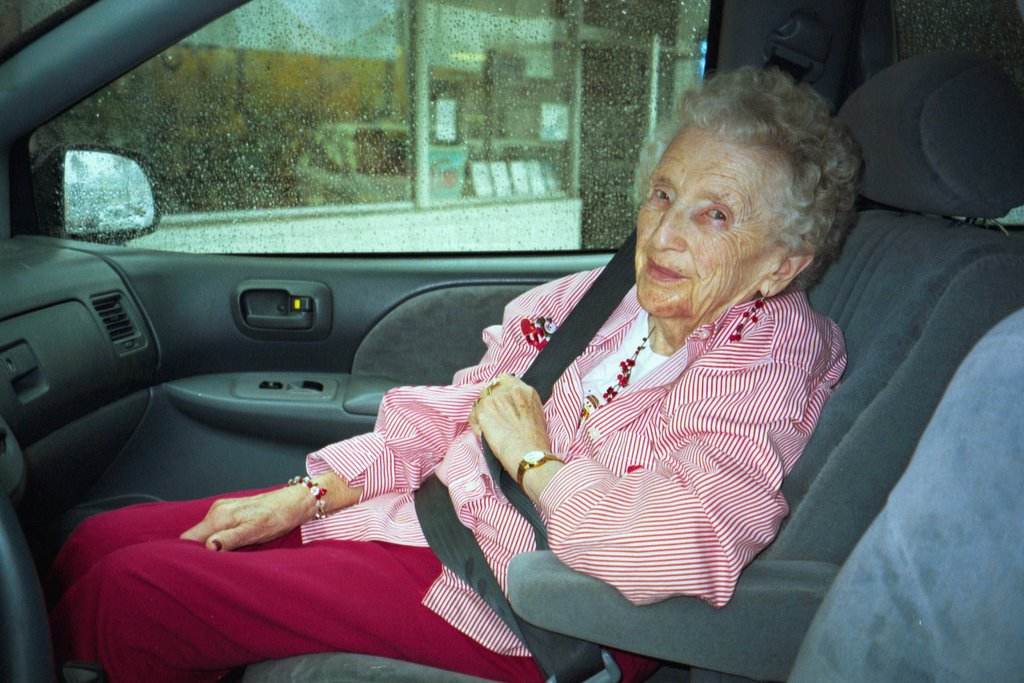
Mom's favorite thing to do, besides sitting in my kitchen and eating raisin toast, is riding in the car. At least once a week she gets out to go to church or to a doctor's appointment or just to do errands.
She sits happily in the Sav-On parking lot while I buy Kleenex, Efferdent, Depends, wipes, boxes of 50 thin green plastic gloves, etc.
She's good at telling me when the light has turned green (I'm often studying a map or talking on the cell phone and need to be told). The only problem comes when I can't respond--there are cars ahead of me--but she still thinks the green light means "Go!"
Today our errands include picking up from the tailor four pairs of velour and cotton elastic-waist pants that have been shortened by 6-8 inches. I am removing several dresses and skirts from her closet in favor of pants, which are easier for the caregiver to deal with during toileting. Then we stop at the dry cleaners and also at Out of the Closet, a local thrift shop that benefits AIDS LA.
But the first errand on her mind is going to 31 Flavors. She remembers that we didn't do this yesterday, after physical therapy, and I had promised tomorrow. So we do that first. She always wants a scoop of butter pecan on a plain cone. I bravely put a 24 x 18 plastic bib on the front of her (it's really a sheet for protecting chairs or the bed) and give her the cone. She has lost touch with how to catch the dripping ice cream by licking and rotating the cone, but she enjoys tackling it in big bites. Usually it's not too big a mess.
After the other errands we drive to the post office to mail valentines to her two oldest and dearest friends. Cookie S. went through nurses training with Mom in the 1930s at Children's Hospital in Denver and now lives in Georgia. Janelle K. worked with Mom as a public health nurse in Boulder in the 1950s and was later dean of the school of nursing at the University of Arizona.
Then it's back to Ocean View--a successful trip because she got to ride around, but I only had to get her in and out of the car once.
Where the Dead Still Live
The other errand Mom wanted to do today was visit her brother Reynold, who died over a year ago.
"We ought to stop and see Reynold for a minute, shouldn't we?" she asks as we emerge from the parking garage and head toward Baskin-Robbins.
I don't answer, trying to figure out what to say.
I have learned not to keep reminding her that her mother and others have died. Therapists say that discovering this anew can cause grief, and I've seen her upset like this.
Earlier today I didn't comment when she accidentally called me "Mother." I do contradict her when she thinks we are in Colorado. I pick my battles.
It's true that we visited Reynold in Laughlin, Nevada, two years ago this weekend. Furthermore, he didn't have a memorial service--there was no travel to a family gathering--so that makes it harder for her to hang onto the information that he died.
"He doesn't get much company," she continues, as I continue stalling.
Right, I think. He doesn't.
"Anyway, he's a Mason and that's important because the men are Masons and the women are--"
She pauses, trying to remember what the women are, then says "DARs."
The conversation moves to another topic, and I am grateful.
Half an hour later, as we are driving toward Sav-On, she suddenly says, "Maybe he's driving that truck."
I know who she's talking about, but I don't answer her.
An hour later I say, "The errands are done. Time to go back to Ocean View."
"We didn't go see Reynold yet!" she says urgently. She has thought of a reason to avoid going back to her residence.
"No, we didn't," I say, again stalling. "He's a long ways away."
"Where does he live?" she asks suddenly. "Telluride?"
"That's a long way away," I say, not explaining that he lived many years in Washington state. "We need to just go back to Ocean View."
"My big brother might be there," she says.
"You think he'll be there," I comment.
"Yes, it's not that far for him," she says. "He'll say I'm spoiled. I'm the only girl. I have three brothers."
I don't argue. Who knows? Maybe he's there. Maybe it's not that far.
She must have had a vivid dream about Reynold this afternoon before I arrived to do errands.
Either that or she had a visit.
"We ought to stop and see Reynold for a minute, shouldn't we?" she asks as we emerge from the parking garage and head toward Baskin-Robbins.
I don't answer, trying to figure out what to say.
I have learned not to keep reminding her that her mother and others have died. Therapists say that discovering this anew can cause grief, and I've seen her upset like this.
Earlier today I didn't comment when she accidentally called me "Mother." I do contradict her when she thinks we are in Colorado. I pick my battles.
It's true that we visited Reynold in Laughlin, Nevada, two years ago this weekend. Furthermore, he didn't have a memorial service--there was no travel to a family gathering--so that makes it harder for her to hang onto the information that he died.
"He doesn't get much company," she continues, as I continue stalling.
Right, I think. He doesn't.
"Anyway, he's a Mason and that's important because the men are Masons and the women are--"
She pauses, trying to remember what the women are, then says "DARs."
The conversation moves to another topic, and I am grateful.
Half an hour later, as we are driving toward Sav-On, she suddenly says, "Maybe he's driving that truck."
I know who she's talking about, but I don't answer her.
An hour later I say, "The errands are done. Time to go back to Ocean View."
"We didn't go see Reynold yet!" she says urgently. She has thought of a reason to avoid going back to her residence.
"No, we didn't," I say, again stalling. "He's a long ways away."
"Where does he live?" she asks suddenly. "Telluride?"
"That's a long way away," I say, not explaining that he lived many years in Washington state. "We need to just go back to Ocean View."
"My big brother might be there," she says.
"You think he'll be there," I comment.
"Yes, it's not that far for him," she says. "He'll say I'm spoiled. I'm the only girl. I have three brothers."
I don't argue. Who knows? Maybe he's there. Maybe it's not that far.
She must have had a vivid dream about Reynold this afternoon before I arrived to do errands.
Either that or she had a visit.
Thursday, February 09, 2006
New Teeth
Today after physical therapy we went straight to the dentist's office.
Fortunately, the dentist is next door and PT is half a block away. Location, location, location.
Dr. Feder slipped the new lower plate into her mouth, and it fit perfectly.
We thanked everyone and left, promising not to lose it this time.
Every night it will go into the small container for soaking with Efferdent.
It will not go under her pillow to be stolen away by the tooth fairy.
(See blogs from mid-December, 2005.)
Fortunately, the dentist is next door and PT is half a block away. Location, location, location.
Dr. Feder slipped the new lower plate into her mouth, and it fit perfectly.
We thanked everyone and left, promising not to lose it this time.
Every night it will go into the small container for soaking with Efferdent.
It will not go under her pillow to be stolen away by the tooth fairy.
(See blogs from mid-December, 2005.)
Graduation Day
On Tuesday when Mom arrived at the center for her physical therapy and started slowly shoving her walker forward, the therapist immediately noticed a decline.
"She's not doing well today," Michael whispered to me and Jona.
"No," I answered. "On Sunday she walked easily all the way to the dining room for breakfast, and back afterward. But yesterday she couldn't put her right foot down solidly. She was kind of limping along, and I had to have the wheelchair brought for her when she was about halfway there."
On Wednesday I don't know how she did--my sister visited her and I took a day off.
But today she's doing better than ever.
In the morning Jona walked with Mom all the way to the dining room, about one hundred feet, and she didn't keep a hand on her. Instead she followed directly behind her with the wheelchair, so that if she collapsed the chair would be there.
"You didn't get anyone from Ocean View to help you walk with her?" I asked anxiously.
"They were too busy,"Jona said.
I could imagine the scene: all the caregivers rounding up the 28 residents and bringing them to the dining room, with some residents leaving their seats at the table before lunch was served, before others had arrived.
"Okay," I said, "As long as you don't hurt your back."
But Jona assured me that Mom had even pulled herself to standing, after Jona raised the electric recliner to its maximum, reared-up position.
She admitted that she hadn't used the gait belt, but I couldn't complain because I don't use it either.
When we arrived at physical therapy today, Suzanne the PT saw Mom at her best.
She pulled herself to standing at her walker a few times--slowly, with complaints.
The effort she put into this caught my heart--it was a glimpse of her old self, fiercely determined to do something, not letting anything stop her.
She walked easily in a circle around the room using her walker, without anyone holding onto her. At the parallel bars, she stood up from her wheelchair by herself ten times, even more slowly with even more complaints. Then Suzanne required another six or ten times, occasionally giving her a boost by pulling up on the gait belt around her waist.
After another spin around the room, Suzanne pronounced Mom finished with her physical therapy. It had been just five sessions, but she had made good progress.
Medicare benefits have been cut back to 15 physical therapy or speech therapy sessions per year, so Suzanne didn't want to use them all up in the first two months. I assured her that Mom's Blue Cross / Blue Shield covers about 50 visits per year, but Suzanne still wanted to declare Mom rehabilitated.
"She's reached a plateau, and I don't think we are going to see improvement from this point. The goal is just to keep her walking and pulling herself to stand as she is now."
"Wow! Congratulations, Mom, you graduated," Connie and I told Mom.
She was proud of herself.
Our job now is to make sure she walks as much as possible, at least three trips to the dining room and back per day.
She also needs to push herself to stand from sitting, ten times in a row, once or twice per day.
In today's PT she had done a step-up exercise, stepping up onto a small platform five times with one foot leading, then five times with the other. I bought a step for her to continue practicing this one, but she will need two people ready to support her in case she falls.
We fussed over her for doing well today, but the reality is that there will be neither a smooth upward curve nor any guarantee of staying on a plateau.
One of the features of Lewy Body Dementia is that each day, her physical and mental condition is different.
We can hope that she stays generally at this level for a good while longer, but at some point there will be a steep decline, if the dementia she has is really Lewy Body.
"She's not doing well today," Michael whispered to me and Jona.
"No," I answered. "On Sunday she walked easily all the way to the dining room for breakfast, and back afterward. But yesterday she couldn't put her right foot down solidly. She was kind of limping along, and I had to have the wheelchair brought for her when she was about halfway there."
On Wednesday I don't know how she did--my sister visited her and I took a day off.
But today she's doing better than ever.
In the morning Jona walked with Mom all the way to the dining room, about one hundred feet, and she didn't keep a hand on her. Instead she followed directly behind her with the wheelchair, so that if she collapsed the chair would be there.
"You didn't get anyone from Ocean View to help you walk with her?" I asked anxiously.
"They were too busy,"Jona said.
I could imagine the scene: all the caregivers rounding up the 28 residents and bringing them to the dining room, with some residents leaving their seats at the table before lunch was served, before others had arrived.
"Okay," I said, "As long as you don't hurt your back."
But Jona assured me that Mom had even pulled herself to standing, after Jona raised the electric recliner to its maximum, reared-up position.
She admitted that she hadn't used the gait belt, but I couldn't complain because I don't use it either.
When we arrived at physical therapy today, Suzanne the PT saw Mom at her best.
She pulled herself to standing at her walker a few times--slowly, with complaints.
The effort she put into this caught my heart--it was a glimpse of her old self, fiercely determined to do something, not letting anything stop her.
She walked easily in a circle around the room using her walker, without anyone holding onto her. At the parallel bars, she stood up from her wheelchair by herself ten times, even more slowly with even more complaints. Then Suzanne required another six or ten times, occasionally giving her a boost by pulling up on the gait belt around her waist.
After another spin around the room, Suzanne pronounced Mom finished with her physical therapy. It had been just five sessions, but she had made good progress.
Medicare benefits have been cut back to 15 physical therapy or speech therapy sessions per year, so Suzanne didn't want to use them all up in the first two months. I assured her that Mom's Blue Cross / Blue Shield covers about 50 visits per year, but Suzanne still wanted to declare Mom rehabilitated.
"She's reached a plateau, and I don't think we are going to see improvement from this point. The goal is just to keep her walking and pulling herself to stand as she is now."
"Wow! Congratulations, Mom, you graduated," Connie and I told Mom.
She was proud of herself.
Our job now is to make sure she walks as much as possible, at least three trips to the dining room and back per day.
She also needs to push herself to stand from sitting, ten times in a row, once or twice per day.
In today's PT she had done a step-up exercise, stepping up onto a small platform five times with one foot leading, then five times with the other. I bought a step for her to continue practicing this one, but she will need two people ready to support her in case she falls.
We fussed over her for doing well today, but the reality is that there will be neither a smooth upward curve nor any guarantee of staying on a plateau.
One of the features of Lewy Body Dementia is that each day, her physical and mental condition is different.
We can hope that she stays generally at this level for a good while longer, but at some point there will be a steep decline, if the dementia she has is really Lewy Body.
Wednesday, February 08, 2006
Suddenly, We're Not Alone
It has been almost two years since Dr. Kawas first suggested Lewy Body Dementia as a possible diagnosis for Mom.
In that time, I've told many people about her illness. None had heard of LBD before.
But in the last two weeks suddenly three people have said to me, "Oh yes, my mother [husband] [sister] has it too."
First was my friend Ginny in Berkeley, who emailed to say that her younger sister in Denver has been diagnosed with LBD. She's very concerned about her sister's care and how her sister's husband will cope with the challenges of care giving.
Then a lawyer who is helping us handle some inherited property mentioned that his mother in Santa Barbara has LBD. He spends a lot of time driving up there and back to manage her care. Fortunately, his own practice is flexible enough that he can work evenings or weekends to make up for hours lost in caregiving.
On Friday at the P.E.O. meeting, my new friend Dorothy asked what kind of dementia my mother has, and I told her Mom's probable diagnosis.
"Oh, my husband has Lewy Body too," she said. "At least that's what his doctors are saying now. They don't know for sure."
Her husband's illness began three years ago with peripheral neuropathy and falling down. Now he is in a wheelchair and needs a Hoyer lift to be helped into and out of bed. He has dementia, too, much like my mother, but he doesn't get out of the house much because he is too heavy for just one person to handle.
It's really sad to think of these three people afflicted with this mentally and physically crippling disease.
But I'm grateful that I now have several friends with whom to share the suffering and questions. Dealing with the illness is hard enough, without having to start from zero in every conversation: "No, it's not Alzheimer's. It's the second most common dementia...."
Suddenly, my siblings and I are not alone.
In that time, I've told many people about her illness. None had heard of LBD before.
But in the last two weeks suddenly three people have said to me, "Oh yes, my mother [husband] [sister] has it too."
First was my friend Ginny in Berkeley, who emailed to say that her younger sister in Denver has been diagnosed with LBD. She's very concerned about her sister's care and how her sister's husband will cope with the challenges of care giving.
Then a lawyer who is helping us handle some inherited property mentioned that his mother in Santa Barbara has LBD. He spends a lot of time driving up there and back to manage her care. Fortunately, his own practice is flexible enough that he can work evenings or weekends to make up for hours lost in caregiving.
On Friday at the P.E.O. meeting, my new friend Dorothy asked what kind of dementia my mother has, and I told her Mom's probable diagnosis.
"Oh, my husband has Lewy Body too," she said. "At least that's what his doctors are saying now. They don't know for sure."
Her husband's illness began three years ago with peripheral neuropathy and falling down. Now he is in a wheelchair and needs a Hoyer lift to be helped into and out of bed. He has dementia, too, much like my mother, but he doesn't get out of the house much because he is too heavy for just one person to handle.
It's really sad to think of these three people afflicted with this mentally and physically crippling disease.
But I'm grateful that I now have several friends with whom to share the suffering and questions. Dealing with the illness is hard enough, without having to start from zero in every conversation: "No, it's not Alzheimer's. It's the second most common dementia...."
Suddenly, my siblings and I are not alone.
Tuesday, February 07, 2006
61,000 Members and Growing Fast--What Is It?
You guessed it: the centenarians club in the US today.
There are a lot of families dealing with how to care for 100-year old relatives, not to mention those caring for people in their nineties or eighties, or those caring for LBD patients of still younger ages.
For a discussion of financial issues, go to my blog entry for January 31, based on the Wall Street Journal article on January 23.
We caregivers are starting to think about our own financial planning for later years. Buying long-term care health insurance is starting to look like a smart step. A benefit of $100 per day would not cover assisted living, but it would supplement Social Security and Medicare to make devouring one's life savings in the last few years of life less likely.
My husband has long-term health care insurance.
The serious cost and my own optimism have prevented me from signing up for it so far, but if I want to protect my children from the financial impact of my care after some event such as a stroke, I should start paying now.
Well, maybe not now--how about after we finishing paying college tuitions?
There are a lot of families dealing with how to care for 100-year old relatives, not to mention those caring for people in their nineties or eighties, or those caring for LBD patients of still younger ages.
For a discussion of financial issues, go to my blog entry for January 31, based on the Wall Street Journal article on January 23.
We caregivers are starting to think about our own financial planning for later years. Buying long-term care health insurance is starting to look like a smart step. A benefit of $100 per day would not cover assisted living, but it would supplement Social Security and Medicare to make devouring one's life savings in the last few years of life less likely.
My husband has long-term health care insurance.
The serious cost and my own optimism have prevented me from signing up for it so far, but if I want to protect my children from the financial impact of my care after some event such as a stroke, I should start paying now.
Well, maybe not now--how about after we finishing paying college tuitions?
Monday, February 06, 2006
Lunacy with Flashes of Clarity
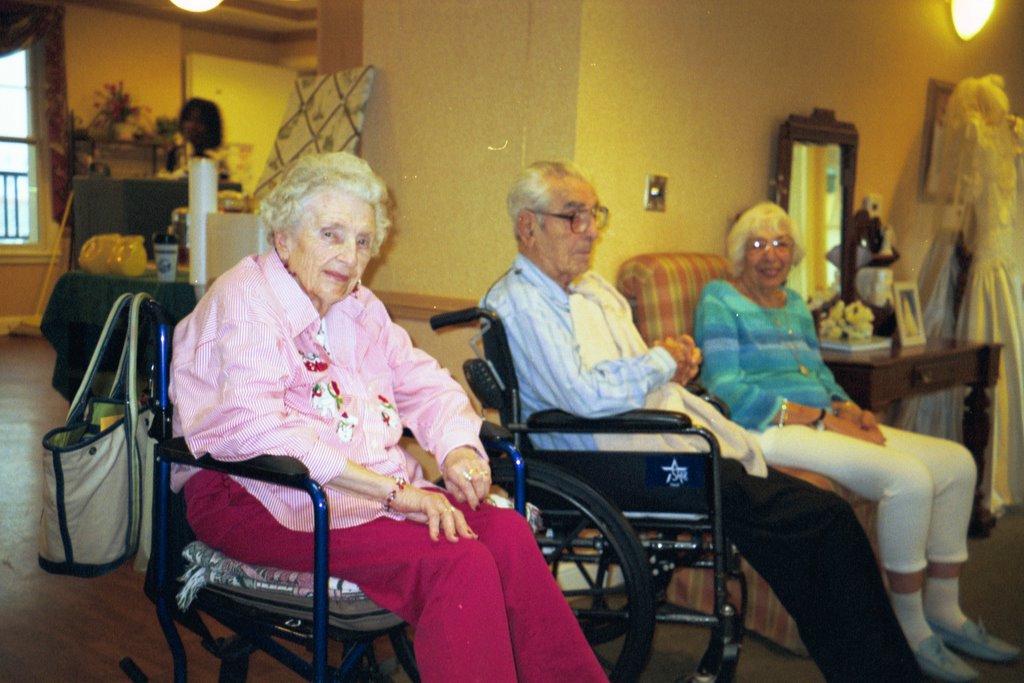
When I arrived at 3:15 pm, Mom was sitting in her recliner in her room watching television. She was upset.
"Anne, this is a terrible show about dinosaurs that swallow people. Turn it off!"
I checked the television; it was the National Geographic channel with a show about crocodiles. I turned it off.
"It's just a show about crocodiles, Mom."
"You came late. I've been sitting here too long watching this television. When I'm here alone, things get scary."
She was absolutely accurate about those statements. She had been alone since 2 pm, apparently not sleeping, and her mind takes her to strange places when she is alone.
I helped her walk with her walker to the toilet, but for some reason she could barely do it today. After walking one hundred feet to the dining room yesterday for breakfast, and one hundred feet back, today she could not place her right foot firmly on the ground. Instead she put only her toes down, walking well with her left foot but taking only small steps with her right foot and never letting her heel touch the ground.
Next we worked on sending valentines to all her children and grandchildren, and her sister-in-law as well. She did fine at signing her name as coached.
When we got to her grandson in the Naval Academy, I told her to write, "I'm proud of you. I was in the Navy too." She wrote, "I'm proud of you! I was a Navy Nurse!"
When we got to her oldest grandchild, Jennifer, she started writing a note, completely uncoached:
"Buy yourself something pretty and useless. I'm so proud what you are doing at Crested Butte. I'm just now learning to walk again with help from your Aunt Anne! Love, Grandma Gussie."
A moment of clarity! She knew where Jennifer lives and that she's working in adaptive sports there. And she proudly added her news about walking.
Because she apparently wanted to give Jennifer some money, I slipped a $20 bill inside the card before sealing it.
On all the notes to grandchildren she used her nickname, Gussie, from her teen years as Evelyn Gustafson. (Twenty-four years ago I had encouraged her to become "Grandma Gussie" because she didn't like the name "Grandma Eggebroten"--it reminded her of her mother-in-law.)
After doing the Valentines, when I tried to get her to walk to dinner, she could barely do fifty feet. She was limping along not putting her right foot down completely--but did not complain of any pain in her feet or legs. A caregiver brought us the wheelchair.
Julie A., meanwhile, was pushing her walker to dinner behind us and yelling "I wish I were dead! I wish I were dead!"
(Lunacy or clarity? You decide.)
At dinner Mom sat down next to Howard and Jeannie, the new sweethearts on the floor. Jeannie has a sharp tongue but for some reason was adopted by Howard, who only arrived a month or two ago, as his surrogate spouse. Howard is a gentle ex-businessman who walks around trying to making phone calls and keep appointments. He seems very happy with his arm around Jeannie.
"Okay, Mom, enjoy your dinner. I'm leaving now."
"You're not going, are you? Don't leave me alone! They never take me back to my room after dinner."
"Now, Mom, Connie will be here any minute. She'll take you back to your room. I have to leave."
"I don't like the way you speak to your child!" interrupted Jeannie, glaring at me. "You shouldn't talk to her that way. She'll never grow up."
"I'm sorry, Jeannie," I said. "Goodbye, Mom."
I went back to her room to get the pants we bought yesterday, which I will take to a tailor to be shortened.
When I passed the dining room on my way out, I heard Mom loudly singing, "Jesus loves me, this I know, for the Bible tells me so. Little ones to him belong; they are weak, but he is strong. Yes, Jesus loves me! Yes, Jesus loves me...."
Mom was never particularly religious during the first sixty years of her life, though she did get to church once a month or so, and more often after she retired.
Punching in the code to open the door to leave, I sighed with relief.
Lunacy--with flashes of clarity.
Note: The mystery of why she was singing was partly answered four days later when I took her to dinner. Another private caregiver then said to her, "Sing, Evelyn. Are you going to sing for me?
And Mom started singing "Jesus loves me."
At least there's a reason why she suddenly was singing... She had done it on some occasion before, so now someone prompts her to do it.
CDs are always played during dinner, everything from Diana Ross to church music. Sometimes various caregivers or residents sing along. I feel better knowing that Mom's singing on this occasion was not completely out of the blue.
Sunday, February 05, 2006
Seeing Spots and Crooked Stems
Small spots on the floor or rug worry Mom. In fact, anything that is uneven or out of place worries her.
Because it is Sunday, I arrive just after 6 am to be her caregiver until 2 pm.
She wakes at 6:45 and I help her to sit up in bed and then to stand at her walker.
As I escort her into the bathroom, she comments about a small dark spot on the floor.
"I hate that black thing on the floor, and the other spots too --the dogs eat them and get poisoned and die."
I've noticed that spot for a while and tried to clean it up before without success.
Today it has to go. I start scraping at it with sharp scissors and 409 and a powdered cleanser. It turns out to be a bit of chewing gum. I get it all off and scrub a few other spots and streaks on the floor as well.
We drive to church and have a nice time. As we are driving home, she suddenly speaks.
"These stems are so crooked!"
"What stems?" I ask.
After a few more questions, I realize she is talking about the long row of palm trees outlined against the sky as we drive west on Santa Monica Boulevard. Yes, their tall trunks are all slightly crooked, not quite parallel to each other.
Yesterday it was a bit of white tissue on the rug that caught her attention, started a story in her mind, and had to be picked up and disposed of.
Last June when I posted a big note on her cupboard door outlining the rules for eating and swallowing after her hospitalization, it seemed to her to be a threatening note from bad people who were going to do something to her. I removed it.
A week ago the red light in a surge protector on the floor was the sign of danger.
When she uses her walker, the little zip pouch for things she might need has to hang exactly in the center of the front bar of the walker.
When she stands or sits, grabbing onto a bar in the bathroom or onto her walker, her rings have to be adjusted first. The stones might have slipped inside to her palm, but she moves each around: the diamond ring, the pearls, the opal.
As William Carlos Williams wrote in "The Red Wheelbarrow," so much depends on those rings being in the right place.
So much depends on there being no odd spots on the floor or pieces of paper posted anywhere in the room.
Because it is Sunday, I arrive just after 6 am to be her caregiver until 2 pm.
She wakes at 6:45 and I help her to sit up in bed and then to stand at her walker.
As I escort her into the bathroom, she comments about a small dark spot on the floor.
"I hate that black thing on the floor, and the other spots too --the dogs eat them and get poisoned and die."
I've noticed that spot for a while and tried to clean it up before without success.
Today it has to go. I start scraping at it with sharp scissors and 409 and a powdered cleanser. It turns out to be a bit of chewing gum. I get it all off and scrub a few other spots and streaks on the floor as well.
We drive to church and have a nice time. As we are driving home, she suddenly speaks.
"These stems are so crooked!"
"What stems?" I ask.
After a few more questions, I realize she is talking about the long row of palm trees outlined against the sky as we drive west on Santa Monica Boulevard. Yes, their tall trunks are all slightly crooked, not quite parallel to each other.
Yesterday it was a bit of white tissue on the rug that caught her attention, started a story in her mind, and had to be picked up and disposed of.
Last June when I posted a big note on her cupboard door outlining the rules for eating and swallowing after her hospitalization, it seemed to her to be a threatening note from bad people who were going to do something to her. I removed it.
A week ago the red light in a surge protector on the floor was the sign of danger.
When she uses her walker, the little zip pouch for things she might need has to hang exactly in the center of the front bar of the walker.
When she stands or sits, grabbing onto a bar in the bathroom or onto her walker, her rings have to be adjusted first. The stones might have slipped inside to her palm, but she moves each around: the diamond ring, the pearls, the opal.
As William Carlos Williams wrote in "The Red Wheelbarrow," so much depends on those rings being in the right place.
So much depends on there being no odd spots on the floor or pieces of paper posted anywhere in the room.
Subscribe to:
Posts (Atom)